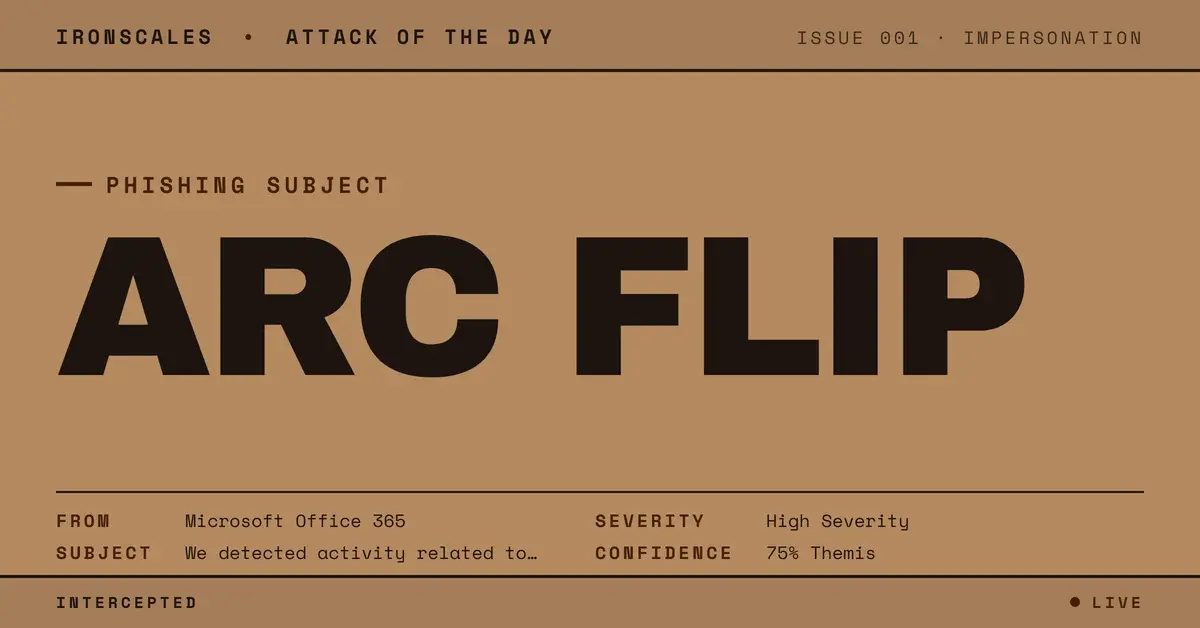
TL;DR A fake OneDrive storage alert used Microsoft's own mail domain, which publishes DMARC p=reject, as its From address. The first ARC instance recorded spf=fail, dkim=none and dmarc=fail with action=oreject. The second instance and the final results read spf=pass, dmarc=pass and compauth=pass, with the only DKIM signature coming from an unaligned onmicrosoft.com domain. The message reached five mailboxes at an air cargo carrier. The record does not explain the flip, so the lesson is to read ARC instances against each other and never treat a brand's p=reject as proof.
Severity: High Brand Impersonation Email Spoofing MITRE: T1566.002
One message. One set of headers. Two opposite DMARC verdicts.
The first ARC instance recorded spf=fail, dkim=none and dmarc=fail with action=oreject for a From address on Microsoft's own mail domain, which publishes a p=reject policy. The second instance, and the final Authentication-Results line, recorded spf=pass, dmarc=pass and compauth=pass with reason 100. Same message. Same body hash. Opposite answers.
It landed as a OneDrive storage alert in a shared operations mailbox and four staff mailboxes at a US air cargo carrier.
Read the instances against each other
Most analysts read the bottom line, see compauth=pass, and move on. The instance numbers are where this case lives.
| Hop | Evaluated by | SPF | DKIM | DMARC | SCL |
|---|
| ARC i=1 | Raw connection into Exchange Online Protection | fail | none (unsigned) | fail, p=reject, action=oreject | 8 |
| ARC i=2 and final | Microsoft outbound, then the victim tenant | pass | pass, d= an onmicrosoft.com domain | pass, action=none, compauth=pass reason=100 | 1 |
The From was a Microsoft alert address on a first-party brand domain. At the raw hop, the connecting IP was not authorised for that domain, nothing was signed, and the policy said reject. A spam confidence level of 8 agreed.
Two legs later the same message carried a DKIM signature that did not align with the From domain at all. The signer was an onmicrosoft.com tenant domain, not the Microsoft brand domain. Under DMARC alignment rules, that signature should not have rescued the message.
The record does not say why it did. It could be tenant relay behavior, a connector, or an evaluation quirk. This analysis does not claim any of them, and does not claim that anyone failed. What the headers prove is the outcome: a fail at one hop, a pass at the next, and an inbox verdict that contradicts the record's own first hop.
A p=reject policy is not a guarantee
The assumption worth retiring is simple. If a brand publishes p=reject, a spoof of that brand cannot reach an inbox.
Here, the first hop did exactly what p=reject asks. It recorded the oreject action. Then the message kept moving. The policy described what receivers should do. It did not control what the recipient's tenant finally stamped.
The 2026 Verizon Data Breach Investigations Report puts phishing at 16% of breach initial access and finds 62% of breaches involve the human element. A lure that carries a passing authentication verdict gives that human element every reason to trust it.
See Your Risk: Calculate how many threats your SEG is missing
The lure carried its own tells
The body was a Microsoft-styled card: "We detected activity related to one of your alerts," a OneDrive account at 105% of a 1 TB quota, status Blocked, signed "The Office 365 team."
Two template defects gave it away.
The line labelled "Time of activity (UTC)" printed the raw Date header inside literal quotation marks, complete with a -0700 offset. That is a substitution artifact. A real UTC label would not carry a Pacific offset. And after the card, a leftover MIME boundary-style placeholder with the literal word Subject in square brackets sat in the body, followed by a zero-by-zero image from a tracking host.
Five buttons were styled as admin actions: review storage settings, manage the subscription, free up space, review other triggering activities, and open the Admin Center. Behind the recipient's own SafeLinks wrappers, all five went to non-Microsoft addresses on one host, each with a different long numeric string and per-recipient values in the path. Only the footer links went to Microsoft.
What those pages did was never observed. The scans never completed, so this post makes no claim about credential collection or any other payload. It was mapped as T1566.002, spearphishing via link.
Indicators
| Type | Indicator | Context |
|---|
| Email | microsoftoffice365@messaging[.]microsoft[.]com | Spoofed From and Return-Path. Real Microsoft domain used as a costume, not attacker-owned |
| Domain | my-files-directory[.]dongho17[.]com | Host of all five button destinations. Paths omitted because they embed recipient data |
| Domain | dongho17[.]com | Apex created 2024-08-07, record updated the day before delivery, privacy-protected |
| Domain | 444ik[.]com | Zero-by-zero tracking pixel host. Query token omitted |
| IP | 5[.]181[.]3[.]204 | Raw connecting IP, SPF fail for the spoofed domain |
| Domain | HELO name under folio[.]io[.]vn | Sender-controlled at the raw hop, no whois data, ownership not established |
The apex was about two years old, so this was not a freshly registered domain. The SafeLinks wrappers belong to the recipient and are not attacker infrastructure.
What to do with this
The fix is a reading habit.
- Read ARC instance numbers in order. Compare i=1 with i=2 and the final line. A flip is a finding, not noise.
- Check alignment yourself. dmarc=pass beside a DKIM d= that does not match the From domain deserves a second look, whatever the verdict says.
- Do not let a brand's policy substitute for a verdict. Microsoft Digital Defense Report 2024 and the NIST definition of phishing both treat authentication as one layer among several.
The CISA phishing guidance says the same in plainer words.
The automated verdict here did not rest on the pass. Adaptive AI and Themis flagged sender address spoofing with a recommendation confidence of 83, the incident was automatically resolved as phishing, and the four staff mailboxes show the email as mitigated or reverted. No click data exists in the record, so what any recipient did with the buttons is unknown.
Email Attack of the Day is a daily series from
IRONSCALES spotlighting real phishing attacks caught by Adaptive AI and our community of 35,000+ security professionals. Each post breaks down a real attack. What it looked like, why it worked, and what to do about it.