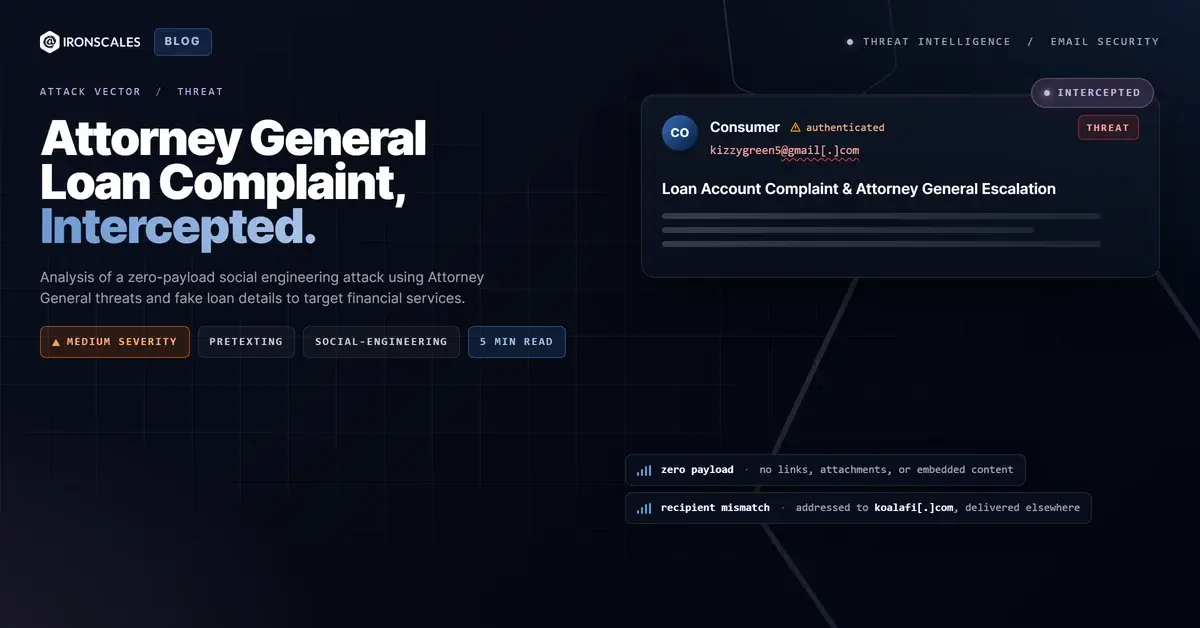
TL;DR An attacker uses a consumer Gmail account to send a fabricated loan complaint with specific account IDs, dates, and dollar amounts to a financial services customer service inbox. The email threatens escalation to the Attorney General and references a different financial vendor in the headers. With no links or attachments to scan, this zero-payload social engineering attack bypasses traditional detection and relies entirely on urgency to trick agents into revealing sensitive account information.
Severity: Medium Social-Engineering Pretexting MITRE: T1566.001 MITRE: T1598.003
Not every phishing email carries a malicious link or weaponized attachment. Some carry nothing but words, and the words are chosen to make a customer service agent act before thinking. This email arrived at a financial services organization's customer service inbox from a consumer Gmail address, containing zero technical indicators of compromise, yet it was one of the more dangerous messages analysts reviewed that week.
The sender, using kizzygreen5@gmail[.]com, delivered a detailed loan complaint referencing three specific account IDs, exact dollar amounts, and origination dates. The complaint threatened escalation to the Attorney General's Office if the issue was not resolved. For a customer service agent handling dozens of complaints daily, the instinct to look up those account numbers and respond is exactly what the attacker was counting on.
SPF, DKIM, and DMARC all passed. The email genuinely originated from Google's mail infrastructure. Traditional email security had nothing to flag.
The Social Engineering Mechanics
The message headers revealed an important routing anomaly: the email was addressed to CustomerService@koalafi[.]com but delivered to the financial services organization's customer service inbox. This recipient-domain mismatch suggests the attacker referenced a known financial vendor (a lending platform) to add legitimacy to the complaint while targeting a different organization that services similar accounts.
The body read as a consumer complaint about three loan accounts. Each entry included a loan ID, an origination date, and an exact dollar amount. The language was direct, with minor typos and non-standard capitalization consistent with a frustrated consumer, not a polished corporate communication. That imperfection was part of the design. A grammatically perfect legal threat from a Gmail address might trigger suspicion. A slightly messy one looks authentic.
The Attorney General escalation language served as a behavioral lever. Customer service teams at financial institutions take regulatory threats seriously because they carry real operational consequences. The attacker did not need a link or an attachment. They needed the agent to look up the account IDs, validate the complaint, and respond with sensitive information, account status, balances, or callback numbers that could be used for further social engineering.
Why Zero-Payload Attacks Work
This attack had no links for URL scanners to evaluate, no attachments for sandbox detonation, and no embedded content for content filters to flag. The Gmail origin meant all standard authentication checks passed cleanly. The email was, from a technical standpoint, indistinguishable from a legitimate customer complaint.
That is the design. By stripping away every scannable element, the attacker forces detection entirely onto behavioral and contextual analysis: Is this a first-time sender? Does the recipient-domain mismatch make sense? Is the language pattern consistent with social engineering? These are questions that traditional secure email gateways are not built to answer.
See Your Risk: Calculate how many threats your SEG is missing
MITRE ATT&CK
How Adaptive AI Detects This
Zero-payload attacks expose the gap between authentication and intent. A message can pass every cryptographic check and still be malicious. The Adaptive AI on the IRONSCALES platform evaluates behavioral signals that authentication cannot capture: first-time sender patterns, recipient-domain mismatches, urgency language directed at service roles, and the absence of any prior communication thread. Community intelligence correlates similar pretexting campaigns across organizations, identifying patterns even when each individual message contains no scannable payload. Research shows that 67.5 phishing emails per 100 mailboxes per month bypass traditional secure email gateways.
Hardening Recommendations
- Train customer service teams on zero-payload social engineering. Legal threats, regulatory escalations, and fabricated account details are common pretexting tactics that require human recognition.
- Never validate account IDs in response to inbound email. Require callers and emailers to verify their identity through established authentication procedures before discussing account details.
- Flag first-time Gmail senders to corporate service inboxes. Consumer email addresses contacting business-critical service addresses warrant elevated review.
- Implement response templates for legal threats. Standardized responses that do not disclose account information remove the human judgment variable from the equation.
- Investigate recipient-domain mismatches. When headers show a message was addressed to a different organization, treat it as a potential social engineering indicator.
Indicators of Compromise
| Indicator | Type | Context |
|---|
kizzygreen5@gmail[.]com | Email | Sender address |
CustomerService@koalafi[.]com | Email | Header recipient (mismatch) |
mail-lf1-x130.google[.]com | Hostname | Google mail relay |
Email Attack of the Day is a daily series from
IRONSCALES spotlighting real phishing attacks caught by Adaptive AI and our community of 36,000+ security professionals. Each post breaks down a real attack. What it looked like, why it worked, and what to do about it.







/Blue%20Feature%20Flower%20Icons/gear%20head%20icon.svg)
/Misc%20Icons/icon-nav-credential-theft.svg)










/Leadership%20Headshots/Audian%20Paxson%20Headshot%201000x1000%20032026.webp?width=100&height=100&name=Audian%20Paxson%20Headshot%201000x1000%20032026.webp)



.png?width=50&height=50&name=Untitled%20-%20July%2030%2c%202026%20at%2014.53.38%20(3).png)



/Misc%20Icons/icon-red-teaming-agent-gradient-simple.svg)
/Misc%20Icons/icon-phishing-soc-agent-gradient-simple.webp?width=158&height=167&name=icon-phishing-soc-agent-gradient-simple.webp)
/Misc%20Icons/icon-phishing-simulation-agent-gradient-simple.svg)


/Misc%20Icons/icon-nav-encryption.svg)