TL;DR A single-line email impersonating a company CEO reached the Controller with no links, no attachments, and no direct payment request. It asked only whether same-day wire transfers carried an extra fee. Because the attacker used a genuine consumer mailbox and spoofed only the display name, SPF, DKIM, and DMARC all passed and Microsoft scored it as non-spam. This is BEC reconnaissance: a low-risk probe that confirms the target's role and responsiveness before the real fraudulent wire request arrives. Detection has to come from behavior and identity context, not authentication or payload scanning.
Severity: High Bec Ceo Fraud Impersonation MITRE: T1566 MITRE: T1598 MITRE: T1684.001
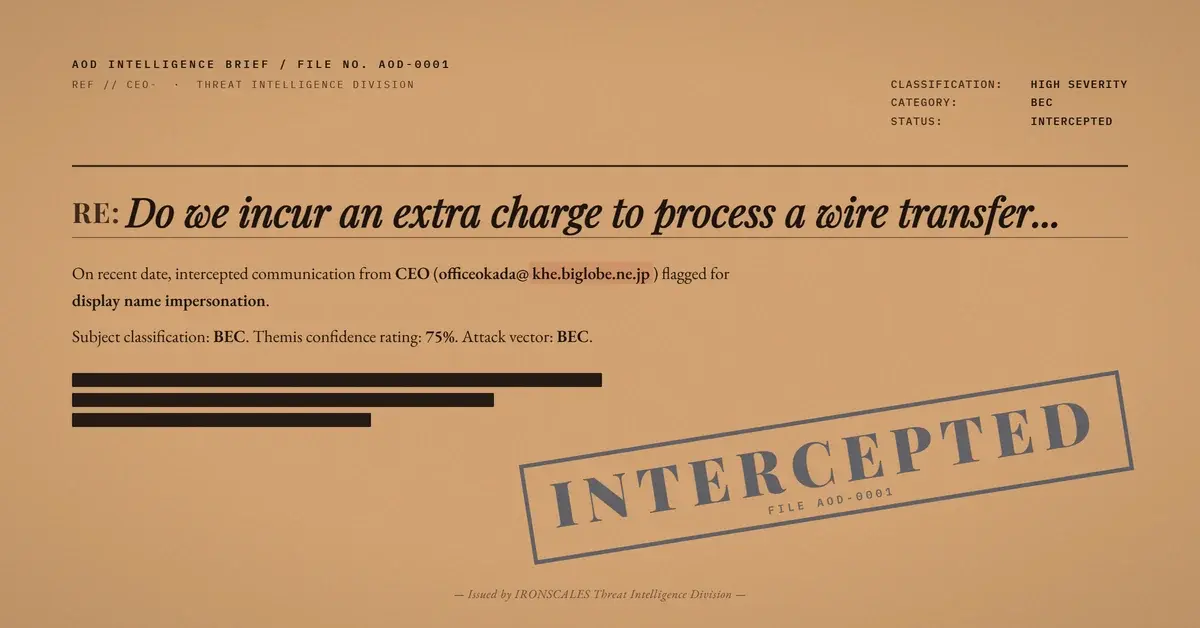
The email was one sentence long. No link to click. No attachment to open. No invoice, no account number, no urgent red banner. Just a question, apparently from the CEO, sent to the person who signs off on wire transfers.
"Do we incur an extra charge to process a wire transfer same day?"
Signed, simply, with the CEO's first name.
To the Controller at a mid-size technology firm, it read like a five-second favor from the boss. To every automated filter in the path, it looked like clean, fully authenticated mail. And that is exactly the point. This message was not the attack. It was the scout sent ahead of the attack, and it slipped through because there was nothing in it to catch.
The Question Is the Whole Payload
Business Email Compromise (BEC) does not always open with a wire request. The sophisticated version opens with a handshake. A short, context-free question that does two jobs at once: it confirms the target is the right person to move money, and it opens a live conversation the attacker can escalate later.
Ask about wire transfer fees and you learn three things. The recipient handles wires. The recipient answers the CEO quickly. And the recipient did not question a message that arrived from nowhere. Reply once, and the next email in the thread is the one with the beneficiary account and the deadline.
This is why the probe carries no payload. Links and attachments create detection surface. A single innocuous question creates none. The attacker is trading immediate payoff for stealth, and against payload-focused defenses, stealth wins.
Pretexting, the patient setup of a believable scenario before any ask, has grown enough to be tracked as its own initial-access category. The 2024 Verizon Data Breach Investigations Report identifies pretexting, most of it BEC, as the top social-engineering incident type, with a median BEC transaction of roughly $50,000, and a context-free CEO question is pretexting in its purest form.
Why Every Authentication Check Passed
Here is the part that should worry any security team leaning on email authentication as an identity control. This message passed SPF. It passed DKIM. It passed DMARC. Microsoft scored it with a Spam Confidence Level of 1, meaning the filtering stack rated it as not spam.
None of that is a failure of authentication. It is authentication working exactly as designed, on the wrong question.
SPF, DKIM, and DMARC verify that a message genuinely came from the domain it claims in the envelope and header. They say nothing about the human name a recipient actually reads. In this case the attacker never forged the company domain. They sent from a real mailbox on a legitimate Japanese consumer internet provider, a domain they fully controlled, and simply set the display name to the CEO's full name. The sending domain authenticated cleanly because it was authentic. The deception lived entirely in the display name, a field no authentication protocol validates.
Authentication answers "did this domain really send this?" It does not answer "is this person who the name says they are." Display name impersonation lives in that gap.
The one structural tell was buried in the headers: the Reply-To address pointed to a different domain entirely, a lookalike consulting domain unrelated to both the sending mailbox and the company. Reply to the CEO, and your answer would have quietly routed to attacker-controlled infrastructure. Standard mail clients hide Reply-To behind the friendly display name, so the Controller would never have seen it.
The Attack Chain, Step by Step
- Step 1: The attacker registers or compromises a mailbox on a legitimate consumer ISP, giving themselves a domain that authenticates cleanly.
- Step 2: They set the display name to the target company's CEO, harvested from the website, LinkedIn, or a press release. The MITRE ATT&CK framework tracks this as Impersonation (T1684.001).
- Step 3: They add a Reply-To pointing to separate lookalike infrastructure, so any response is diverted away from both the real CEO and the visible sender.
- Step 4: They send a single, low-signal question to a finance decision-maker. This reconnaissance step maps to Phishing for Information (T1598), the information-gathering sibling of classic Phishing (T1566).
- Step 5: If the target replies, the attacker escalates the same thread into a fraudulent same-day wire request.
The indicators worth capturing here are not files or URLs. They are the sender infrastructure and the routing mismatch:
| Type | Indicator | Context |
|---|
| Email (From) | officeokada@khe[.]biglobe[.]ne[.]jp | Genuine consumer ISP mailbox, display name spoofed to the CEO |
| Email (Reply-To) | ceo@consultingweststreet[.]com | Lookalike domain diverting replies to attacker infrastructure |
| Domain | khe[.]biglobe[.]ne[.]jp | Authenticating sending domain (SPF, DKIM, DMARC all pass) |
| IP | 27[.]86[.]113[.]9 | Sending host, Japan-based consumer ISP range |
The financial logic behind targeting the Controller is brutal and simple. That role can authorize or execute wires, which is the shortest distance between a compromised conversation and stolen funds. The FBI Internet Crime Complaint Center has reported BEC losses exceeding 2.9 billion dollars in a single year, and reconnaissance probes like this one are how many of those thefts begin.
Where the Gateway Ends and Behavior Begins
A secure email gateway (SEG) evaluates reputation, authentication, and payload. This message offered a clean record on all three. There was no malicious URL to sandbox, no attachment to detonate, and no domain to blocklist. On the criteria a gateway is built to judge, it was a model citizen.
That is the recurring lesson across business email compromise cases: the most dangerous email is often the emptiest one. Catching it means shifting the question from "what is in this message" to "does this message make sense."
In the incident we analyzed, that shift is what surfaced the threat. The IRONSCALES platform models each sender's normal identity and behavior, so Themis, the agentic AI virtual SOC analyst, saw what the gateway could not: a known executive name arriving from an external consumer mailbox it had never used, paired with a Reply-To that diverged from the From address and a finance question with no prior thread. Themis flagged the message as VIP impersonation and BEC at 90 percent confidence, and the email was quarantined before the Controller ever had to make a judgment call.
See Your Risk: Calculate how many threats your SEG is missing
What to Change Before the Next Probe Lands
Zero-payload BEC probes reward defenders who treat identity as a first-class signal, not an afterthought.
- Alert on display name and domain mismatch. When an internal executive's name arrives from an external or unfamiliar domain, that pairing alone warrants scrutiny, regardless of authentication results.
- Surface Reply-To divergence. Make it visible when Reply-To does not match From. It is one of the cleanest structural tells in impersonation mail and it is normally hidden from users.
- Build a finance-specific playbook. Any payment-related request that arrives out of band, even a harmless-sounding question, should route through a verification step on a known channel before anyone replies. The joint CISA guidance on stopping the phishing attack cycle makes out-of-band confirmation of financial requests a core network-defender control.
- Train for the empty email. Phishing simulation that only tests link-clicking misses this pattern entirely. Finance staff need reps recognizing the pretext, not just the payload.
Authentication tells you a domain is real. It does not tell you a person is. The attackers building BEC campaigns understand that distinction precisely, which is why they send you one clean sentence and wait to see who answers.
Email Attack of the Day is a daily series from
IRONSCALES spotlighting real phishing attacks caught by Adaptive AI and our community of 36,000+ security professionals. Each post breaks down a real attack. What it looked like, why it worked, and what to do about it.





/Blue%20Feature%20Flower%20Icons/gear%20head%20icon.svg)
/Misc%20Icons/icon-nav-credential-theft.svg)








/Leadership%20Headshots/Audian%20Paxson%20Headshot%201000x1000%20032026.webp?width=100&height=100&name=Audian%20Paxson%20Headshot%201000x1000%20032026.webp)



.png?width=50&height=50&name=Untitled%20-%20July%2030%2c%202026%20at%2014.53.38%20(3).png)



/Misc%20Icons/icon-red-teaming-agent-gradient-simple.svg)
/Misc%20Icons/icon-phishing-soc-agent-gradient-simple.webp?width=158&height=167&name=icon-phishing-soc-agent-gradient-simple.webp)
/Misc%20Icons/icon-phishing-simulation-agent-gradient-simple.svg)


/Misc%20Icons/icon-nav-encryption.svg)