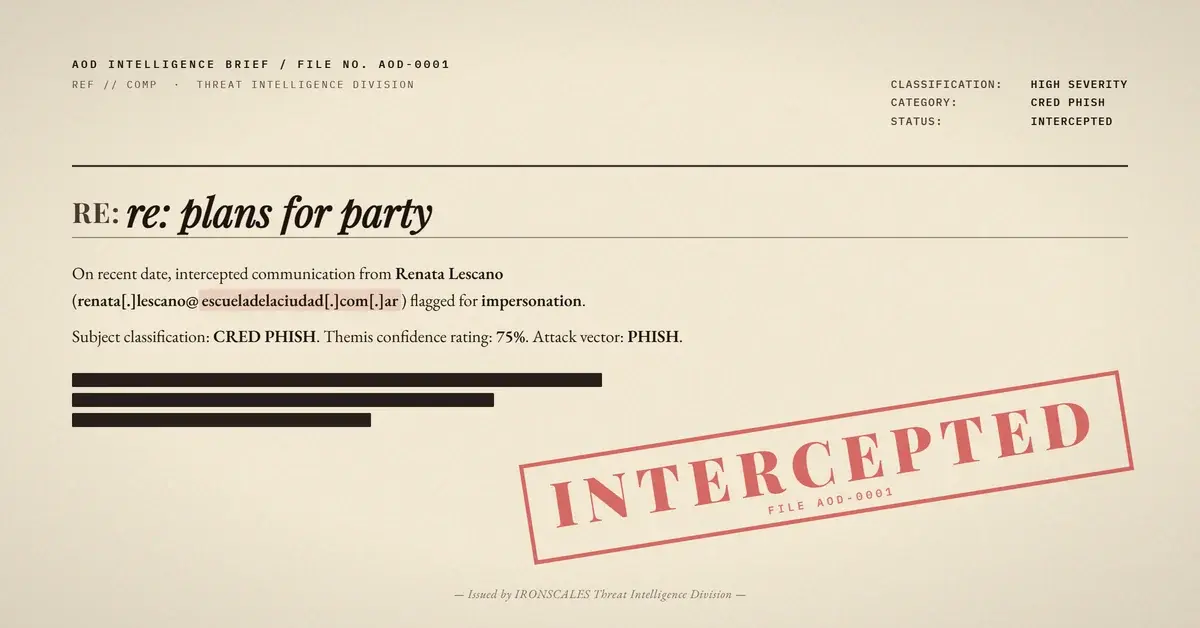
TL;DR A compromised Microsoft 365 account at an Argentine educational institution (escueladelaciudad[.]com[.]ar) sent a phishing email to a K-12 school district in the eastern United States. The email used exact display name impersonation of a known community contact, passed SPF/DKIM/DMARC, and contained a single link to a domain (ethrecn[.]com) registered the same day as the attack. The casual subject line ('re: plans for party') was designed to bypass suspicion. IRONSCALES community intelligence flagged the incident and the message was quarantined.
Severity: High Credential Harvesting Account Compromise MITRE: T1566.002 MITRE: T1036.005 MITRE: T1586.002
The subject line was disarmingly casual: "re: plans for party." The sender name matched a community contact the recipient had corresponded with before. The message came from an educational institution's email server, passed every authentication check, and contained a single link that led to a domain registered hours earlier.
Nothing about this email said "phishing" at first glance. Everything about it was.
In May 2026, IRONSCALES detected a spear-phishing campaign targeting a K-12 school district in the eastern United States. The attack originated from a compromised Microsoft 365 tenant belonging to an Argentine educational institution, used exact display name impersonation of a known community contact, and delivered a credential-harvesting link to a same-day registered domain. The IRONSCALES community flagged the incident, and the message was quarantined before the recipient engaged.
The Email That Knew the Recipient's Contact List
The message arrived with a display name matching a person the recipient had previously communicated with through a personal email address. IRONSCALES' impersonation detection engine recognized the mismatch immediately: the platform knew this display name was associated with a different email address, and the incoming message was sent from renata[.]lescano@escueladelaciudad[.]com[.]ar, an Argentine school's M365 account.
This is not generic spray-and-pray phishing. The attacker either had access to the recipient's contact graph (suggesting upstream reconnaissance or data from a prior compromise) or was operating from a compromised account that shared organizational directory data with the target. Either way, the display name was not random. It was selected to trigger recognition and trust.
The subject line reinforced the deception. "re: plans for party" suggests an ongoing conversation. The lowercase "re:" prefix mimics a reply. The topic is social, not transactional, sidestepping the heightened scrutiny that financial or IT-themed lures typically receive in security-aware organizations.
Full Authentication Pass From a Compromised Tenant
The email's authentication results were spotless:
- SPF: Pass (escueladelaciudad[.]com[.]ar designates Microsoft's outbound IPs)
- DKIM: Pass (signed with the institution's
selector1 key, verified)
- DMARC: Pass (p=NONE, action=none)
The sending infrastructure was Microsoft 365's own outbound pool. The DKIM signature was valid and aligned with the From domain. The SPF record authorized Microsoft's IPs. From an authentication standpoint, this email was indistinguishable from a legitimate message sent by a staff member at the Argentine school.
This is the fundamental challenge of compromised-account phishing. DMARC, SPF, and DKIM verify that the sending infrastructure is authorized to send on behalf of a domain. When the attacker controls an account within that domain's tenant, every authentication check passes by design. The protocols work exactly as intended; they simply cannot distinguish between a legitimate user and an attacker who has hijacked that user's credentials.
See Your Risk: Calculate how many threats your SEG is missing
The Link That Existed for Hours
The email body contained a single link: bgiur[.]ethrecn[.]com/ulusouaienkueortkeci.
The domain ethrecn[.]com was registered on May 21, 2026, the same day the phishing email was sent. WHOIS records showed privacy registration with no identifiable registrant. The domain had no website, no historical DNS records, no email infrastructure, and no presence in any reputation database. The URL path was a randomized string, consistent with one-time credential-harvesting links that expire after use or after a brief campaign window.
Same-day domains are a deliberate evasion technique. URL reputation systems score domains based on accumulated signals: blocklist entries, abuse reports, historical traffic patterns. A domain that has existed for hours has none of these signals. It occupies a blind spot in reputation-based detection, where the absence of negative history is treated as neutral rather than suspicious.
The subdomain bgiur adds another layer of disposability. Even if ethrecn[.]com were eventually blocklisted, the attacker could rotate subdomains indefinitely, each one generating a fresh URL with no prior detection history.
International Relay: Argentina to the Eastern U.S.
The attack's geographic profile is notable. The compromised sending account belongs to an educational institution in Argentina. The target is a K-12 school district in the eastern United States. The M365 tenant headers confirm the message originated from Microsoft's LAMP regional infrastructure (CPWP152MB4110.LAMP152.PROD.OUTLOOK.COM) and was delivered to Google Workspace (mx.google.com) at the target district.
Cross-border attacks from compromised educational accounts are increasing. Education tenants are attractive to attackers because they often run M365 or Google Workspace with full authentication configured but limited monitoring. Once compromised, these accounts provide a clean sending platform with institutional domain reputation. The attacker inherits the trust that the institution has built.
MITRE ATT&CK Mapping
- T1566.002 (Phishing: Spearphishing Link): Single credential-harvesting link in a targeted email
- T1036.005 (Masquerading: Match Legitimate Name): Exact display name impersonation of a known community contact
- T1586.002 (Compromise Accounts: Email Accounts): Compromised M365 account at an Argentine educational institution
Indicators of Compromise
| Type | Indicator | Context |
|---|
| Sender Email | renata[.]lescano@escueladelaciudad[.]com[.]ar | Compromised Argentine school M365 account |
| Phishing Domain | ethrecn[.]com | Registered 2026-05-21 (same day as attack), privacy-registered |
| Phishing URL | bgiur[.]ethrecn[.]com/ulusouaienkueortkeci | Randomized path, single-use credential harvester |
| Sending Infrastructure | Microsoft 365 (LAMP152 region) | Regional M365 outbound pool |
| Subject Line | re: plans for party | Casual, reply-mimicking social pretext |
Community Intelligence as the Detection Layer
Themis, the IRONSCALES Adaptive AI, assigned a baseline confidence score to this message, but the decisive detection signal came from IRONSCALES community intelligence. The community flagged the incident based on pattern matching against similar campaigns, and the message was quarantined.
The impersonation detection engine provided the structural evidence: the display name was known to the platform from a different email address. When a familiar name arrives from an unfamiliar address, that mismatch becomes a high-confidence indicator, even when every authentication protocol returns a passing grade.
Authentication tells you whether the infrastructure is authorized. Community intelligence tells you whether the behavior is normal. For a casual party-planning email sent from an Argentine school to a Virginia school district, impersonating a local community contact, the answer was clear.
Email Attack of the Day is a daily series from
IRONSCALES spotlighting real phishing attacks caught by Adaptive AI and our community of 36,000+ security professionals. Each post breaks down a real attack. What it looked like, why it worked, and what to do about it.







/Blue%20Feature%20Flower%20Icons/gear%20head%20icon.svg)
/Misc%20Icons/icon-nav-credential-theft.svg)










/Leadership%20Headshots/Audian%20Paxson%20Headshot%201000x1000%20032026.webp?width=100&height=100&name=Audian%20Paxson%20Headshot%201000x1000%20032026.webp)



.png?width=50&height=50&name=Untitled%20-%20July%2030%2c%202026%20at%2014.53.38%20(3).png)



/Misc%20Icons/icon-red-teaming-agent-gradient-simple.svg)
/Misc%20Icons/icon-phishing-soc-agent-gradient-simple.webp?width=158&height=167&name=icon-phishing-soc-agent-gradient-simple.webp)
/Misc%20Icons/icon-phishing-simulation-agent-gradient-simple.svg)


/Misc%20Icons/icon-nav-encryption.svg)