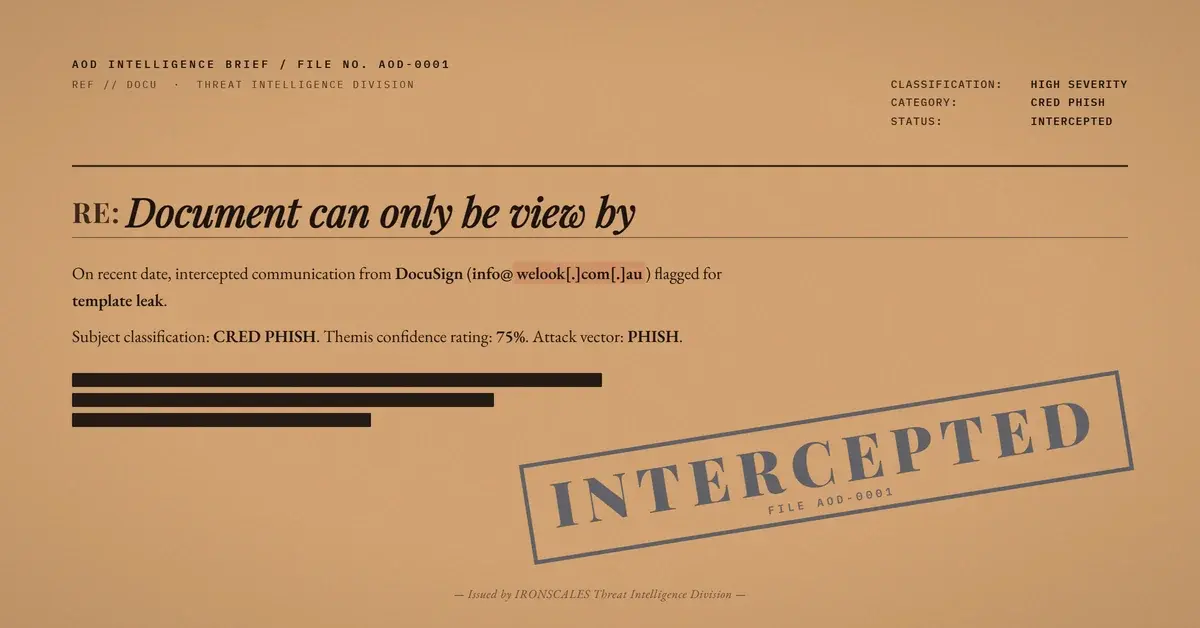
TL;DR A message using DocuSign branding was sent from info@welook[.]com[.]au via SendGrid with an AppRiver security gateway in the relay path. SPF produced a softfail at the AppRiver hop and DKIM results were inconsistent. The body contained an unpopulated template placeholder ({Frmsite}), the grammar error 'Document can only be view by,' and an unrelated mailing-list thread appended below the DocuSign content. The View Completed Document CTA routed through link.edgepilot.com (click protection) and u53717309.ct.sendgrid.net (click tracking) before surfacing a Microsoft OAuth authorize URL at login.microsoftonline.com with a redirect to grammarly.com/callback. The attack combined brand impersonation, exposed template infrastructure, and a multi-stage redirect chain to deliver an OAuth credential-theft flow.
Severity: High Credential Harvesting Brand Impersonation Oauth Abuse MITRE: {'id': 'T1566.002', 'name': 'Phishing: Spearphishing Link'} MITRE: {'id': 'T1528', 'name': 'Steal Application Access Token'} MITRE: {'id': 'T1036.005', 'name': 'Masquerading: Match Legitimate Name or Location'}
The DocuSign notification looked professional enough to pass a quick glance, but the attackers shipped their template before populating it. The placeholder {Frmsite} sat in the body text. "Document can only be view by" betrayed a grammar error the template author never fixed. Below the signing CTA, an unrelated mailing-list thread was stitched into the message, a bulk-send artifact that no legitimate DocuSign notification would contain. These were the visible mistakes. The invisible part, the multi-hop redirect chain ending at a Microsoft OAuth endpoint, was considerably more sophisticated than the wrapper it arrived in.
A Sending Path That Doesn't Match the Brand
The message was sent from info@welook[.]com[.]au, an Australian domain unrelated to DocuSign, through SendGrid transactional infrastructure at 149[.]72[.]126[.]143. An AppRiver SecureTide gateway at 8[.]31[.]233[.]206 scanned and relayed the message downstream, breaking SPF alignment in the process (softfail recorded at the AppRiver hop). DKIM results were inconsistent across relay hops.
The body used DocuSign branding complete with the real DocuSign corporate address ("221 Main Street, Suite 1550 San Francisco, CA 94105"). But the sending domain, return path, and tracking infrastructure all pointed to SendGrid and a third-party Australian domain. Legitimate DocuSign notifications originate from docusign.com with matching DKIM signatures.
Three Redirects to an OAuth Endpoint
The "View Completed Document" CTA did not link to docusign.com. The click path was:
link.edgepilot[.]com (click-protection/rewriting gateway)u53717309.ct.sendgrid[.]net (SendGrid click tracking)login[.]microsoftonline[.]com/common/oauth2/v2.0/authorize with redirect_url=https://www.grammarly.com/callback
The final URL was a legitimate Microsoft OAuth authorize endpoint. URL reputation checks returned clean because login.microsoftonline.com is a real Microsoft domain. The attack lived in the parameters: the OAuth flow would prompt the recipient to authenticate and potentially grant permissions to an application controlled by the attacker. The grammarly.com/callback redirect target added another layer of plausibility, piggybacking on a well-known brand's domain.
An encoded registered-trademark symbol appeared in the query parameters, a sign of malformed or obfuscated strings typical of phishing kits that manipulate URL parameters to evade pattern matching.
Two Quality Tiers in One Attack
The template errors ({Frmsite}, grammar mistakes, appended mailing-list content) suggest a low-sophistication operator. The redirect chain (EdgePilot, SendGrid tracking, Microsoft OAuth with a plausible callback) suggests a capable credential harvesting infrastructure. This mismatch, sloppy presentation over competent technical plumbing, is increasingly common as phishing-as-a-service platforms provide pre-built redirect chains to operators who lack the skill to write clean lure content.
See Your Risk: Calculate how many threats your SEG is missing
Indicators of Compromise
| Type | Indicator | Context |
|---|
| Sender Domain | welook[.]com[.]au | Australian domain, not DocuSign |
| Sending IP | 149[.]72[.]126[.]143 | SendGrid transactional infrastructure |
| Relay | encryptdel201.appriver[.]com (8[.]31[.]233[.]206) | AppRiver SecureTide gateway |
| Redirect Hop 1 | link.edgepilot[.]com | Click-protection/rewriting |
| Redirect Hop 2 | u53717309.ct.sendgrid[.]net | SendGrid click tracking |
| OAuth Endpoint | login[.]microsoftonline[.]com/common/oauth2/v2.0/authorize | Microsoft OAuth flow |
| OAuth Redirect | grammarly[.]com/callback | Plausible callback target |
| Template Token | {Frmsite} | Unpopulated phishing kit variable |
MITRE ATT&CK Mapping
| Technique | ID | Relevance |
|---|
| Phishing: Spearphishing Link | T1566.002 | Multi-hop redirect chain to OAuth endpoint |
| Steal Application Access Token | T1528 | Microsoft OAuth authorize flow harvests tokens |
| Masquerading: Match Legitimate Name or Location | T1036.005 | DocuSign branding and corporate address |
Email Attack of the Day is a daily series from
IRONSCALES spotlighting real phishing attacks caught by Adaptive AI and our community of 36,000+ security professionals. Each post breaks down a real attack. What it looked like, why it worked, and what to do about it.







/Blue%20Feature%20Flower%20Icons/gear%20head%20icon.svg)
/Misc%20Icons/icon-nav-credential-theft.svg)










/Leadership%20Headshots/Audian%20Paxson%20Headshot%201000x1000%20032026.webp?width=100&height=100&name=Audian%20Paxson%20Headshot%201000x1000%20032026.webp)



.png?width=50&height=50&name=Untitled%20-%20July%2030%2c%202026%20at%2014.53.38%20(3).png)



/Misc%20Icons/icon-red-teaming-agent-gradient-simple.svg)
/Misc%20Icons/icon-phishing-soc-agent-gradient-simple.webp?width=158&height=167&name=icon-phishing-soc-agent-gradient-simple.webp)
/Misc%20Icons/icon-phishing-simulation-agent-gradient-simple.svg)


/Misc%20Icons/icon-nav-encryption.svg)