TL;DR A consumer Gmail account name-dropped the chief executive of a Fortune 500 automotive manufacturer in the subject line of a message sent to one of that company's benefits managers, then asked in two plain sentences for the best number to reach her on. There were no links or malicious attachments, and the mail passed SPF, DKIM, and DMARC because it came from real Gmail infrastructure. The payload was a phone number, harvested to seed a later callback or CEO-fraud attempt. A broken personalization template signed the note with the recipient's own first name, exposing the automation behind it.
Severity: Medium Phishing For Information Reconnaissance Business Email Compromise MITRE: T1598 MITRE: T1589
A free Gmail account put a Fortune 500 automaker's chief executive in the subject line, sent it to a benefits manager at that same company, and asked for one thing: her direct phone number. That is the entire attack. No malicious link, no attachment, no payload of any kind. Just a well-known CEO's name used as a hook and a two-sentence request for a way to reach the target by phone.
The cleverest part was an accident. The message was clearly built from a personalization template, and the template broke. Instead of signing off as the CEO or a plausible executive assistant, it signed with the recipient's own first name. The automation had merged the target's identity into the sender field, and nobody proofread it before it went out.
A subject line doing all the work
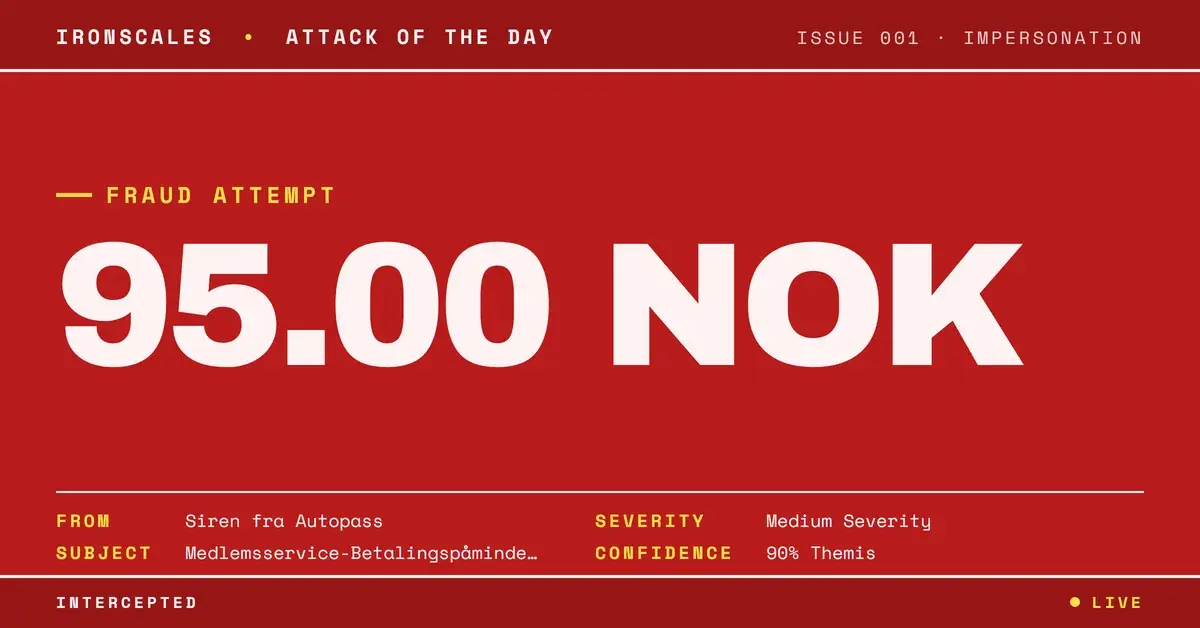
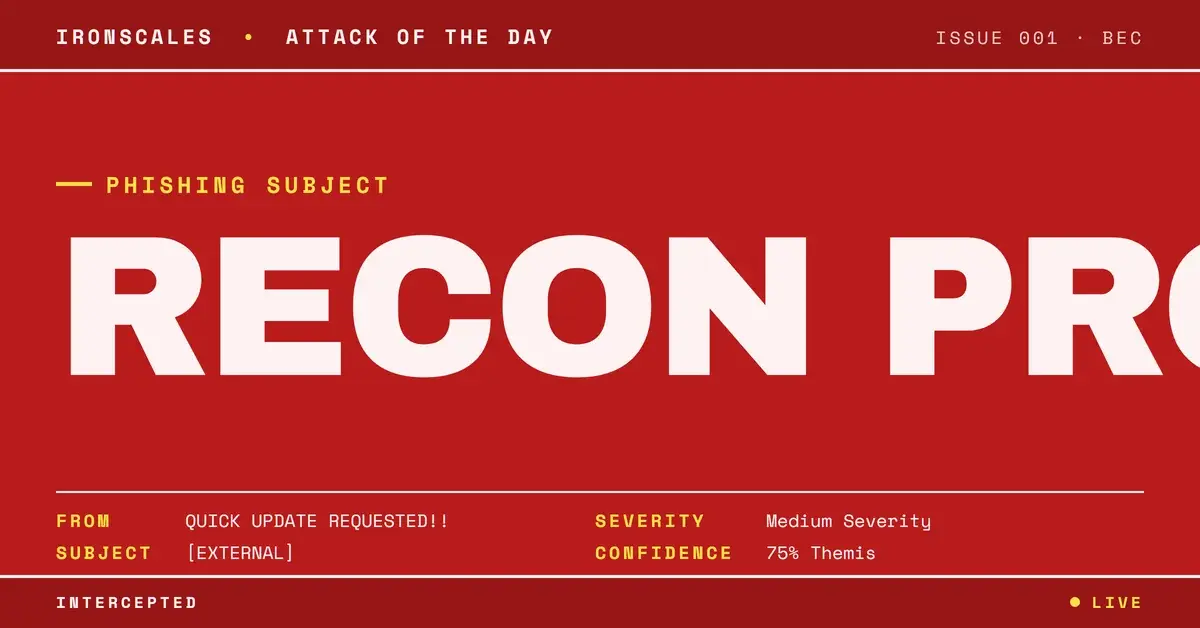
The sending address was teamsreport2@gmail[.]com, a throwaway consumer mailbox with the display name QUICK UPDATE REQUESTED!! in shouting capitals. The subject line was nothing but the automaker's chief executive's name with an external tag in front of it. That name reads instantly against an employee's inbox, and dropping it there is a targeted bet: the recipient recognizes it, and curiosity does the rest.
Notice what the attacker did not do. There was no spoofed corporate domain, no forged executive signature, no fake DocuSign or invoice. The name in the subject was never backed by a matching claim in the body. This was a namedrop used to get the message opened, not an impersonation of the CEO herself. It is a subtle distinction, and it matters, because it means every server-level defense that hunts for domain spoofing had nothing to catch.
The body was two generic sentences asking what the most convenient number to reach her on would be. No pretext, no story, no urgency beyond the display name. When the payload is a single phone number, the attacker does not need a narrative. They need the target to reply.
When "authenticated" means the wrong thing
Here is where most gateways lose the plot. The message passed SPF from the sending IP, passed DKIM under d=gmail[.]com, and passed DMARC. Microsoft logged compauth=pass reason=100, the strongest composite-authentication verdict available.
Every one of those checks was correct. The mail genuinely came from Google's consumer infrastructure. That is exactly the problem. Authentication confirms that a real Gmail account sent the message. It says nothing about whether the human behind that account is who the subject line implies. A DMARC pass on a consumer Gmail message is the expected result for any mailbox, benign or malicious, and reputation systems that weight Gmail as a trusted sender were always going to wave this through.
The attacker did not defeat authentication. They stayed entirely inside it, using a legitimate free mailbox precisely because it authenticates cleanly. No infrastructure to burn, no domain to register, nothing for a blocklist to bite on.
The payload was reconnaissance
There was nothing to click, so there was nothing to sandbox. The only actionable artifacts beyond boilerplate were the sender address and that subject line. This is phishing for information, and the goal is a foothold for the next stage.
A direct phone number is a channel. Once an attacker moves the conversation to voice, the email trail ends and so does most of the tooling built to inspect it. A follow-up call claiming to be from the CEO's office, or from HR about a benefits or retirement matter, lands with far more weight when it arrives on the number the target volunteered. That is why a benefits and rewards operations manager was a deliberate choice rather than a random one: the role touches payroll, retirement, and personal employee data, all of which pay off in a later voice-based approach.
See Your Risk: Calculate how many threats your SEG is missing
Mapping to MITRE ATT&CK
The tradecraft is short and clean, which is the point of a reconnaissance probe.
- T1598 Phishing for Information covers the core move: a socially engineered message whose objective is data, here a phone number, rather than credentials or code execution.
- T1589 Gather Victim Identity Information covers the intent behind it, building out a contact profile that fuels a follow-on callback or business-email-compromise attempt.
There is no delivery technique to map because there is no delivery payload. That absence is itself the signature.
Indicators of Compromise
| Type | Indicator | Context |
|---|
| Sender email | teamsreport2@gmail[.]com | Free consumer mailbox, first-time sender, full Gmail auth pass (compauth=100) |
| Display name | QUICK UPDATE REQUESTED!! | All-caps urgency string in the From field |
| Subject line | [EXTERNAL] | Namedrop of a Fortune 500 CEO used purely as an open hook |
Detecting an attack with almost no surface
Signature and reputation checks were never going to flag this. The infrastructure is legitimate, the authentication is genuine, and there is no link or file to detonate. Detection has to read intent. The signals that matter are a first-time external sender on a free consumer domain, a high-recognition name in the subject with no matching claim in the body, and a bare request for a phone number or other contact detail with no business context around it.
That is the relationship layer static gateways cannot see, and it is where Themis, the Adaptive AI analyst on the IRONSCALES platform, does its work. Themis weighs the mismatch between the name being leveraged, the actual sending identity, and the unusual ask the way a trained analyst would, flagging the probe even when every authentication result comes back green. The 2024 Verizon Data Breach Investigations Report puts the human element in 68 percent of breaches and names pretexting, most of it business email compromise, as the top social-engineering incident type, with a median transaction near 50,000 dollars. The Microsoft Digital Defense Report 2024 documents the same drift toward abusing trusted services instead of breaking them, and the FBI's 2023 Internet Crime Report ranks business-identity fraud among the costliest categories year after year. Across the 36,000+ security professionals and 18,000+ organizations that IRONSCALES protects, the pattern holds: the quiet, payload-free ask is often the opening move, not the whole play.
The takeaway
A recognizable name and a reasonable-sounding question are enough to start an attack, and neither one trips a scanner. The defense is to treat a subject-line namedrop as decoration rather than proof, and to route any unexpected request for a phone number or personal contact detail through a channel you already trust instead of the one the sender is steering you toward. CISA's guidance on recognizing and stopping phishing early is a solid reference for building that reflex across a team: https://www.cisa.gov/resources-tools/resources/phishing-guidance-stopping-attack-cycle-phase-one
Email Attack of the Day is a daily series from
IRONSCALES spotlighting real phishing attacks caught by Adaptive AI and our community of 36,000+ security professionals. Each post breaks down a real attack. What it looked like, why it worked, and what to do about it.







/Blue%20Feature%20Flower%20Icons/gear%20head%20icon.svg)
/Misc%20Icons/icon-nav-credential-theft.svg)










/Leadership%20Headshots/Audian%20Paxson%20Headshot%201000x1000%20032026.webp?width=100&height=100&name=Audian%20Paxson%20Headshot%201000x1000%20032026.webp)



.png?width=50&height=50&name=Untitled%20-%20July%2030%2c%202026%20at%2014.53.38%20(3).png)



/Misc%20Icons/icon-red-teaming-agent-gradient-simple.svg)
/Misc%20Icons/icon-phishing-soc-agent-gradient-simple.webp?width=158&height=167&name=icon-phishing-soc-agent-gradient-simple.webp)
/Misc%20Icons/icon-phishing-simulation-agent-gradient-simple.svg)


/Misc%20Icons/icon-nav-encryption.svg)