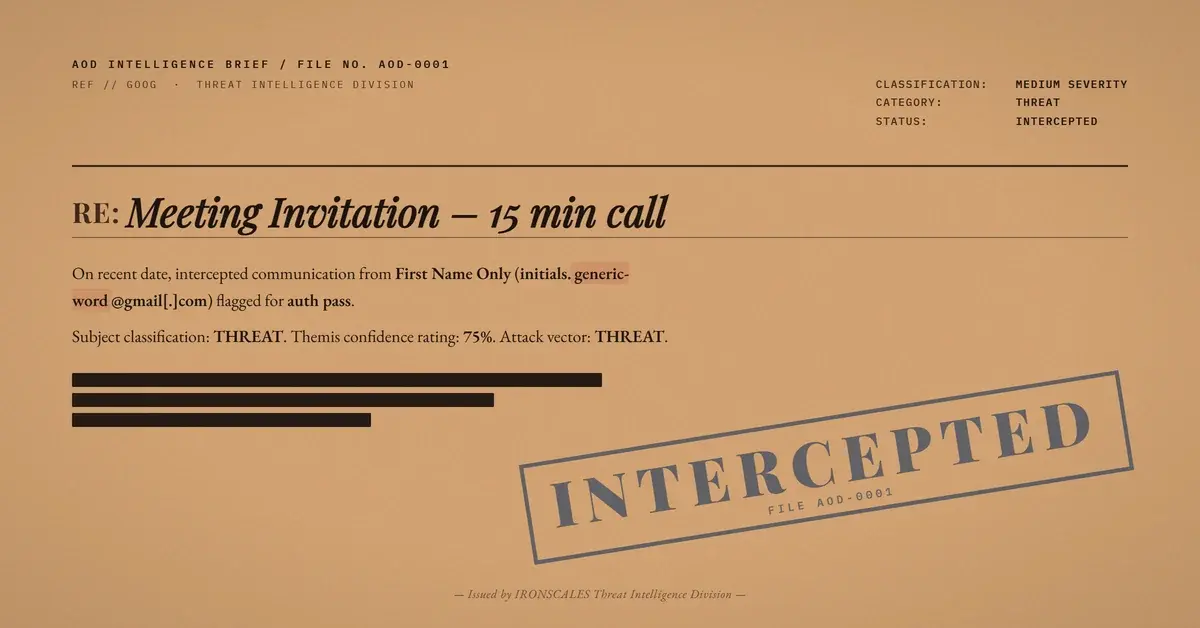
TL;DR A public regional university received a meeting invitation delivered through Google's own calendar-notification pipeline from a free consumer mail account. It passed SPF, DKIM, and DMARC, and composite authentication scored a full pass. The attachment was an ordinary invite file, the embedded room was a real video-conference link, and both scanned clean. The pretext was the payload: a flattering note claiming the sender had discovered the recipient's public code-hosting profile and wanted to discuss freelance collaboration. Automated behavioral analysis flagged it as phishing seconds after delivery, on relationship and content signals alone.
Severity: Medium Social-Engineering Calendar-Invite-Abuse Recruitment-Scam MITRE: T1566.002 MITRE: T1585.002 MITRE: T1593.003 MITRE: T1684.001
The thing that arrived in a faculty mailbox at a public regional university was not really an email. It was a meeting invitation: a fifteen-minute slot two days out, an eyes emoji at the front of the subject line, a few sentences of praise, and a video-call link. Nothing in it failed a check. Nothing in it needed to. Automated detection classified the message as phishing and logged a mitigation roughly four seconds after receipt, and every technical artifact it carried scanned completely clean.
That is what makes the case worth taking apart. No credential page, no macro, no archive to expand, no freshly registered domain to blocklist, no urgency of any kind. The entire attack surface was a sentence engineered to earn a low-friction yes.
Delivered by Google, on Google's behalf
The message came from a free consumer mail account, a Gmail address built around initials and a generic occupational word, with no prior correspondence with this mailbox.
Everything downstream of that account was genuine. Because the attacker created a real calendar event and added the target as a guest, the invitation was generated and delivered by Google's own calendar-notification infrastructure, arriving through mail-io1-xd49[.]google[.]com directly into the institution's Microsoft 365 tenant. SPF passed. Two DKIM signatures verified, one for the mail service and one for the calendar service. DMARC passed. Composite authentication returned a full pass with reason code 100.
There was no spoofing to detect because no spoofing occurred, and that is the practical limit of email authentication rather than a defect in it. As NIST's definition of phishing makes clear, the deception operates on the person, not the protocol. SPF, DKIM, and the DMARC specification in RFC 7489 answer one question well: did the domain claiming to send this message actually send it. They were never designed to judge whether the human holding the account is honest. A free account plus a legitimate invitation pipeline produces a flawless authentication record at zero cost, which is T1585/002, establishing email accounts in its cheapest form.
A pretext built on flattery, not urgency
The invite file and the event description carried the same short note. The sender introduced himself by first name only, described himself as the leader of a group of freelancers in the local area, and said that while exploring a public code-hosting site he had come across the recipient's profile and was genuinely impressed. He suggested the recipient would be a great fit to collaborate with the group, then framed the opportunity around expanding a professional network, diversifying income, and joining forces with other experienced engineers. Both the subject line and the opening line addressed the recipient by first name.
Notice what is absent. No deadline. No threat of account closure. No invoice, no payment change, no password reset. No file to open. The message asks for nothing but a short conversation, and leads with a compliment about work the recipient is publicly proud of.
That inverts the pattern most awareness programs train against. The 2024 Verizon Data Breach Investigations Report identifies pretexting, rather than straightforward credential phishing, as the leading social-engineering type, and puts the human element in the picture for 68% of breaches. Pretexting works because it does not trip the emotional alarms people are taught to watch for. It builds a plausible relationship first and makes the ask later. CISA's phishing guidance makes the same structural point, that the attack cycle starts long before anything malicious is delivered, which is why security awareness training has to cover flattery and opportunity as pretexts, not just fear and urgency.
One caveat matters. The code-hosting profile is a claim inside the lure, not verified tradecraft, and nothing in the record shows the sender ever visited one. But it costs nothing and works either way, and if true it would be textbook T1593/003 reconnaissance against public code repositories. Academic and engineering staff publish under their own names constantly, which makes an "I found your work" opener easy to write and credible to receive.
See Your Risk: Calculate how many threats your SEG is missing
The ask was fifteen minutes, not money
The only link in the message pointed to a real video-conference room on the provider's own meeting domain. It scanned clean because it was clean. No landing page to inspect, no form to fingerprint.
The short duration is part of the design. Fifteen minutes reads as low commitment, which is what an initial-contact request needs to convert. And once the call connects, every email control stops applying. The conversation moves to a live voice channel where the operator can qualify the target, build rapport, and choose the real ask: an onboarding fee, identity documents, a fraudulent contract, a wallet transfer, or tooling the target installs voluntarily. That is T1684.001, impersonation, sustained in real time rather than in one message.
The economics justify the patience. The 2023 FBI IC3 Internet Crime Report put reported business email compromise losses near $2.9 billion, and the 2024 DBIR pegs the median BEC transaction at roughly $50,000. The T1566/002 spearphishing link is not the payload here. It is the door to the actual channel.
What caught it, and why reputation could not
With every artifact clean and every authentication result green, detection had to come from relationship and content. IRONSCALES Adaptive AI weighed the combination a suspicious analyst would flag immediately: a first-time sender with no history, a personal consumer account soliciting an employee about paid outside work, a scheduling wrapper carrying a recruitment pitch, and phrasing consistent with a known advance-opportunity pattern. The message was classified as phishing and mitigated within seconds, and the mailbox record shows no user action taken. Remediated before anyone could accept.
Reputation-based controls had nothing to work with, and that is the durable lesson. A blocklist cannot reject the provider's calendar infrastructure. A sandbox cannot condemn a valid invite file or a working meeting room. One mailbox was affected here, but the same invitation costs nothing to send to hundreds, and in tenants where invitations are auto-accepted, the event lands before the note is ever read. Where staff directories and publication histories are public by design, that exposure is structural rather than accidental. Email security for education has to assume the attacker already has the name, the role, and the professional interests, and that the opening message will be polite, specific, complimentary, and technically flawless.
Indicators of Compromise
| Type | Indicator | Context |
|---|
| Email | m.lee.builder@gmail[.]com | Sender and event organizer, free consumer account, first-time sender, no verifiable professional identity behind the display name |
| URL | hxxps://meet[.]google[.]com/yec-ikmr-nqs?hs=224 | Embedded video-conference room, the sole call to action, legitimate meeting domain, scanned clean |
| Filename | invite.ics | Calendar attachment (3,519 bytes) carrying the pretext text and the meeting link, clean verdict |
| Hash | 15d2184025dd9f891891c33de5a869d3 | MD5 of the invite attachment |
| Infrastructure | mail-io1-xd49[.]google[.]com | Provider calendar-notification relay, delivering into the target Microsoft 365 tenant |
| Authentication | SPF pass, DKIM pass on two signatures, DMARC pass, compauth=pass reason=100 | Legitimate delivery chain end to end, no spoofing anywhere |
| Behavior | Personalized recruitment pretext inside a short meeting invitation | Flattery opener citing a public code-hosting profile, ask limited to a fifteen-minute call, no payload |
MITRE ATT&CK Mapping
- T1585/002, Establish Accounts: Email Accounts. A free consumer account provided a fully authenticating sending identity at no cost.
- T1593/003, Search Open Websites and Domains: Code Repositories. The claimed reconnaissance path behind the personalized opener.
- T1566/002, Phishing: Spearphishing Link. The meeting-room link was the only call to action.
- T1684.001, Impersonation. A fabricated freelance-collective leader identity, meant to be sustained live on the call.
See you next time
When a message contains nothing to scan, the content is the indicator. Ask who this sender is to this mailbox, why a stranger's personal account is proposing paid work to your staff, and what happens in the fifteen minutes after the invitation is accepted. Clean authentication and a clean attachment mean the delivery was honest. They say nothing about the intent.
Email Attack of the Day is a daily series from
IRONSCALES spotlighting real phishing attacks caught by Adaptive AI and our community of 36,000+ security professionals. Each post breaks down a real attack. What it looked like, why it worked, and what to do about it.







/Blue%20Feature%20Flower%20Icons/gear%20head%20icon.svg)
/Misc%20Icons/icon-nav-credential-theft.svg)










/Leadership%20Headshots/Audian%20Paxson%20Headshot%201000x1000%20032026.webp?width=100&height=100&name=Audian%20Paxson%20Headshot%201000x1000%20032026.webp)



.png?width=50&height=50&name=Untitled%20-%20July%2030%2c%202026%20at%2014.53.38%20(3).png)



/Misc%20Icons/icon-red-teaming-agent-gradient-simple.svg)
/Misc%20Icons/icon-phishing-soc-agent-gradient-simple.webp?width=158&height=167&name=icon-phishing-soc-agent-gradient-simple.webp)
/Misc%20Icons/icon-phishing-simulation-agent-gradient-simple.svg)


/Misc%20Icons/icon-nav-encryption.svg)