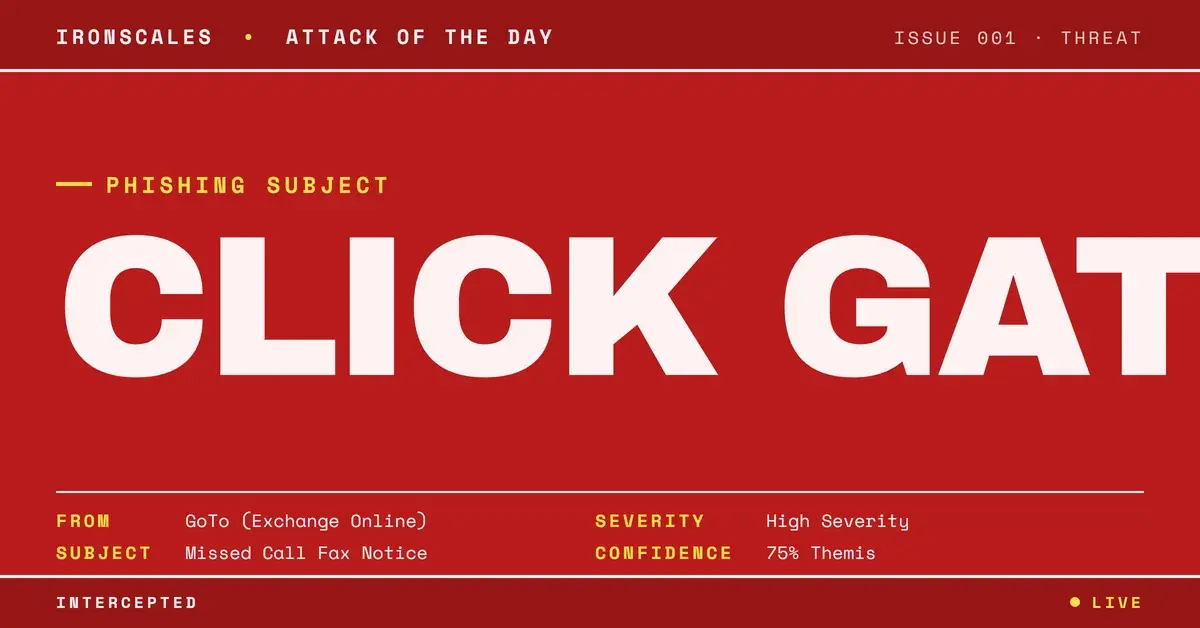
TL;DR An HTML attachment on a fake GoTo missed-call fax notice does nothing when opened. It shows a card reading Security check, one tap to proceed, and waits. Only a click or tap runs the handler that reverses segments, undoes a reversed base64 alphabet, XORs the result with an 84-character key, and clicks a programmatic link. A scanner that renders the file without synthesizing a tap sees no destination at all. The platform automatically resolved the message as phishing and mitigated it, but no one observed the landing page, so the redirect is the verified artifact.
Severity: High Malicious Attachment Evasion MITRE: T1566.001 MITRE: T1027 MITRE: T1204.002 MITRE: T1036
The file did nothing. That was the whole point.
A 3,206-byte HTML attachment landed in a loan processor's mailbox at a lending company, attached to a fake GoTo "Missed Call" fax notice. Open it and you get one white card with an animated green checkmark and the words "Security check" and "One tap to proceed." No form. No input. No network call. A sandbox that opens the file, waits, and watches sees a screensaver.
The attachment scanner agreed. It rated the file clean.
The Gate Is a Tap, Not a Load Event
Most evasive HTML attachments fire on load and hope nobody is watching. This one does not. A transparent div is pinned over the entire viewport (fixed position, full inset, top z-index, pointer cursor), and it carries an inline click handler. Everything dangerous lives behind that handler.
That changes what detonation proves. "Opened and rendered clean" is not the same as "inspected." Unless the sandbox synthesizes a click on the right element, the code path that produces the destination never executes. The decoy card even tells the human what to do, which makes the tap feel like part of a normal security prompt. Notably, the card is only text and an animation, with no widget behind it.
The handler is also tidy in what it avoids. The IRONSCALES analysis found no eval, no document.write and no script element. It builds an anchor, sets the address, appends it, clicks it programmatically and removes it. This maps to MITRE T1204.002 (user execution of a malicious file), with the tap as the execution trigger.
A Three-Layer Decode Parked in a Data Attribute
The destination is not in the markup as a URL. It sits in a data attribute on a template element, an inert tag that most scanners do not treat as script. When the click lands, the handler runs three steps in order:
- Split the value on the "@" character and reverse every odd-indexed segment.
- Map each character through the standard base64 alphabet reversed, then base64-decode.
- XOR the bytes with an 84-character hex-looking key and decode the text.
The IRONSCALES analysis re-implemented that exact handler against the attachment bytes. A readable URL came out the other end, which confirms the segment logic, the alphabet and the key. A wrong step would have produced binary noise. This is T1027 (obfuscated files or information), and it is cheap for the attacker: a few lines of JavaScript, no packer, no known signature.
The result is a random ten-character subdomain on a .de domain behind Cloudflare nameservers. WHOIS returned no registrar, creation date or registrant, so the registration age is unknown and nothing here establishes who owns the domain. A compromised or abused site cannot be ruled out.
The Lure Argues With Itself
The envelope is sloppier than the attachment. The sender address uses an Exchange Online inbound-endpoint hostname as its domain. Authentication shows a single hop: SPF returned a temporary error from a DNS timeout (not a failure), DKIM was absent, DMARC returned a temporary error, and the sender had no prior history with the recipient. Microsoft scored the message SCL 1 and delivered it.
The body is a GoTo fax-notice template pasted beneath a block of public-records boilerplate that appears twice. Then the details unravel:
- The timestamp reads "19:48:28 PM EDT," a 24-hour clock with PM, on a message whose UTC delivery time works out to mid-afternoon Eastern.
- The displayed caller number for an Arkansas city carries a tel: link pointing at a different number.
- A stray "Thank You#98685" fragment sits at the top.
- A second attachment, an .eml, shows a forged Microsoft-style From address and says remittance checks are "enclosed in a secure HTML file." That contradicts the GoTo fax story on the outside.
Two pretexts, one message, one forged sender. See Your Risk: Calculate how many threats your SEG is missing
Indicators of Compromise
| Type | Indicator | Context |
|---|
| File | DANHGHBV.HTM | 3,206-byte HTML attachment, scanner verdict clean |
| Hash (MD5) | c0e3e98a2a6e7024daa50c5527d05e81 | DANHGHBV.HTM |
| File | MailedChecksAndStatementRequest.eml | Second attachment, 10,034 bytes |
| Hash (MD5) | c73cf56113888bfeb828b3d4ce04100e | The .eml attachment |
| IP | 45[.]92[.]156[.]25 | Connecting IP, Netherlands, no reverse DNS name |
| URL | hxxps://[random-10-char-label].[.de-domain-withheld]/l/<11-char-token> | Redirect target decoded from the click handler, never observed live |
| Domain | Exchange Online inbound-endpoint hostname (tenant label withheld) | Sender domain, possible uninvolved tenant |
What the Record Does and Does Not Show
Here is the honest limit. After the decode, the trail stops. There is no link scan, screenshot or landing capture for the destination in the record. Nobody observed what it served, and nothing here says it was a particular kind of page. The verified artifact is the redirect. The .eml was read only as visible text, so a payload link inside it is not established either. The record also does not show that the recipient opened or tapped anything.
What it does show: the platform's automated detection resolved the incident as phishing, the reporter was Automated Threat Detection, and the mailbox was mitigated. The record does not say how.
The defensive takeaway is about trust in verdicts. The attachment scanner said clean, and native filtering delivered the message. Both signals were honest about what they measured: a static file with no live behavior. The 2026 Verizon Data Breach Investigations Report puts the human element in 62% of breaches and phishing at 16% of initial access, and a file that waits for a human tap is built for exactly that gap. The same report's email gateway mix (Fig. 54) describes what gateways block: 80% plain phishing and 10% malware-laden. A file that stays inert until a tap is built for the space between those categories.
Treat the attachment and the message as one object. A forged sender, an impossible timestamp and two incompatible pretexts are visible without running a line of JavaScript. This is phishing delivered as T1566.001 (spearphishing attachment), and CISA's phishing guidance still starts from the right place: break the chain at the first phase. Context-aware detection like IRONSCALES Adaptive AI weighs the message and the file together, and layered controls such as advanced malware and URL protection should decode handler logic statically rather than wait for runtime behavior.
The Microsoft Digital Defense Report 2024 and the FBI IC3 2024 report both keep email as the dominant entry point. A file that sits still until someone taps is a reminder that "nothing happened" is a measurement, not a verdict.
Email Attack of the Day is a daily series from
IRONSCALES spotlighting real phishing attacks caught by Adaptive AI and our community of 35,000+ security professionals. Each post breaks down a real attack. What it looked like, why it worked, and what to do about it.