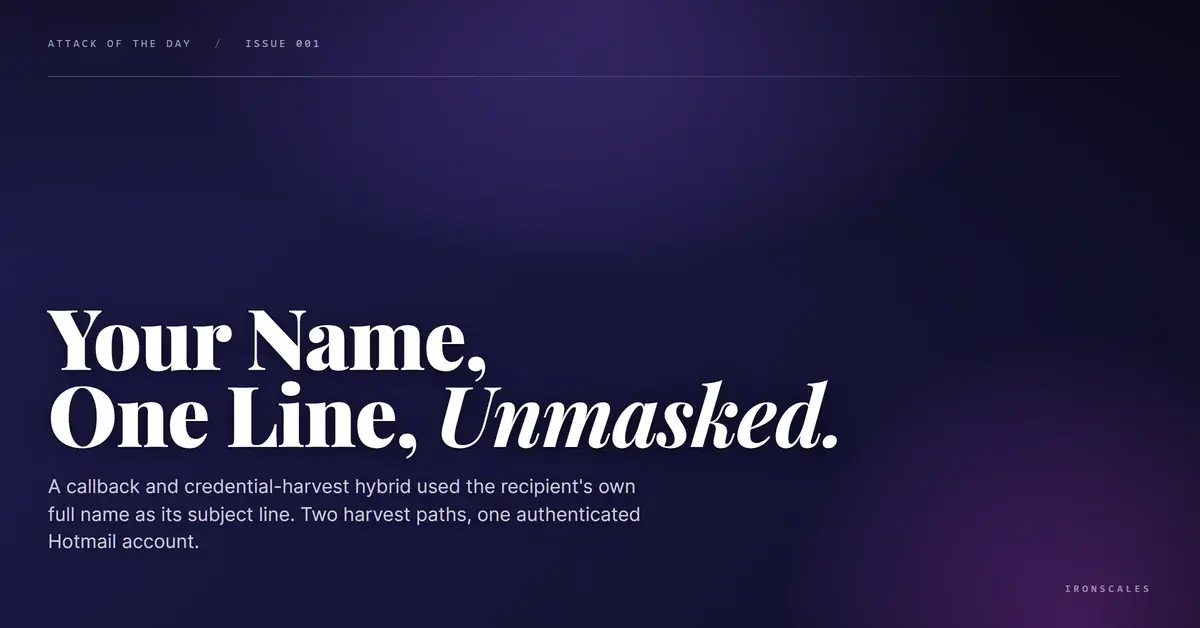
TL;DR A fully authenticated message from a disposable Hotmail account used the recipient's own full name as its entire subject line, then claimed to be a Student Loan Debt Department holding an open case file with one day left to resolve. The body offered a toll-free callback number and, separately, instructed the recipient to paste a URL into a browser and submit an email address. That hybrid design harvests data whether or not anyone dials the number. The mailbox was a flagged VIP in a legal function, and Themis scored the message at 89 percent.
Severity: High Callback Phishing Credential Harvesting Social Engineering Vip Targeting MITRE: T1566.004 MITRE: T1598 MITRE: T1684.001
An email landed in the work mailbox of a corporate secretary in the legal function of a Latin America-based industrial and mining company. Its subject line contained exactly one thing: the recipient's own full name, given name and both surnames, spelled correctly. No reference number in the subject, no urgency banner, no brand, no verb. Just the name, arriving from an address that had never corresponded with anyone at the company.
That single field is what separates this message from the debt-relief junk that piles up in every quarantine. Bulk spam works from a list of addresses and cannot personalize the one line a recipient reads before deciding whether to open anything. Whoever sent this had a name and address pair, and chose to spend it in the most visible place available.
The Subject Line Was the Recipient's Own Name
Inside, the message claimed to represent a Student Loan Debt Department, cited a case number already open in the recipient's name, and set a window of one day before that case would close. The tone was administrative rather than alarming. The fabricated authority has no counterpart in any federal loan program, but the recipient had no way to know that from the message, and the personalized subject line had already done the work of implying that a file existed.
Then came the part that makes this case worth a teardown. The body offered a toll-free number to call, which is the familiar callback pattern. It also, in a separate instruction, told the recipient to open a browser, paste an address into the bar, and submit an email address to continue. Two channels for handing something to a stranger, delivered in one message, and neither of them a clickable link.
A Second Path That Never Needs a Phone Call
Most callback lures live or die on the phone. If nobody dials, the operator gets nothing. This one hedged. The paste-the-address instruction converts a portion of recipients into confirmed, self-submitted addresses without a single call being placed, and it does so in a way that leaves almost nothing for a mail system to inspect. There is no anchor tag to rewrite. There is no destination to reputation-check, because the destination arrives as text a human retypes. There is no attachment to detonate. Whatever page the recipient reaches is reached in a browser session the gateway will never observe.
Speed is what makes that design pay. The 2024 Verizon Data Breach Investigations Report puts the median time to click a phishing link at 21 seconds and the median time to submit data after clicking at 28 seconds. Under a minute from open to disclosure, with no technology in the path once the browser leaves the mail client. The same report attributes 68 percent of breaches to a human element and finds stolen credentials involved in 38 percent of them, which is the reason a data-submission step is worth bolting onto a voice pretext even when the voice pretext is the headline.
See Your Risk: Calculate how many threats your SEG is missing
Authenticated by Microsoft, Vouched For by Nobody
The delivery path was spotless. SPF passed. DKIM passed with a signing domain of hotmail[.]com. DMARC returned a pass verdict, the ARC chain validated, and composite authentication scored 100, the highest value the receiving edge assigns. Every green light a mail system can produce, produced.
None of it speaks to identity. DMARC confirms that a message came from infrastructure authorized to send for the domain in the From header. Hotmail is Microsoft-managed infrastructure, so mail from a Hotmail mailbox authenticates correctly by design, exactly as RFC 7489 specifies. The claim being made in the body, that a loan authority holds an open case file, is not the kind of assertion any authentication protocol evaluates. NIST defines phishing around the deception itself rather than the transport, and that distinction is the whole story here.
The message dressed itself further with an opt-out reference pointing at stoptheemails[.]org, a domain with no authoritative tie to any loan servicer or agency. Unsubscribe furniture reads as compliance to a human eye. In this context it is set decoration.
Why a Flagged VIP in the Legal Function
The recipient was not a random mailbox, but a mailbox flagged as a VIP inside the platform. The role, corporate secretary in a legal function, is one that handles filings, board records, and correspondence with outside counsel. A personal-finance pretext aimed at a work address is a deliberate combination: it is plausible enough to answer privately, awkward enough to keep out of a help-desk ticket, and it opens a voice channel with someone whose job is signing and attesting to documents. Personalization plus role selection is a different threat model from volume spam, and it should be triaged as one.
What Actually Caught It
There was no malicious URL in the retrievable body and no attachment, so signature and reputation layers had nothing to bite. Detection had to read the arrangement of the message instead: a disposable free-mail sender claiming institutional authority, a subject line consisting solely of the recipient's name, a deadline measured in hours, a phone number as the primary action, and a second instruction to submit an address out of band. Themis, the Adaptive AI analyst on the IRONSCALES platform, weighed those together and scored the message at 89 percent confidence, classifying it as a vishing attempt against a VIP recipient. The incident resolved automatically as phishing, without an analyst having to build the case by hand.
Mapping to MITRE ATT&CK
- T1566.004 Spearphishing Voice covers the callback path, where the email exists only to move the target onto a phone line the mail system cannot see.
- T1598 Phishing for Information covers the second vector, the instruction to paste an address and submit an email address, which is information gathering rather than payload delivery.
- T1684.001 Impersonation covers the invented loan authority and the case number offered as evidence that it exists.
Indicators of Compromise
| Type | Indicator | Context |
|---|
| Phone | 855-764-4204 | Toll-free callback number for the fabricated loan case; primary action requested in the body |
| Domain | stoptheemails[.]org | Opt-out reference used as legitimacy furniture; no authoritative link to any loan servicer or agency |
| Email | xetcjjh6470[at]hotmail[.]com | Disposable free-mail sending address; display name presented as a person with no traceable public identity |
| Pretext | "Student Loan Debt Department" | Invented authority with no counterpart in any federal loan program |
| Behavior | Recipient full name as entire subject line | Personalization signal absent from bulk debt-relief spam |
| Behavior | Paste-address and submit-email instruction | Out-of-band harvest path with no clickable link for a gateway to inspect |
The Habit That Breaks Both Paths
Treat any contact details a message hands you as part of the message, not as a way to verify it. That applies to the phone number and, in this case, to the address you are asked to type by hand. A real loan servicer can be reached through a statement you already hold or a site you already know, and no legitimate authority resolves a case file in a browser tab you were told to open by a stranger with a free webmail account. CISA's guidance on stopping the phishing attack cycle early is a good anchor for that reflex, and it holds whether the hook is a deadline, a case number, or your own name in the subject line.
Email Attack of the Day is a daily series from
IRONSCALES spotlighting real phishing attacks caught by Adaptive AI and our community of 36,000+ security professionals. Each post breaks down a real attack. What it looked like, why it worked, and what to do about it.







/Blue%20Feature%20Flower%20Icons/gear%20head%20icon.svg)
/Misc%20Icons/icon-nav-credential-theft.svg)










/Leadership%20Headshots/Audian%20Paxson%20Headshot%201000x1000%20032026.webp?width=100&height=100&name=Audian%20Paxson%20Headshot%201000x1000%20032026.webp)



.png?width=50&height=50&name=Untitled%20-%20July%2030%2c%202026%20at%2014.53.38%20(3).png)



/Misc%20Icons/icon-red-teaming-agent-gradient-simple.svg)
/Misc%20Icons/icon-phishing-soc-agent-gradient-simple.webp?width=158&height=167&name=icon-phishing-soc-agent-gradient-simple.webp)
/Misc%20Icons/icon-phishing-simulation-agent-gradient-simple.svg)


/Misc%20Icons/icon-nav-encryption.svg)