TL;DR A Russian-language security alert told a technology manager at a Western-European coffee and beverage company that a new device had gained access to his account and that a certificate had been issued. The only remedy was a phone call, offered twice as a tel: control. There was no login page for any URL control to score. The printed IP address and handset were text in the lure, not telemetry. A recipient-address tracker hid in an empty anchor. Microsoft delivered the message to Junk, then Themis flagged it and a human analyst resolved it as malicious.
Severity: High Callback Phishing Account Takeover Lure Social Engineering MITRE: T1566.004 MITRE: T1684.001 MITRE: T1598.004
The alert had no login page because it did not want you to log in. It wanted you to call.
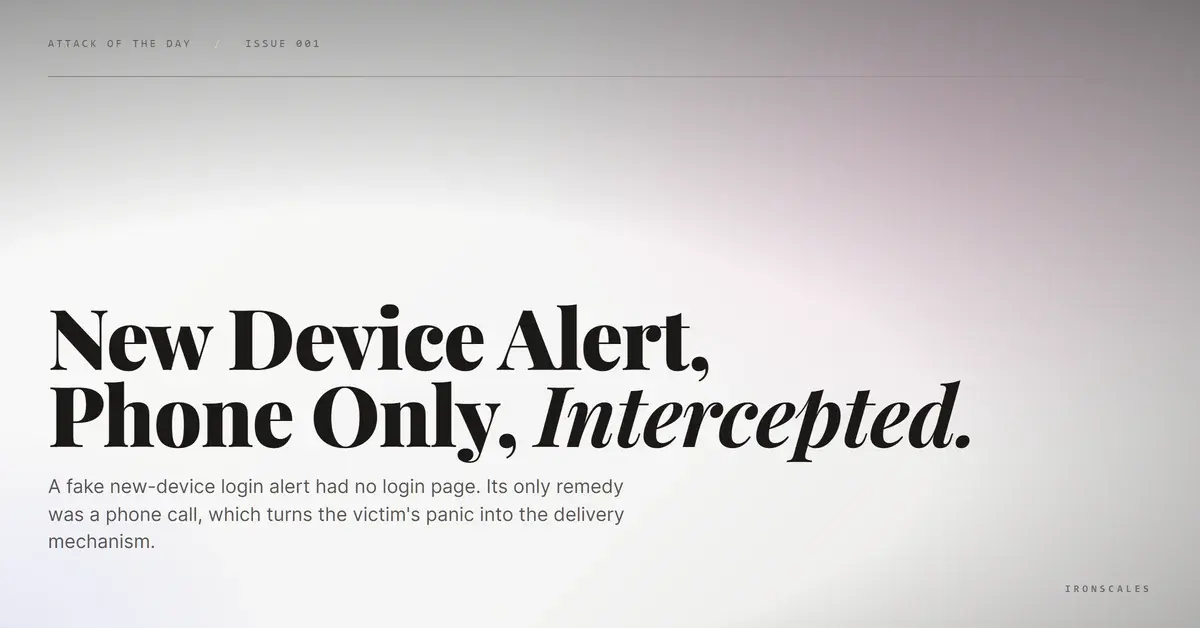
A technology manager at a Western-European coffee and beverage company received a Russian-language notice that a new device had gained access to his account and that an enhanced electronic signature certificate had been issued. The headline lived in a hotlinked hero image, and the record preserves its alt text rather than its pixels. Below it sat a block of device details and one instruction: if this is not you, contact support.
There was nowhere to click that said "secure my account." There was a bold phone number and a blue button, and both dialed the same number.
The Remedy Is the Delivery Mechanism
Most account-takeover lures borrow the shape of a real alert and point the victim at a fake sign-in page. This one dropped the page. The reader's "it wasn't me" reflex had a single outlet, and the outlet was a telephone.
That design choice removes the thing defenders usually inspect. A credential page can be fetched, screenshotted and scored. A tel: control cannot. What remains is an email whose threat sits in what it makes you feel, which is why the pretext deserves as much analysis as the payload. MITRE ATT&CK tracks the pattern as spearphishing voice, T1566.004, and the follow-on intent resembles phishing for information through voice, T1598.004. The record shows no call data, so what a caller would have heard is unknown.
The 2026 Verizon Data Breach Investigations Report puts callback and TOAD (telephone-oriented attack delivery) at 5% of the attack mix that email gateways block, against 80% for plain phishing. Small slice, awkward shape: the one thing a gateway cannot rewrite is a phone number.
Telemetry That Belongs to No One
The alert printed a source IP address and a handset model, an Android phone, as proof of the unfamiliar login. Neither is evidence of anything. They are text in the lure, and nothing in the delivery chain ties them to a real session. The IRONSCALES analysis treats them as set dressing, and so should a triage note.
The other tell is simpler. A Russian-language alert arrived at a Western-European company, from a sender the organization had never heard from, under a Cyrillic support display name. That display name had previously appeared on a message from an unrelated business, which the platform tagged as exact display-name impersonation. That business is a bystander. The record does not show it was compromised.
See Your Risk: Calculate how many threats your SEG is missing
An Invisible Link That Swallowed a Mailbox
One clickable element sat outside the phone controls: a footer sentence wrapped around an anchor with no visible text. Its rewritten address resolved to a tracker host, with the recipient's full mailbox appended directly to the path, no slash and no separator. The path was malformed, which suggests a template filled in by a script that never checked the output.
The link scored clean, and a clean verdict on an invisible tracker is not exculpatory. It also is not proof of malicious infrastructure. Treat it as what it most plausibly is: an open-and-address beacon, riding along with a message built for a phone call. No attachment, QR code or OCR text accompanied it.
Authentication Passed at the Wrong Hop
The sender domain was registered in 2004. At the receiving hop, SPF, DKIM and DMARC all returned none, yet composite authentication passed with reason 105, the implicit path for a domain that publishes no DMARC record. That is not a declaration that the sender was verified.
An earlier hop shows an authenticated submission to a German-hosted Postfix server, which passes SPF only in the sense that someone logged in to a relay. It does not align anything with the From domain. Whether the sending domain was attacker-registered or abused is not established, and neither is the relay owner's role.
Where the Verdict Came From
Microsoft's filtering put the message in Junk, with a spam confidence level of 5 and a Russian language tag. It did not block it, and a Junk folder is not a decision a worried manager reliably respects when the message says his account was accessed.
Themis, the IRONSCALES agentic AI virtual SOC analyst, returned a confidence of 56 with a Credential Theft label. The label is the platform's, and the actual lure is a callback. Supporting signals were the exact display-name tag, a first contact between the sender and the organization, and the sender's high risk level. The mailbox was quarantined, and a human analyst resolved the incident as malicious. ## What to Do With an Alert That Asks for a Call
Treat "call this number to dispute" as a category, not an absence of findings. A security alert from a real service sends you to a sign-in you already trust, never to a number the alert supplies. Teach that distinction to anyone with admin rights, and give them one rule: if the only action in an account alert is to phone somebody, verify through a channel you already had.
On the detection side, score the message on language, sender history and display-name behavior, since nothing else exists to score. For account protection beyond the inbox, see account takeover attack protection. CISA's phishing guidance and the NIST definition of phishing both treat the lure itself as the control point.
Indicators of Compromise
| Type | Indicator | Context |
|---|
| Email | michi@bastard-irc[.]net | Sender, with a Cyrillic support display name. |
| Domain | bastard-irc[.]net | Registered 2004-12-05, WHOIS updated 2025-12-07. No SPF, DKIM or DMARC at the receiving hop. Attacker ownership unestablished. |
| IP | 85[.]114[.]138[.]35 | Connecting IP at the receiving hop, PTR matches the sender domain. |
| IP | 85[.]143[.]51[.]87 | Client address on the authenticated submission hop. |
| Phone | +79800507601 | Only call to action, two tel: controls. Operator unattributed. |
| URL | hxxps://info[.]bestoffers[.]info/u/c550a864 | Empty-anchor tracker, clean verdict, recipient mailbox appended to the real href. Not confirmed malicious. |
| String | 188[.]16[.]74[.]154 | Printed in the lure as the login source. Not observed telemetry. |
| Subject | Подтверждение действия: вход | Confirm action: login. |
MITRE ATT&CK Mapping
Email Attack of the Day is a daily series from
IRONSCALES spotlighting real phishing attacks caught by Adaptive AI and our community of 35,000+ security professionals. Each post breaks down a real attack. What it looked like, why it worked, and what to do about it.