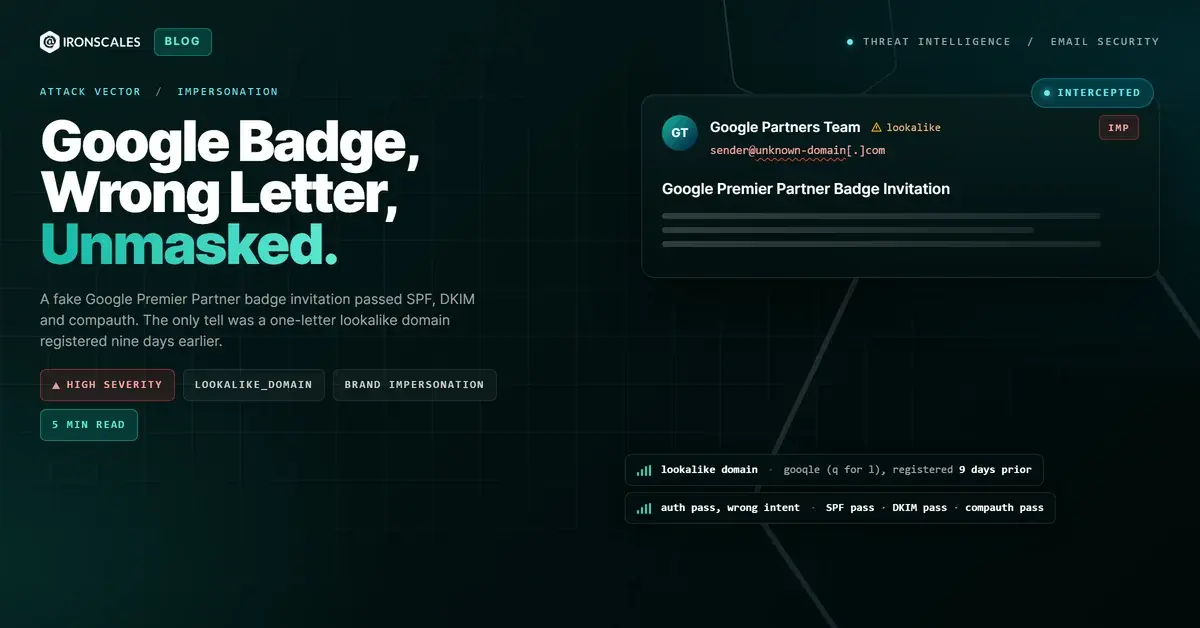
TL;DR A digital marketing employee at a UK IT-services company received a Google Premier Partner Badge invitation, greeted by full name and styled like Google Partners. SPF, DKIM and compauth all passed, and Microsoft filed it to Junk with a spam confidence level of 5. The Accept Invitation button pointed to a lookalike that swaps the l in Google for a q, registered nine days before the send. IRONSCALES quarantined both mailboxes that received it, and a human analyst resolved the incident as malicious. Passing authentication cleared nothing. The spelling of the destination did.
Severity: High Brand Impersonation Lookalike Domain MITRE: T1566.002 MITRE: T1036.005 MITRE: T1583.001
The subject line was "Google Premier Partner Badge Invitation," and every technical check on the message came back green. SPF passed. DKIM passed. Microsoft's composite authentication passed. The only thing wrong with it was a single letter, and it sat in the destination of one button.
The recipient was a digital marketing employee at a UK IT-services company. The email greeted them by full name, said their agency had been chosen for strong Google Ads performance, and was signed "Google Partners Team." The footer carried a Google copyright line. For someone who manages ad spend for a living, this is not a suspicious message. It is a good day at work.
Flattery is the payload
Most phishing manufactures urgency: a locked account, an overdue invoice, a shared file that expires. This one manufactured pride. A badge invitation asks for nothing alarming. It simply says you earned something and gives you a button to claim it.
That matters because the standard training advice, "be wary of urgent requests," never fires. Nothing in the message is urgent. The 2026 Verizon Data Breach Investigations Report puts the human element in 62% of breaches, and lures that reward the reader rather than threaten them are a clean way to reach that human. The 2026 Verizon Data Breach Investigations Report also shows plain phishing making up 80% of the attack mix that email gateways block (Figure 54). Most of it does not look dramatic.
The sender was a person-style mailbox on a domain the tenant had never seen. The display name and the address local-part did not match each other. Small details, easy to miss, and the platform recorded the sender as a first-time sender with a high risk level.
Green authentication, wrong destination
Here is what the delivery hop recorded: SPF pass, DKIM pass, compauth pass. The DMARC result was a permanent error with a policy action of none, so nothing blocked it. Microsoft's filtering scored the message at a spam confidence level of 5 and sent it to the Junk folder rather than stopping it.
That is the result authentication is designed to produce for a message from a domain that signs its mail. It answers "did this domain authorize this send?" It does not answer "is this request real?" A DKIM signature is a proof of origin, not a character reference.
The Accept Invitation button did not point at Google. It pointed through a mail-platform click tracker, which carried the real destination in a redirectTo parameter, to a lookalike domain. That domain replaces the l in "Google" with a q. Read it fast and your brain autocorrects it. WHOIS showed it was created nine days before delivery, fronted by Cloudflare, with the registrant redacted.
Nine days. Long enough to stage a template and send it. Short enough that no reputation feed had a reason to distrust it yet.
See Your Risk: Calculate how many threats your SEG is missing
What the record supports, and what it does not
Precision matters here, so here is the boundary. The landing page was never observed. The only screenshot of it is a generic "404 Page Not Found" with a note that the network environment is not supported, which is a scanner being turned away, not a credential form or a download. This post does not claim either one.
The sender's domain is also a bystander. Its ownership at the time of the send could not be established, and it sent signed mail like any legitimate domain would. Treat it as a channel that was used, not as a proven attacker asset. The attacker-owned asset in this case is the lookalike, which is exactly why the destination is the evidence.
Two mailboxes in the same tenant received the campaign, under two different subjects: the one above, and "Your Google Premier Partner Badge Is Available." Both were quarantined by IRONSCALES, and a human analyst resolved the incident as malicious, which the sender-history record for that domain confirms. The campaign varied its subject line inside a single organization, so a rule keyed to one subject would have caught half of it.
Indicators
| Type | Indicator | Context |
|---|
| Domain | gooqlepartnership[.]com | Final destination of the button; Google lookalike (q for l), registered nine days before delivery, registrant redacted |
| URL | hxxps://gooqlepartnership[.]com/ | Landing URL; payload never observed |
| Subject | Google Premier Partner Badge Invitation | Primary lure subject |
| Subject | Your Google Premier Partner Badge Is Available | Variant sent to a second mailbox in the same tenant |
| Technique | T1566.002, T1036.005, T1583.001 | Spearphishing link, masquerading as a trusted brand, lookalike domain acquisition |
The link technique maps to MITRE ATT&CK T1566.002. The impersonation and the domain purchase are the two supporting behaviors.
The defensive takeaway
Three things stand out for defenders.
First, stop treating a clean authentication header as a verdict. The FBI IC3 2024 report keeps phishing at the top of reported complaint categories. Authentication narrows the field. It does not clear a message.
Second, read the destination, letter by letter. CISA's phishing guidance and the NIST definition of phishing both center on deceiving the recipient into acting on a message that appears legitimate. A lookalike domain is that deception in its smallest form. Branded styling is free. The spelling is the only part the attacker has to pay for.
Third, give weight to who is sending. A first-time sender invoking a household brand to a person whose job touches that brand is a pattern worth flagging on its own. IRONSCALES platform data comes from a community of 36,000+ security professionals across 18,000+ organizations, and that shared visibility, built into the IRONSCALES platform, is how a never-before-seen sender gets recognized as risky before anyone clicks. For teams still relying on a secure email gateway alone, this is the gap: the message cleared the first filter because it was built to.
The badge was never real. The recognition felt earned, and that was the whole attack.
Email Attack of the Day is a daily series from
IRONSCALES spotlighting real phishing attacks caught by Adaptive AI and our community of 35,000+ security professionals. Each post breaks down a real attack. What it looked like, why it worked, and what to do about it.