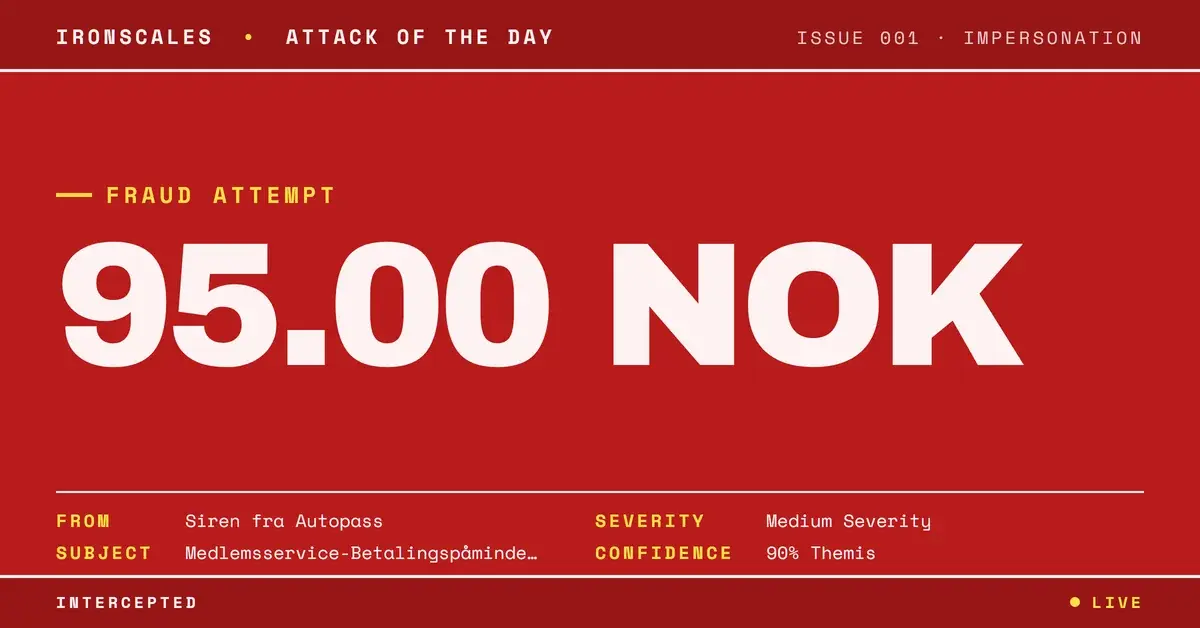
TL;DR A role mailbox at a Norwegian IT consultancy received a payment reminder posing as AutoPASS, demanding 95 NOK: 60 NOK plus a 35 NOK late fee. The message passed SPF and DMARC, so the sender domain checked out. The template did not. The markup declared Danish, the sign-off used the Danish spelling, the footer said Medlemsservice, and a leftover comment named a Renew Membership button. Toll operators have no members, and the bill cited an invoice above that was never shown. Themis flagged the link as malicious and the incident was automatically classified as phishing.
Severity: Medium Brand Impersonation Payment Fraud MITRE: T1566.002 MITRE: T1036
The subject line said Betalingspåmindelse, payment reminder, with a Norwegian flag emoji. The body said the toll was unpaid and the membership might be stopped. Two sentences in, a Norwegian reader should already be asking: what membership?
That question is the whole case. AutoPASS is Norway's road-toll collection brand. You do not join it, and it has no members to suspend. The attacker reskinned a membership-service template and forgot to clean it.
A 95 NOK bill with nothing to pay for
The message reached a single role mailbox at a Norwegian IT consultancy. The display name read "Siren fra Autopass". The body asked for 60 NOK plus a 35 NOK late fee, 95 NOK in total, and pointed to one button labelled "Se og betal faktura" (see and pay invoice).
Look at what a real toll reminder carries: a vehicle registration, a passage date, a toll station. This one said payment for "the invoice above" had not been received. There was no invoice above. No plate, no passage, no station, nothing to dispute or even recognise.
The amount does the work the missing detail cannot. Ninety-five kroner is small enough to just pay. The likely rationale is that nobody opens a ticket over a sum that size. That is our reading of the design, not something the record proves.
Four seams in the kit
The email body is where the template shows its previous life.
- The language tag. The HTML declares
lang="da", Danish, above text written in Norwegian.
- The sign-off. "Med venlig hilsen" is the Danish spelling. Norwegian writes "Med vennlig hilsen".
- The business model. The footer reads "© 2026 Medlemsservice", and the threat is that "medlemskapet" (the membership) may be stopped temporarily if the bill goes unpaid.
- The comment. Directly above the pay button sits an HTML comment:
Add two smaller tells. The page title renders "Betalingsp?mindelse" with a broken character where the å should be, while the subject line rendered correctly. And the line breaks carry stray data-start and data-end attributes, the residue of text pasted out of another rendering environment. We cannot say where the text came from, and we are not guessing.
Together these describe a membership-renewal reminder, built for another country, relabelled as a toll bill. The brand and the amount were swapped. The skeleton was not.
See Your Risk: Calculate how many threats your SEG is missing
Authentication passed, and it did not matter
The sender was a mailbox on an unrelated European domain with no connection to AutoPASS. SPF passed and DMARC passed (policy p=none) for that domain, and the first hop was an authenticated SMTP submission. Those results prove that the domain's server sent the mail. They say nothing about whether the sender is AutoPASS.
Whether that mailbox was compromised or the domain was attacker-registered is not established. WHOIS returned nothing useful, so we will not guess. The sender had also never written to this organization before. This is the pattern the phishing playbook has always exploited: passing authentication tells you which server spoke, not whether the message is honest.
The 2026 Verizon Data Breach Investigations Report puts phishing as initial access in 16% of breaches, and its email gateway mix has plain phishing at 80% of attacks, far ahead of malware and callback lures. Most of what arrives is not exotic. It is a bill with a button.
The landing path and the indicators
The button led to a path on an unrelated Portuguese company website. We are not naming that site, and nothing in the record shows its owner did anything wrong. By analysis time the path returned HTTP 404, so we do not know what the page collected. We describe it only as a pay-the-invoice page.
| Type | Indicator | Context |
|---|
| URL path shape | hxxps://unrelated-portuguese-site[.]tld/eea/NO<9 digits>/ | Pay-button landing on a third-party site, 404 at analysis |
| IP | 185[.]206[.]151[.]181 | Client that made the authenticated submission |
| IP | 212[.]96[.]173[.]4 | Outbound relay of the sender domain's mail provider, listed as IP only |
| Sender | a mailbox on an unrelated .eu domain | Envelope and header sender, authentication passed |
| Subject | Medlemsservice-[flag]Betalingspåmindelse | Payment reminder subject |
This maps to MITRE ATT&CK T1566.002, spearphishing via link, with brand masquerading layered on top.
What caught it
Themis assessed the message at 90% confidence, and the link in the button was flagged as malicious. The incident was automatically classified as phishing, with no human analyst needed to resolve it. No mitigation action was recorded in the incident, so we make no claim about what happened to the message afterwards.
That matters because a rule-based filter has little to grab. The sender authenticated. There was no attachment and no QR code. A secure email gateway judging reputation sees a clean first-time sender with a single link. Behavioral analysis through IRONSCALES Adaptive AI is built to ask a different question: is this message consistent with who claims to have sent it?
Teach the ten-second check
You can give your people a test that needs no tooling. Does the sender's business actually have this relationship with me? A toll operator has no members. A utility has no "Renew" button. A reminder that cites an invoice should show you the invoice.
The FBI's 2024 IC3 report and CISA's phishing guidance both stress reporting suspicious messages over quiet deletion. IRONSCALES platform data reflects the same loop, drawing on 36,000+ security professionals across 18,000+ organizations who report and confirm what filters miss.
Small bills teach the habit of paying without checking. The seams are usually there if someone looks.
Email Attack of the Day is a daily series from
IRONSCALES spotlighting real phishing attacks caught by Adaptive AI and our community of 35,000+ security professionals. Each post breaks down a real attack. What it looked like, why it worked, and what to do about it.