TL;DR A phishing email posing as a Swiss road-toll authority skipped the usual threat. A named clerk said he had personally blocked a 200 CHF fine for 48 hours and offered to close the file for a 40 CHF goodwill payment. The message came from a self-hosted mailing-list server, passed SPF at the recipient's first gateway, was scored clean by the threat scanner, and reached inboxes at SCL -1. Nothing technical fired. The pretext gave it away: a user reported it, and an analyst resolved it as malicious. The same sender ran an Austrian twin.
Severity: Medium Government Impersonation Payment Fraud MITRE: T1566.002 MITRE: T1204.001
The email did not threaten anyone. It offered a favour.
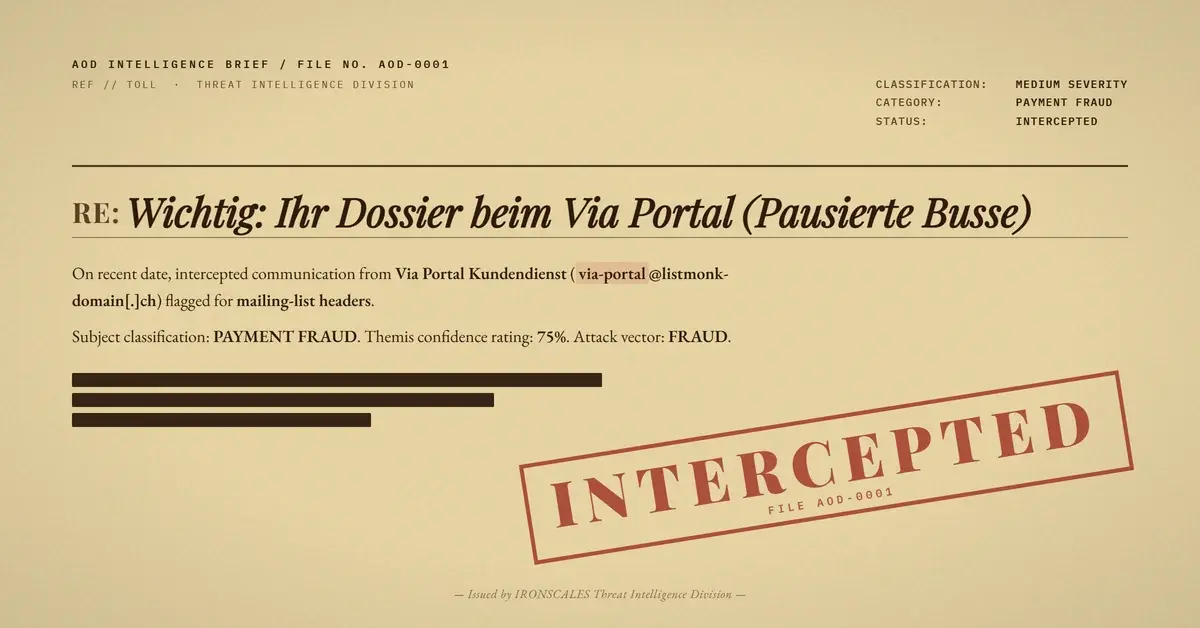
A "clerk" at a Swiss road-toll portal wrote that he was contacting the recipient personally, before the case went to the cantonal police. He had, he said, manually blocked the automatic postal dispatch of a 200 CHF fine for 48 hours. Under an internal goodwill rule, the recipient could activate the missing annual E-Vignette retroactively for 40 CHF and the file would be deleted.
That is the whole attack. A fine, a deadline, and a stranger apparently on your side.
The favour is the pressure
Most government-impersonation phishing leads with consequences. Pay now or face enforcement. Recipients have been trained to spot that tone, and filters key on it.
This lure inverts it. The sender casts himself as the recipient's ally against his own automated system. The 200 CHF figure is the anchor, and 40 CHF looks like a bargain next to it. The 48-hour window turns urgency into generosity: he stuck his neck out, and the offer expires. The only hint of menace is a single line about criminal proceedings with "substantially higher costs", and it reads as friendly advice.
It is borrowed authority done carefully. The body carried the branding of the Swiss federal customs office (BAZG) and "E-Vignette Schweiz | Via Portal", a dossier number (CH-2026-X94B), a citation of the national road-charge law, and a claim that road cameras had seen no valid vignette. The subject line promised a "Dossier" with "paused fines". It was signed by a named persona from a "toll control department".
This is a different shape from the tax-authority lures we have covered. Those lean on format, authentication or sender mismatch. This one leans on tone. It is a road-toll fine, not a tax demand, and the psychology is closer to a salesperson's "I can only do this today" than to an enforcement letter.
One template, two countries
The same sending domain sent a second message the same day, rebranded for Austria. The display name became "Mautservice Österreich" and the subject offered a "Kulanzangebot", a goodwill offer for retroactive vignette payment. Same leniency pretext, new flag.
The target was a Swiss building products manufacturer, and four mailboxes across two of its domains received the Swiss version. One recipient was a field-based technical adviser.
Nothing technical fired
The delivery path is the uncomfortable part.
The message was relayed through a self-hosted Listmonk newsletter server on a long-registered third-party domain. It reached the organization's own on-premises gateway, where SPF passed and the threat scanner returned Negative with an outbreak level of zero. The gateway tagged the subject and added an external-mail banner, then relayed the message into Microsoft 365 over the organization's connector, where it was delivered at SCL -1. The single link scanned Clean. There was no attachment.
The link itself pointed at an unrelated business's ordinary contact page, which asked for nothing but an email address when it was analyzed. The IRONSCALES analysis could not establish a harvest page, a payment form or a redirect chain, and it could not establish that anyone clicked or paid. What it established is the message's intent: a payment-diversion lure, resolved as malicious by a human analyst after a user reported it.
The tell was the pretext. A government notice that arrives with mailing-list headers and a campaign identifier is not a government notice. A federal agency does not pause its own system as a personal courtesy. Neither fact appears in a reputation feed.
| Type | Indicator | Context |
|---|
| IP | 107[.]189[.]7[.]143 | Sending MTA at the first inbound hop |
| Display name | Via Portal Kundendienst | Swiss-branded sender persona |
| Display name | Mautservice Österreich | Austrian twin, same day |
| Subject | Wichtig: Ihr Dossier beim Via Portal (Pausierte Busse) | Swiss lure subject line |
| Reference | CH-2026-X94B | Fabricated dossier number |
| Header | X-Listmonk-Campaign | Mailing-list platform header on a "government" notice |
See Your Risk: Calculate how many threats your SEG is missing
The mapping is simple. The delivery is MITRE T1566.002 (spearphishing link), and the payoff depends on user execution through a single click (T1204.001).
What this means for your controls
Every control that failed here is working as designed. A secure email gateway (SEG) judges reputation, authentication and known-bad content. This message had a clean path and clean content, so it passed. Layering another reputation check on top will not change that outcome.
The 2026 Verizon Data Breach Investigations Report found that 62% of breaches involve the human element, and that 16% of breaches use phishing as initial access. Pretexting accounts for 6% of initial access vectors. Those are the attacks that depend on a story, not a payload. The same report says AI-assisted text in malicious emails doubled year over year, and that its impact is operational: attackers write more convincing messages at scale, not new techniques. A localized, personally voiced favour in German is exactly the kind of message that gets cheaper to produce.
Three practical points follow.
Read the offer, not just the threat. Add discounts on penalties, personal exceptions and "I paused it for you" to your phishing training alongside urgency and fear. CISA's phishing guidance and the NIST definition of phishing both describe deception through trusted identity, and a friendly official is still a trusted identity.
Look for infrastructure that contradicts the sender. Mailing-list headers on a government message are a content-level signal. Detection that reads language and context, such as the IRONSCALES Adaptive AI approach, can weigh that mismatch where a reputation engine sees nothing. IRONSCALES platform data comes from 36,000+ security professionals across 18,000+ organizations, and user reports feed that loop, as they did here.
Report the quiet ones. Nothing in this message was loud. A user reported it, and a human analyst confirmed it as malicious. The FBI IC3 2024 report documents how much money moves through fraud that starts with a believable message. Make reporting a one-click habit, and treat phishing that sounds helpful as seriously as phishing that sounds hostile.
The attacker's best line was not a threat. It was "I did this for you."
Email Attack of the Day is a daily series from
IRONSCALES spotlighting real phishing attacks caught by Adaptive AI and our community of 35,000+ security professionals. Each post breaks down a real attack. What it looked like, why it worked, and what to do about it.