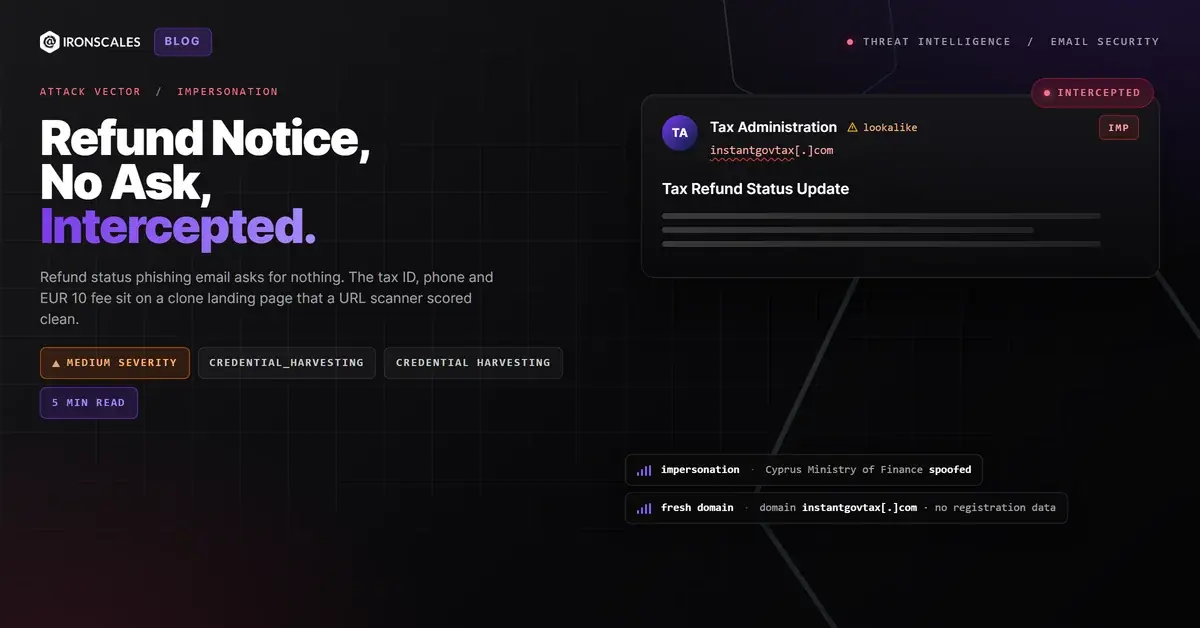
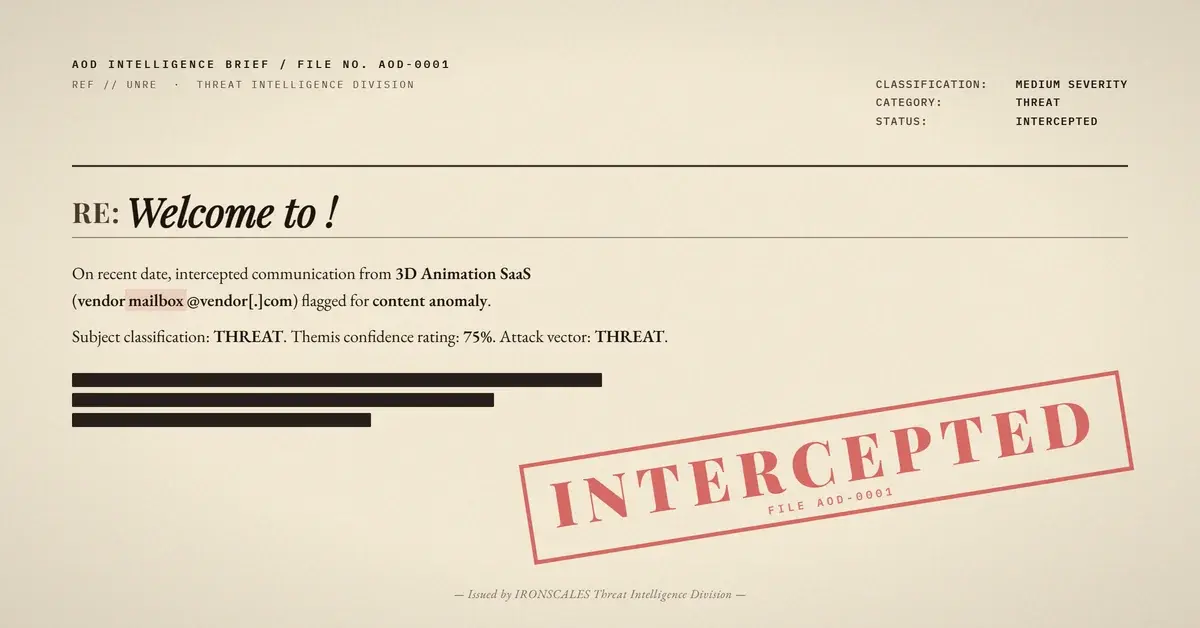
TL;DR A Greek-language email styled as a Cyprus tax department refund status update asked its reader for nothing: no amount, no deadline, no form, no fee. One button led to a government clone page that asked for a tax registration number and a phone number, and printed a EUR 10 processing fee netted against a EUR 338.81 refund. The link scanner scored both free hosting pages clean. A control that reads only the message body had nothing to score, and the visible artifact was the page itself. The step after Continue was not observed, so no payment is claimed.
Severity: Medium Brand Impersonation Credential Harvesting MITRE: T1566.002 MITRE: T1656 MITRE: T1598.003
The email said a tax refund had been processed. Then it asked for nothing at all.
No amount. No deadline. No attachment, no form, no fee, no request for a password. A Greek-language "tax refund status update" arrived in the mailbox of a section head in the payments department of a Greek electric utility group, styled as the Republic of Cyprus Ministry of Finance, with a single button labelled "Go to the Official Website".
That emptiness is the design.
An ask-free email gives a filter nothing to score
Most phishing triage starts with the ask. Urgency, a payment demand, a credential prompt, a threat. This message carried none of them. It said the refund application "has been completed" and told the reader to check status through official electronic services. It even included a notice telling the reader to use only the official tax department sites.
A reader skimming it sees a status update. A content filter sees a status update. Neither has a hook.
The whole fraud sat one click away. The button opened a clone of a tax department VAT refund summary, with a coat of arms, a department header and a "Tax for All" banner. The same page appeared at two free hosts, and the two screenshots were pixel-identical.
What the landing page asked for
Only the landing page carried the ask:
- A field for a tax registration number (AFM).
- A phone field prefilled with the Cyprus country code.
- A pale "Continue" button.
- A sentence stating that a EUR 10 fee is charged for automatic submission of the form.
The refund table did the persuading. Purchases subject to VAT came to 252.57, other expenses to 86.24, a total refund of 338.81, and a line for an "automatic processing fee" of minus 10.00. The arithmetic adds up. A believable table makes a EUR 10 fee feel like routine friction rather than a request.
The page is also where the lure slipped. The label on the tax ID field misspells the Greek word for "tax" in "tax registration number", a small error on a page built to look official. The screen shows what the visitor would hand over before anything else: an identifier and a phone number, both useful for later contact or targeting.
Here is the limit of the evidence. Only the first screen was captured. No card field, payment form or step after Continue appears in any artifact. This post does not claim card data was collected or any payment taken. It claims what the page states and requests.
The scanner said clean, the page said otherwise
The link scanner reached both landing hosts and returned "clean" for each. That is not a scanner failure in the simple sense. Both addresses were subdomains on shared free hosting platforms, and the platforms themselves are not the problem. A verdict on an address cannot read a page that impersonates a government.
So two controls had nothing to work with. A body-only control saw an email that asked for nothing. A URL-reputation control saw two clean addresses. The visible artifact was the page's own refund table, readable only by something that renders the destination and compares it against the claim in the email.
Compare that with other fee lures in this series, where the demand sits in the message itself and the body is the evidence. Here the message is deliberately bare, and the evidence moved downstream.
One more detail from the delivery. The recipient's own external-sender warning banner, carrying the utility's logo, sat directly above the Cyprus government header. One message showed two institutions at once, and only one of them was real to the reader.
How it played out
The first copy landed in the Junk folder and was moved to quarantine after the end user reported it, noting they did not know the sender. A human analyst resolved the incident as malicious. A second copy from the same sender, with a trailing full stop added to the subject, was quarantined on arrival.
The cross-border mismatch was visible to anyone who looked: a Cyprus-branded notice with a Cyprus phone prefix, delivered to a Greek-language recipient at a Greek utility. Nothing tied the refund figures to anything in the email.
See Your Risk: Calculate how many threats your SEG is missing
Indicators
| Type | Indicator | Context |
|---|
| Sender domain | instantgovtax[.]com | Sender and return-path domain, unrelated to any government; no registration data available |
| Sender mailbox | A mailbox at instantgovtax[.]com | Display name "Tax Administration" |
| URL | hxxps://taxiesgoversteamwor48c0c[.]myclickfunnels[.]com/fbb7a4cddd | Button destination, tax department VAT refund clone on a shared hosting platform |
| URL | hxxps://taxiesnetcyprus[.]web[.]app/ | Mirror of the same clone on a free hosting subdomain |
| Subject (translated) | "Tax Refund Status Update" | Greek original, ask-free status wording |
The platforms hosting the pages are shared services, and only the customer subdomains and their content belong to the lure. Official Cyprus tax domains appear nowhere in the message links.
What to do with an empty email
This maps to MITRE ATT&CK T1566.002, a spearphishing link, with impersonation of a government body and information gathering through the landing page.
The 2026 Verizon Data Breach Investigations Report puts the human element in 62% of breaches and phishing as the initial access vector in 16%. Credentials appear in 39% of breaches across the full kill chain. A tax ID and a phone number are exactly what feeds the next stage, whether that is a follow-up call or a targeted message. The FBI IC3 2024 report and IBM Cost of a Data Breach both frame the cost of letting that chain run, and CISA phishing guidance describes the cycle this email is the first phase of. NIST defines phishing as exactly this kind of attempt to obtain information through deception.
Three practical points follow.
- Judge the destination, not just the message. Rendering the landing page and comparing what it requests against what the email claims is the control that catches a deferred ask. Advanced malware and URL attack protection belongs in that conversation.
- Treat a clean address verdict as one input. Shared hosting makes reputation weak evidence in both directions.
- Keep the user report loop short. Here the human report is what moved the first copy to quarantine. The IRONSCALES platform combines that signal with Adaptive AI analysis, drawing on IRONSCALES platform data from 36,000+ security professionals across 18,000+ organizations.
An email that asks for nothing is not a safe email. It may simply have moved its ask somewhere the first control never looks.
Email Attack of the Day is a daily series from
IRONSCALES spotlighting real phishing attacks caught by Adaptive AI and our community of 35,000+ security professionals. Each post breaks down a real attack. What it looked like, why it worked, and what to do about it.