TL;DR A fake document-share email, built from Gmail-composer HTML, closed with a legal-style footer certifying a legitimate business communication between two organizations. Neither organization was the sender, and neither matched the purchase-order subject or the document card. The disclaimer asserted legitimacy while its own named parties contradicted the message. The verdict here was automated, the landing page was never observed, and the sender was a bystander vendor whose account sent the mail. The practical lesson is simple: when a footer certifies a relationship, check whether the parties it names are the parties in the conversation.
Severity: Medium Malicious Link Credential Harvesting MITRE: T1566.002
The most revealing line in this phishing email was not the link. It was the footer, which certified that the message was "a legitimate business communication from organisation A to you regarding a business proposal," sent "because of an existing or potential business relationship with organisation B."
Neither organization was the sender. Neither appeared in the subject, the document card or the button. Two companies that had nothing to do with the message were vouching for it.
A disclaimer that names the wrong parties
The email reached a member-services employee at a wholesale grocery cooperative. Its subject was a purchase-order attention notice, and the body was a Google-Drive-style card: a sender line, a document name, a blue REVIEW DOCUMENT button and a link labelled with a long quote-and-PO filename ending in .pdf.
That filename was a web link, not a file. There were no attachments, no QR codes and no images carrying text. One link, shown twice, was the entire payload.
The footer sat under the card. Its sentence structure, with the names replaced, read: "This email is a legitimate business communication from organisation A to you regarding a business proposal. This is not unsolicited commercial email (UCE) or spam. You are receiving this email because of an existing or potential business relationship with organisation B." A contact line followed, masked in the record.
The sender was a third company altogether. The disclaimer's parties matched neither the sender name, nor the PO subject, nor the document card. That is the tell: a certification of legitimacy whose own facts contradict the message around it.
Gmail fingerprints in the card markup
The card's HTML used class names such as gmail-sender-info, gmail-document-name, gmail-document-link, gmail-footer and gmail-disclaimer. Directly above the disclaimer sat an empty footer div, the kind of residue left when a block is deleted but its container is not.
Together these suggest a card composed in Gmail and a disclaimer pasted in from an unrelated template. The author did not write a footer for this sender. They reused one.
The message also addressed itself, with the sender's address in the To line and the five real recipients hidden. That pattern has its own write-up elsewhere in this series, so it gets one sentence here and no more.
What the record does and does not show
Precision matters on this one, so here is the evidence boundary.
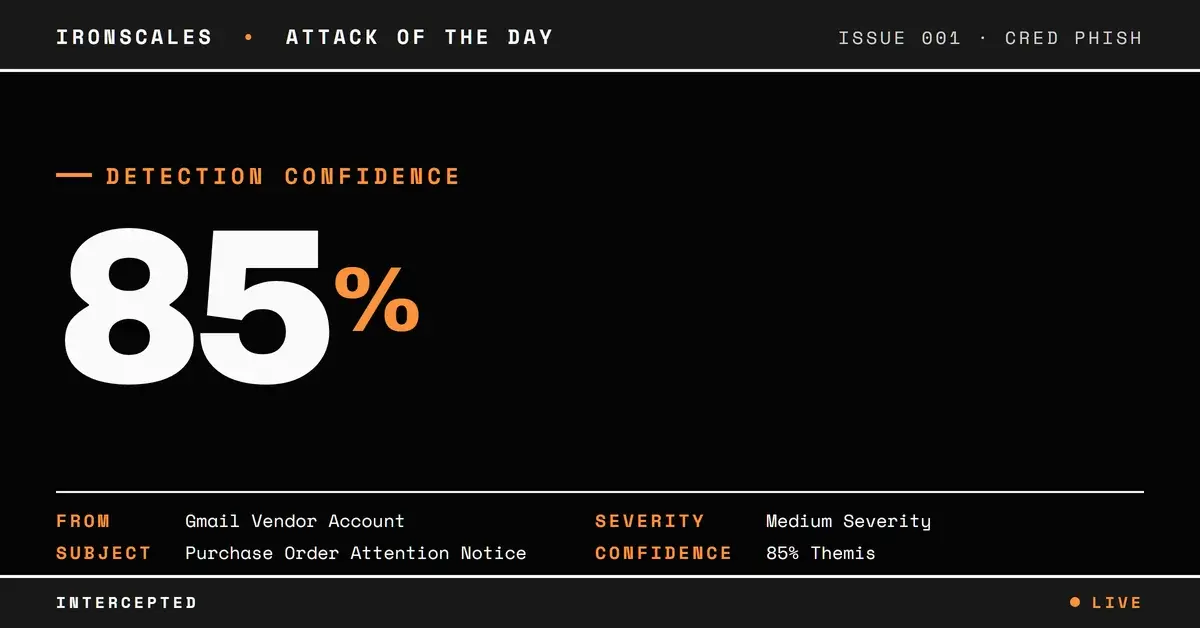
- The verdict was automated. The incident was automatically resolved as phishing. Themis, the IRONSCALES agentic AI virtual SOC analyst, scored it with confidence 85 and labelled it credential theft and VIP recipient. No human analyst confirmed the verdict. The message was quarantined.
- The landing page was not observed. The link verdict came back partial. Credential theft is Themis's inference from the lure pattern, not a captured form.
- The destination is a subdomain on a hosted-site platform. It was a single generated hostname, so blocking the platform's parent domain would be wrong.
- The sender is a bystander. DKIM-signed mail left Gmail for an established vendor domain with recorded prior correspondence. The record does not prove compromise, spoofing or intent. It is a small vendor whose account sent the message, and the vendor is not the attacker.
The tenant's own URL rewriting wrapped the link before delivery. That wrapper is the recipient's gateway, not attacker infrastructure, and it is not evidence of anything.
Reading the footer as evidence
This maps to T1566.002, phishing with a link. The delivery mechanics are ordinary. What stands out is that the lure paid for a compliance paragraph and then failed to proofread it.
See Your Risk: Calculate how many threats your SEG is missing
A secure email gateway (SEG) judging this message at the perimeter saw a clean, DKIM-signed, aged-domain sender with no attachment. Nothing in that checklist reads the footer. Yet the footer was the only part of the message that disagreed with itself.
The 2026 Verizon Data Breach Investigations Report puts phishing at 16% of initial access and the human element in 62% of breaches. Its email gateway attack mix is 80% plain phishing, 10% malware-laden, 5% callback and 3% business email compromise (BEC). Plain phishing, a single link and a believable card, is the bulk of what arrives. The FBI IC3 annual report and CISA's phishing guidance both stress the same user habit: check who is actually asking you to act.
IOC table
| Type | Indicator | Context |
|---|
| Domain | instant-gz818ir[.]runable[.]site | Destination of both links; landing page not observed; a subdomain on a hosted-site platform, so do not block the platform's parent domain |
| URL | hxxps://instant-gz818ir[.]runable[.]site | Link target before the recipient-side gateway rewrite |
| Mailbox | A Gmail-hosted vendor mailbox | Sender and To address; a bystander vendor account, not the attacker |
| String | "legitimate business communication from organisation A ... business relationship with organisation B" | Footer certification naming two unrelated organizations |
| HTML | gmail-disclaimer, gmail-footer (empty) | Card composed in Gmail with a pasted footer |
The takeaway for analysts and users
Teach one habit: read the footer's parties against the sender. A genuine disclaimer names the company that sent the mail. A pasted one names whoever the template's last author cared about.
For detection, treat a mismatch between the organizations in a certification and the organizations in the thread as a feature in its own right. An agentic analyst such as Themis can weigh signals like this alongside sender history and link behavior, and the credential harvesting protection approach covers the click that follows. For background on the broader category, see the IRONSCALES phishing glossary entry and the NIST definition.
A disclaimer is just text. Anyone can paste one, and this one proved it by vouching for the wrong people.
Email Attack of the Day is a daily series from
IRONSCALES spotlighting real phishing attacks caught by Adaptive AI and our community of 35,000+ security professionals. Each post breaks down a real attack. What it looked like, why it worked, and what to do about it.