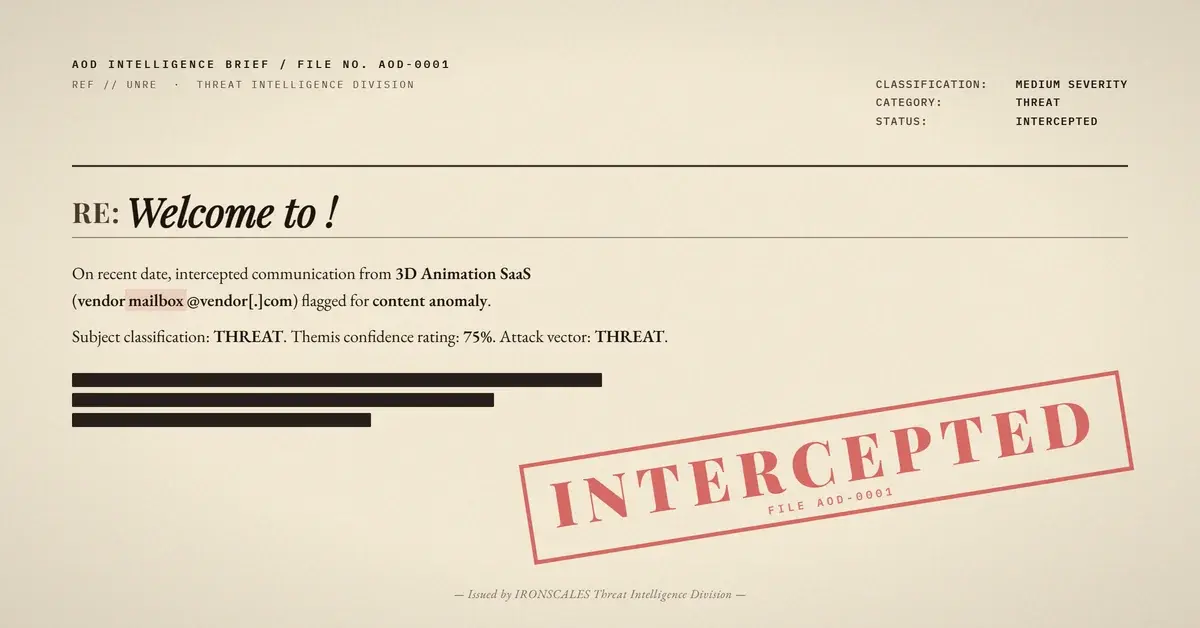
TL;DR A senior executive at a UK recruitment agency received a real, correctly authenticated welcome email from a 3D-animation software vendor for an account nobody requested. The text sitting where a greeting name would render claimed a Coinbase card had been topped up and told the reader to withdraw the funds and send proof of receipt to a chat. That is money-mule recruitment, not credential theft. The activation button was genuine and irrelevant. The failed authentication at the final hop came from the recipient's own gateway rewriting links, not from the attacker.
Severity: Medium Advance Fee Fraud Money Mule Recruitment MITRE: T1566.002
The email was real. The sender was real. The activation button worked. The only fake part was the first line, where a greeting name should have been.
A senior executive at a UK recruitment and staffing agency in the energy and engineering sector received a "Welcome to..." message from a 3D-animation SaaS platform. They had not asked for it. Their own address was printed back at them as the account username.
Above the standard "you've just been signed up" paragraph sat something else. It was wrapped in diamond emoji and read like a greeting that had swallowed a sales pitch: a claim of a Coinbase partnership, a card "topped up" with a three-decimal dollar amount, a link, and an instruction to withdraw the funds and send proof of receipt to the Coinbase online chat. A stray comma sat right after the closing emoji, exactly where the comma after a salutation and a first name would go.
Bait in a slot the vendor fills for you
We cannot say how the text got there. The signup was never observed, and the record does not show who submitted the address. What the body shows is structure: the bait sits where a greeting name would render, its inline styling differs from the rest of the template, and everything below it is untouched vendor boilerplate.
That is the point. The attacker did not need to forge a sender, spoof a domain or compromise a mailbox. The vendor's own pipeline composed, signed and delivered the message. The reader's own address even made it look personalized.
This is a different shape from the pattern where attacker text drives a platform's subject line, and from the cases where a platform mailer leaves no sender to block. Here the lure is a single paragraph in a greeting position, and the template around it is a decoy of legitimacy.
What the lure actually asks for
This is not credential theft. The activation button was the vendor's real one, and the username line was real. Neither is the scam.
The instruction is to withdraw money and report back. That is advance-fee and money-mule recruitment dressed as a windfall: a "balance" appears, the reader is invited to move it, and the reader is steered toward a chat for the next step. The dollar figure is attacker text with no currency authority behind it. It should not be read as a real balance, and the record does not show whether any money moved.
The link opens a page on a public publishing platform, titled "IBQ", with a Coinbase Card hero image and a single CONTINUE link. Nothing past CONTINUE was observed. The platform is a general-purpose host, and only that one page is attacker-authored.
The 2026 Verizon Data Breach Investigations Report puts pretexting at 6% of initial access vectors, and its gateway-blocked mix is 80% plain phishing, 10% malware-laden, 5% callback and 3% BEC. A message like this one is none of those categories cleanly. It carries no attachment, no QR code and no credential form.
See Your Risk: Calculate how many threats your SEG is missing
Green at origin, red at the end
Authentication tells an unusual story here. At the first hop inside the recipient's environment, the message passed DKIM for the vendor's domain, passed DMARC at policy none, and passed SPF for the vendor's mail subdomain.
At the final Microsoft 365 hop, all three showed fail. The sender IP there was the recipient's own inbound gateway, relaying after it rewrote every link in the message. Rewriting changes the body, so the DKIM body hash no longer matches. The origin signature hash and the later hash differ, while the two ARC instances agree with each other, which is what a recipient-side rewrite looks like.
So the failure is a gateway artifact, not attacker tampering. This is the reverse of the usual lesson. It is normally "green authentication on a bad mail." Here it is red authentication on a message whose origin was clean. Neither colour tells you whether the paragraph is safe.
Indicators
| Type | Indicator | Context |
|---|
| URL | hxxps://graph[.]org/IBQ-06-25 | Attacker-authored page on a public publishing platform, Coinbase Card hero, CONTINUE link, rated malicious |
| Sender | A mailbox at the vendor's own domain | Genuine vendor sender, bystander, not attacker infrastructure; address withheld |
| Subject | Welcome to ! | Genuine template, abused greeting position |
| Technique | T1566.002 | Spearphishing link |
The host domain is listed only because the link lives there. It is a public platform, not an attacker domain, and blocking it wholesale would be the wrong response.
Where the signal is
Sender reputation, domain age and authentication all pointed the wrong way on this message. The detectable signal was the content: a crypto-withdrawal instruction inside a software-welcome template, plus a malicious-rated link. A human decision resolved the incident as malicious.
Defenders should treat the body, not the envelope, as the unit of analysis for platform-generated mail. IRONSCALES platform data comes from 36,000+ security professionals across 18,000+ organizations, and cases like this one are why content-level analysis alongside a SEG matters: a gateway that trusts the sender has nothing to say about a paragraph.
The FBI IC3 2024 report, CISA phishing guidance and the NIST phishing definition all frame the human as the last control. For this one, the instruction to the reader was simple: do not withdraw, do not reply, do not open the chat.
Email Attack of the Day is a daily series from
IRONSCALES spotlighting real phishing attacks caught by Adaptive AI and our community of 35,000+ security professionals. Each post breaks down a real attack. What it looked like, why it worked, and what to do about it.