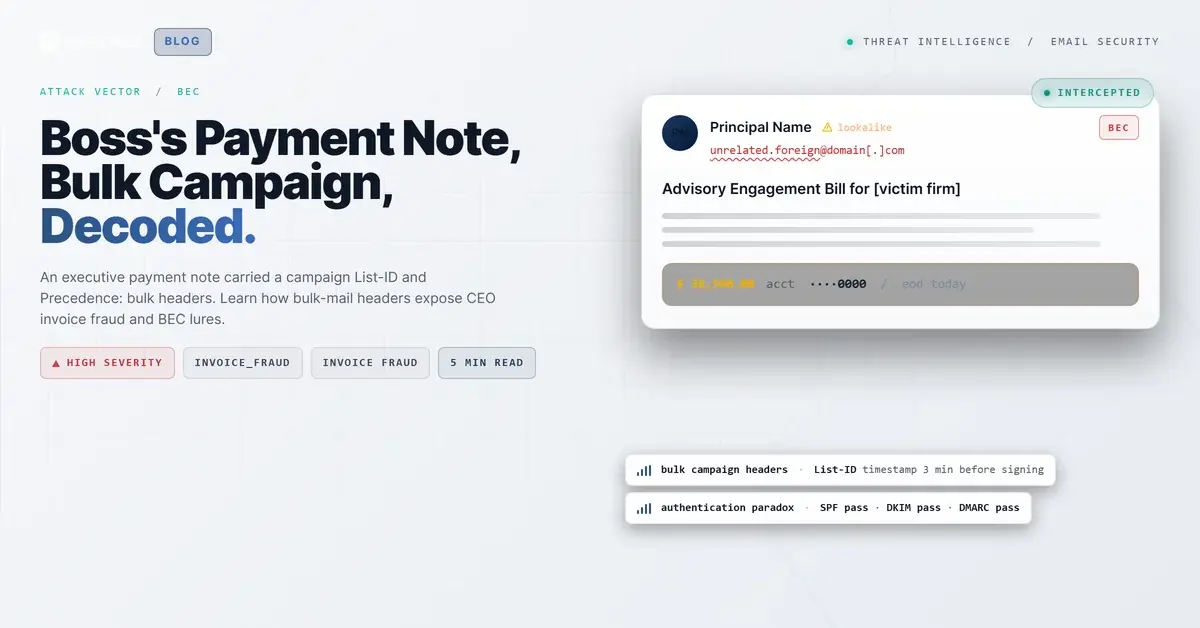
TL;DR A UK IT consultancy's shared Accounts mailbox received a one-line payment instruction under the name of the firm's own principal. The headers exposed it as mass mail: a campaign List-ID whose millisecond timestamp predates the DKIM signature by three minutes, a Precedence: bulk line and an X-Entity-ID tag, all present when the message was signed. The rendered invoice below it was billed to the victim, addressed to the same principal ordering payment, with a free-mail remittance address. A human analyst confirmed it malicious and the message was removed from the mailbox.
Severity: High Business Email Compromise Invoice Fraud Executive Impersonation MITRE: T1566 MITRE: T1078 MITRE: T1585.002
The payment instruction was one line long, signed with the name of the firm's own principal, and sent to the shared Accounts mailbox. Its headers said it was a mass mailing.
The message carried List-ID: campaign-1794477973564.[sending domain], a Precedence: bulk line, an X-Entity-ID: TC13wCBn2ZZ1PZnS tag and an X-Complaints-To abuse address. That is the plumbing of a campaign run. Nobody typing a quick note to their finance team produces any of it.
The target was a small UK IT and cloud-security consultancy. The lesson is simple: a supposedly personal executive request should never arrive wearing bulk-mail headers.
A personal note stamped with a campaign ID
Human mail clients do not add a List-ID to a message for a colleague. That header exists so list software and receiving systems can identify a mailing list or campaign. Precedence: bulk is an old convention that tells auto-responders to stay quiet. Entity tags and complaint addresses belong to senders managing volume.
The number inside the List-ID is more interesting than the header itself. 1794477973564 is a millisecond Unix timestamp, and it decodes to 10:06:13 UTC on 12 November 2026. The DKIM signature's own t= value, 1794478153, decodes to 10:09:13 UTC. The Date header reads 10:09:07.
The campaign identifier existed three minutes before the "personal" note was signed.
The record does not show which software stamped that List-ID, and we are not going to guess. It does show that the header was present when the message was signed. The DKIM h= list covers List-ID, From, To, Reply-To, Subject and Date, so the campaign stamp and the free-mail Reply-To were both part of the message as signed, not bolted on downstream.
The invoice is addressed to the person ordering payment
The instruction asked Accounts to pay a supplier invoice rendered directly below it. It added that the supplier's 30% discount had lapsed on Friday, but the supplier had agreed to honour it anyway. That line does one job: it pre-explains why the invoice is past due and why the amount is an odd, reduced figure.
There was no attachment and no link. The invoice was HTML in the body, dated 7 October 2026 and due 6 November 2026, with a subtotal of GBP 55,085.71, a 30% discount of GBP 16,525.71 and a total of GBP 38,560.00. The arithmetic holds up.
Look at who it was billed to. The victim firm, "Attn" the same principal whose name signed the instruction to pay it.
That closes the loop. The usual control for a payment request is to call back the person asking. Here the person asking and the person billed are the same executive, so the email has already vouched for itself.
Three other details do not fit:
- The subject read "Advisory Engagement Bill for [victim firm]", but the line items were "platform & licensing" and "Implementation & support". Nothing advisory.
- The VAT line read "VAT (20%) · reverse charge" at GBP 0.00, between a London-addressed supplier and a UK recipient. That is unusual for a domestic UK supply.
- BACS details were printed, but remittance went to a free-mail mailbox, and replies went to a different free-mail address than the one in From.
Authentication proves the route, not the author
The earliest Received hop records an authenticated ESMTPSA submission. The client announced itself as [127.0.0.1], and the provider logged the real peer, 198.13.63.219. The message went out through an unrelated, long-established overseas company's own mail service with a valid login. That company is a bystander, and nothing in the record shows it did anything wrong.
At the Microsoft current hop: spf=pass, dkim=pass, dmarc=pass, compauth=pass, SCL 1. Every check confirmed the route. None of them could say who wrote the note.
MITRE mapping: T1566 Phishing for the lure, T1078 Valid Accounts for the authenticated submission, and T1585.002 Email Accounts for the two free-mail mailboxes that collect replies and remittance.
The 2026 Verizon Data Breach Investigations Report puts the human element in 62% of breaches and pretexting at 6% of initial access vectors. Its gateway data (Figure 54) shows BEC at 3% of the attacks email gateways blocked. A message like this one, fully authenticated and link-free, is the kind a gateway has little to block on.
See Your Risk: Calculate how many threats your SEG is missing
Indicators from the header and the body
| Type | Indicator | Context |
|---|
| Header | List-ID: campaign-1794477973564.[sending domain] | Bulk campaign ID; timestamp 10:06:13 UTC, three minutes before signing |
| Header | Precedence: bulk | Bulk-mail marker on a "personal" executive note |
| Header | X-Entity-ID: TC13wCBn2ZZ1PZnS | Bulk-mailer entity tag |
| IP | 198[.]13[.]63[.]219 | Authenticated (ESMTPSA) submitting client, announced HELO [127.0.0.1] |
| Email | replnn@email[.]com | Reply-To, attacker-controlled free-mail mailbox |
| Email | account@europemail[.]com | Remittance address printed in the invoice |
| Subject | Advisory Engagement Bill for [victim firm] | Subject contradicts licensing line items |
How it was caught
Microsoft's first-contact banner fired on the message, because the sender had never written to the organization before. The display name was the firm's own principal, the address belonged to an unrelated foreign domain, and the Reply-To pointed somewhere else again.
The IRONSCALES crowdsourced threat intelligence layer, drawing on 36,000+ security professionals across 18,000+ organizations, flagged it as phishing. A human analyst reviewed it and confirmed it malicious, and the message was removed from the mailbox.
Check for headers no human writes
The FBI IC3 2024 report again ranks business email compromise (BEC) among the costliest crimes it tracks, and the Microsoft Digital Defense Report 2024 documents how heavily attackers lean on valid identities. Passing DKIM is table stakes for these lures now. The tells live elsewhere.
- Flag executive display names with bulk headers. A mail-flow rule that matches an internal leader's name on external mail carrying
List-ID or Precedence: bulk is cheap and has almost no legitimate hits.
- Break the closed loop. If an invoice is addressed to the executive instructing payment, verify with that executive through a known channel, never by reply.
- Stop on free-mail remittance. No real supplier collects remittance advice at a consumer mailbox.
- Read the invoice against the subject. "Advisory" billed as licensing, and reverse-charge VAT on a domestic supply, are inconsistencies a trained payables clerk can spot.
CISA phishing guidance makes the same point about verifying payment changes out of band. Pair that discipline with business email compromise protection that reads the whole message, headers included.
The note looked like one line from the boss. Its own headers said it was one copy of a campaign.
Email Attack of the Day is a daily series from
IRONSCALES spotlighting real phishing attacks caught by Adaptive AI and our community of 35,000+ security professionals. Each post breaks down a real attack. What it looked like, why it worked, and what to do about it.