Part 2 of a 4-Part Series: The SEG Breakup Guide for MSPs
You know that feeling when you see another MSP at a conference, and they're genuinely excited about their email security? They're not complaining about quarantine queues or late-night remediation calls. They're talking about growth, taking on new clients, actually having time for strategic work.
And you think: maybe things could be better for me.
That thought doesn't go away. It sits there while you're explaining to another client why that vendor impersonation email made it through. While you're updating rules for the third time this month. While you're watching competitors win deals by offering demonstrably better protection.
So you start looking at the numbers. Not because you want to rip everything out tomorrow, but because you need to know if what you're feeling is real.
The Data You've Been Avoiding
Here's what modern MSPs are seeing across the industry.
In 2025, analysis of nearly 2,000 customer environments using a SEG alongside an Integrated Cloud Email Security solution revealed a gap that most MSP owners suspected but couldn't quantify. On average, SEGs miss 67.5 phishing emails per 100 mailboxes every month.
Not over a year. Not in some theoretical scenario. Every single month.
If you're managing 5,000 mailboxes across your client base, that's potentially 3,375 missed threats monthly. That's 3,375 opportunities for a client breach, a support ticket, an insurance claim, or a lost account.
But it gets worse when you look at who's most at risk. Small businesses face up to 7.5 times more missed attacks than large enterprises. And if you're an MSP, small and mid-sized businesses are your bread and butter. The clients who trust you to make the right technology decisions are the ones most exposed.
What's Getting Through
The attacks bypassing SEGs aren't random spam that users catch with common sense. These are sophisticated, targeted threats designed to look legitimate.
Vendor scams represent 30-40% of missed attacks across all major SEG providers. These are emails that appear to come from trusted suppliers, requesting invoice payments or account updates. They pass authentication checks. They don't contain obvious malware. They just ask your client to wire $47,000 to a fraudulent account.
Credential theft attacks make up another 21-41% of what's slipping through. These are phishing emails designed to harvest login credentials, often using legitimate-looking login pages and urgent language about account verification.
Business Email Compromise attempts round out the top three. CEO impersonations. CFO requests for wire transfers. Executive communications that look completely legitimate because they are legitimate in every way except one: they're not actually from the executive.
These aren't the attacks your clients can spot easily. These are the ones that look right, feel right, and only reveal themselves as threats after the damage is done.
The Vendor Reality Check
If you're running a SEG, here's what the research shows about how different providers perform against modern threats:
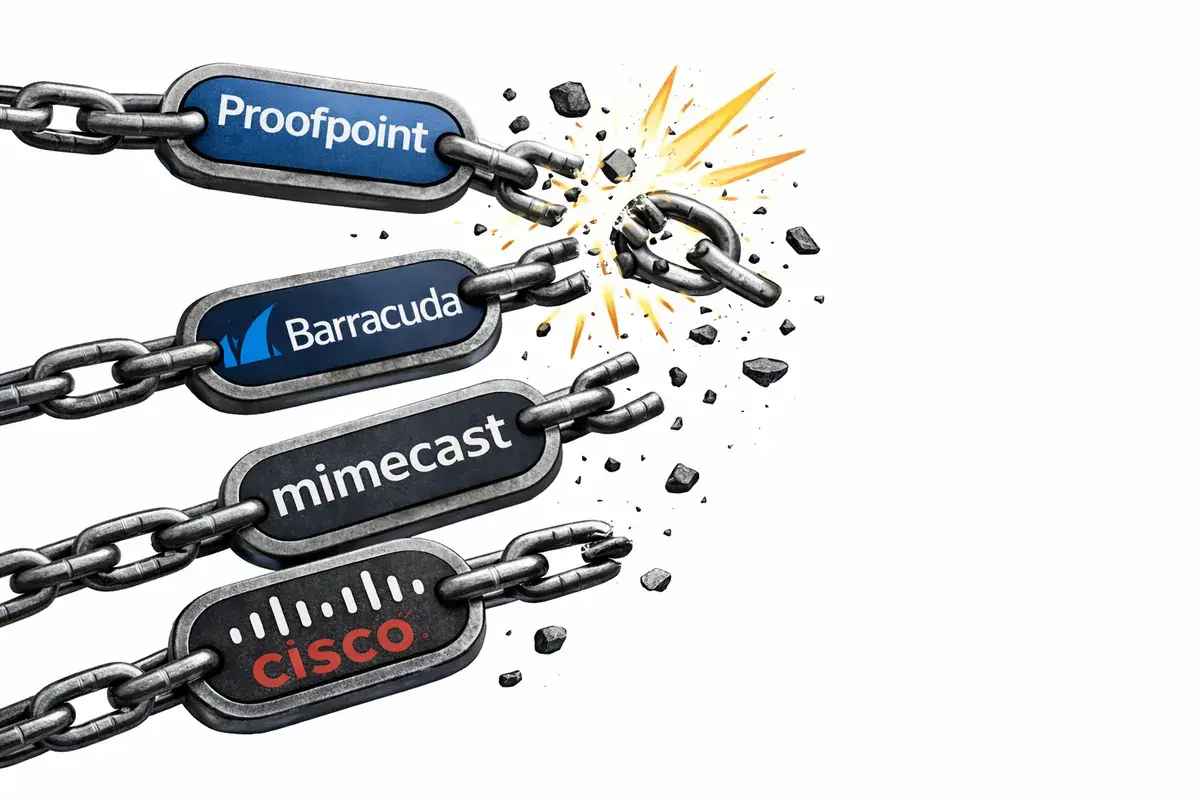
Barracuda customers saw an average of 101 missed attacks per 100 mailboxes monthly. Proofpoint users experienced 68.4 missed attacks. Cisco IronPort missed 51.6 attacks on average. Even Mimecast, often positioned as a premium option, still allowed 38.4 phishing emails through per 100 mailboxes each month.
This isn't about picking on specific vendors. This is about understanding that the entire category of traditional SEG technology is struggling against modern attack techniques. When threat actors are using AI to craft convincing phishing emails, when they're weaponizing trust through impersonation, when they're deliberately avoiding the signature-based triggers that SEGs look for, static filtering falls short.
Why This Creates Liability for MSPs
When a phishing email bypasses your client's defenses and causes a breach, nobody asks what the SEG vendor's detection rate is. They ask what you're doing to protect them. They ask why their trusted MSP didn't have better controls in place.
According to the 2024 Verizon Data Breach Investigation Report, nearly 100% of socially engineered phishing attacks use email as their initial attack vector. Email isn't just one threat surface among many. It's the primary battleground.
This creates three immediate problems for your MSP:
-
Service delivery gaps. You're selling email security as part of your managed services stack. Your clients assume that means they're protected. When attacks get through and cause damage, that assumption breaks. So does trust.
-
Operational overhead. Every missed attack becomes a support ticket, an incident response call, a remediation project. Your technicians spend time cleaning up breaches instead of working on projects that grow your business.
-
Competitive vulnerability. Other MSPs are moving to modern solutions and using that as a differentiator in competitive deals. When a prospect asks what email security you provide and you list a traditional SEG, they're doing the same research you're doing now.
The Questions You Should Be Asking
If you've made it this far, you're probably asking yourself:
"Is my current email security stack actually protecting my clients, or just creating a false sense of security?"
"How much time are my technicians spending on manual remediation that should be automated?"
"What's the real cost of a client breach in terms of reputation, retention, and insurance premiums?"
"Am I making technology decisions based on what I've always used, or based on what actually works against modern threats?"
These are the right questions. The fact that you're asking them means you're taking this seriously.
What Modern MSPs Are Doing Differently
The MSPs who aren't stuck in the same cycle have moved to a different approach entirely. They're deploying Integrated Cloud Email Security solutions that work inside the inbox, not at the perimeter. They're using AI-driven detection that learns communication patterns and spots anomalies, not just signature matches. They're automating remediation across all client tenants instead of handling each incident manually.
They're not spending weekends updating SEG rules. They're not explaining to clients why sophisticated attacks keep getting through. They're not losing competitive deals because their email security story hasn't evolved past 2015.
They made a decision to evaluate their options based on current data, not past relationships with technology vendors.
You can make that same decision.
Where This Goes Next
Understanding the gap is the first step. Acknowledging that what you have isn't working the way you need it to work. Recognizing that your clients deserve better protection and your business deserves better economics.
But awareness alone doesn't change anything. In Part 3, we'll break down what an ICES-powered future actually looks like for your MSP. We're talking deployment timelines, operational impact, and how thousands of MSPs globally are already using IRONSCALES to catch threats faster, reduce manual work, and deliver measurably better protection to their clients.
You've seen the numbers. Now let's talk about what you do with them.
Missed Part 1? Start with It's Not Your MSP, It's Your Email Security: Why Change is Hard.
Want the full picture now? Download The SEG Breakup Guide: Why MSPs Are Moving On.







/Blue%20Feature%20Flower%20Icons/gear%20head%20icon.svg)
/Misc%20Icons/icon-nav-credential-theft.svg)















.png?width=50&height=50&name=Untitled%20-%20July%2030%2c%202026%20at%2014.53.38%20(3).png)



/Misc%20Icons/icon-red-teaming-agent-gradient-simple.svg)
/Misc%20Icons/icon-phishing-soc-agent-gradient-simple.webp?width=158&height=167&name=icon-phishing-soc-agent-gradient-simple.webp)
/Misc%20Icons/icon-phishing-simulation-agent-gradient-simple.svg)


/Misc%20Icons/icon-nav-encryption.svg)
/Leadership%20Headshots/Audian%20Paxson%20Headshot%201000x1000%20032026.webp?width=100&height=100&name=Audian%20Paxson%20Headshot%201000x1000%20032026.webp)