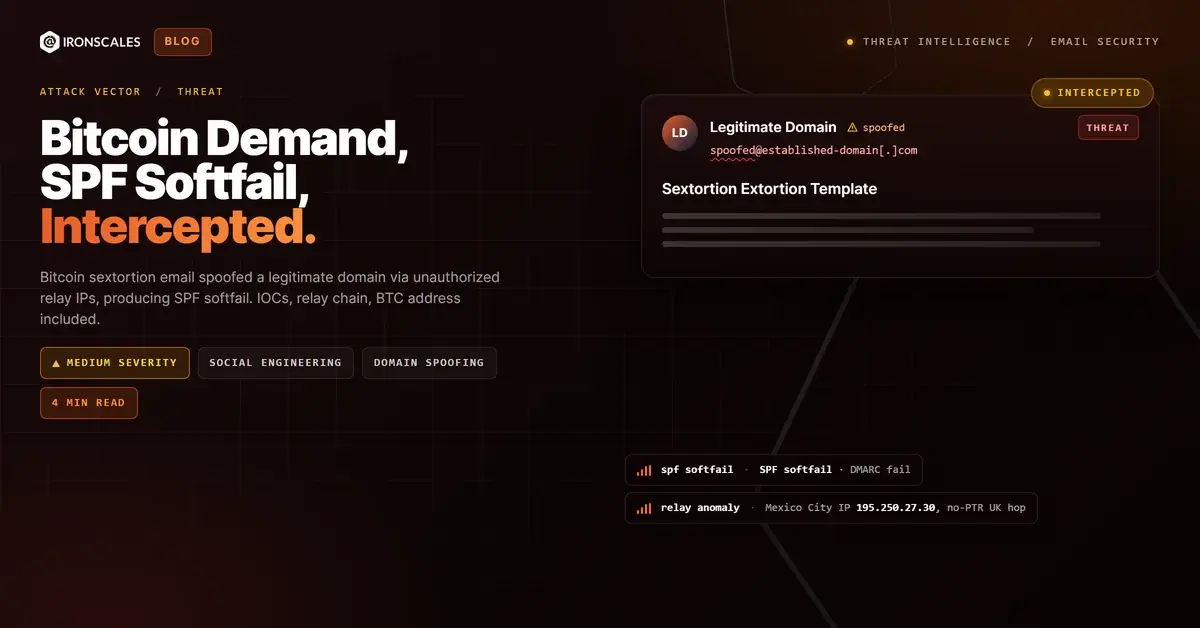
TL;DR An attacker spoofed a long-established legitimate domain in the From header and routed the message through unauthorized relay infrastructure (Mexico City IP 195[.]250[.]27[.]30, UK IP 107[.]59[.]4[.]235), generating an SPF softfail and DMARC fail. The body is a mass-template sextortion demand: anonymous device-compromise claims, a Bitcoin payment demand of approximately $2,100 to address 119YUFBrK7CiVwrPLDK9Sz3F32dauv26i, and a 50-hour deadline. No links or attachments were included. The Bitcoin address appears on public scam-tracking resources connected to prior sextortion campaigns.
Severity: Medium Extortion Social Engineering Domain Spoofing MITRE: T1566 MITRE: T1684.001
A sextortion email with a $2,100 Bitcoin demand cleared the recipient's gateway by spoofing a long-established legitimate domain in the From header while routing through unauthorized relay infrastructure that produced only an SPF softfail. The absence of links and attachments stripped away the detection layers most email security tools rely on, leaving the message to be evaluated on content alone.
What the Attack Looked Like
The From header displayed an address at a long-established domain (registered in 2002) that would appear credible to both humans and spam filters. The message was never sent from that domain's authorized mail servers. Instead, it traversed two relay hops: an SMTP relay at 195[.]250[.]27[.]30 (reverse DNS: s3418[.]mex1[.]stableserver[.]net, geolocation: Mexico City) and an upstream hop at 107[.]59[.]4[.]235 (no PTR record, UK allocation). Neither IP is authorized by the spoofed domain's SPF policy. The intermediary relay domains observed in the headers (14307[.]com, 75970[.]com) carry minimal WHOIS data consistent with throwaway bulk-mail infrastructure.
The body followed a well-worn sextortion template:
- Anonymous claim of Trojan infection and full camera/microphone access
- Threat to distribute alleged private recordings to the recipient's contacts
- Bitcoin payment demand: approximately $2,100 to address
119YUFBrK7CiVwrPLDK9Sz3F32dauv26i
- A 50-hour deadline framed as "5O h&ours (2 days)" with intentional typographic obfuscation
- No recipient name, no account detail, no unique personal information
Low personalization, heavy typos, and odd diacritics throughout match the characteristics of a mass-targeting template distributed at scale. The Bitcoin address has prior reports on public scam-tracking resources for use in sextortion campaigns.
Why It Bypassed Defenses
The SPF result for this message was softfail, not fail. The distinction matters operationally. A softfail (~all in the SPF policy) is designed as a warning mechanism rather than a hard rejection trigger. Many gateway configurations log or deprioritize softfail rather than quarantine or reject. Attackers who spoof domains with ~all policies exploit exactly this gap.
DMARC failed for the spoofed From domain because the sending IPs are not covered by the domain's SPF record and no DKIM signature aligned to that domain was present. However, DMARC enforcement is only as effective as the receiving organization's inbound policy enforcement. A DMARC fail on an inbound message does not automatically block it unless the receiving gateway is configured to act on the p=reject or p=quarantine policy of the sending domain.
Critically, the message had no links and no attachments. URL-reputation engines, link-sandboxing, and attachment-detonation checks all had nothing to evaluate. The message had to be caught on header analysis, sender authentication signals, and behavioral content patterns alone. This is a deliberate evasion technique for social engineering attacks delivered entirely in prose.
See Your Risk: Calculate how many threats your SEG is missing
How It Was Caught
The IRONSCALES platform correlated the SPF softfail with the relay infrastructure anomaly (Mexico City IP, no-PTR UK hop, throwaway relay domains) and the content profile. Sender risk was flagged as high. The Bitcoin address in the body matched records on external scam-tracking databases, providing a cross-reference signal that confirmed the extortion nature of the message rather than leaving it in a gray zone.
No gateway-level block occurred. Detection relied on post-delivery behavioral analysis correlating infrastructure, authentication posture, and content signals together.
Defender Takeaway
Sextortion campaigns are not sophisticated at the technical level, but they are calibrated to exploit gaps in gateway configuration. A few high-value controls:
Harden SPF policy evaluation. Treat softfail as a meaningful negative signal at the gateway, not just in spam scoring. If your domain uses ~all, consider moving to -all and auditing all authorized sending sources first.
Enforce on DMARC fails. If the sending domain publishes a DMARC record with a policy of p=quarantine or p=reject, your inbound gateway should honor that signal. Many organizations receive the DMARC fail signal but do not act on it.
Content-only detection is a weak backstop. Messages with no links and no attachments expose the limits of gateway tools that depend on URL reputation and file scanning. Post-delivery analysis using phishing behavioral modeling catches what content filters miss.
User guidance is not enough. Sextortion templates are designed to trigger shame and panic, suppressing the recipient's willingness to report the message. Detection must happen at the platform level before the message reaches the inbox.
Indicators of Compromise
| Type | Indicator | Notes |
|---|
| Bitcoin address | 119YUFBrK7CiVwrPLDK9Sz3F32dauv26i | Payment demand; linked to prior sextortion campaigns on scam-tracking databases |
| Relay IP | 195[.]250[.]27[.]30 | PTR: s3418[.]mex1[.]stableserver[.]net; Mexico City; SPF softfail source |
| Relay IP | 107[.]59[.]4[.]235 | No PTR; UK allocation; upstream relay hop |
| Relay domain | 14307[.]com | Throwaway relay domain; minimal WHOIS |
| Relay domain | 75970[.]com | Throwaway relay domain; minimal WHOIS |
| Authentication | SPF=softfail, DMARC=fail | From domain not authorized for sending IPs |
| MITRE | T1566 | Phishing |
| MITRE | T1684.001 | Impersonation |
Email Attack of the Day is a daily series from
IRONSCALES spotlighting real phishing attacks caught by Adaptive AI and our community of 36,000+ security professionals. Each post breaks down a real attack. What it looked like, why it worked, and what to do about it.







/Blue%20Feature%20Flower%20Icons/gear%20head%20icon.svg)
/Misc%20Icons/icon-nav-credential-theft.svg)










/Leadership%20Headshots/Audian%20Paxson%20Headshot%201000x1000%20032026.webp?width=100&height=100&name=Audian%20Paxson%20Headshot%201000x1000%20032026.webp)



.png?width=50&height=50&name=Untitled%20-%20July%2030%2c%202026%20at%2014.53.38%20(3).png)



/Misc%20Icons/icon-red-teaming-agent-gradient-simple.svg)
/Misc%20Icons/icon-phishing-soc-agent-gradient-simple.webp?width=158&height=167&name=icon-phishing-soc-agent-gradient-simple.webp)
/Misc%20Icons/icon-phishing-simulation-agent-gradient-simple.svg)


/Misc%20Icons/icon-nav-encryption.svg)