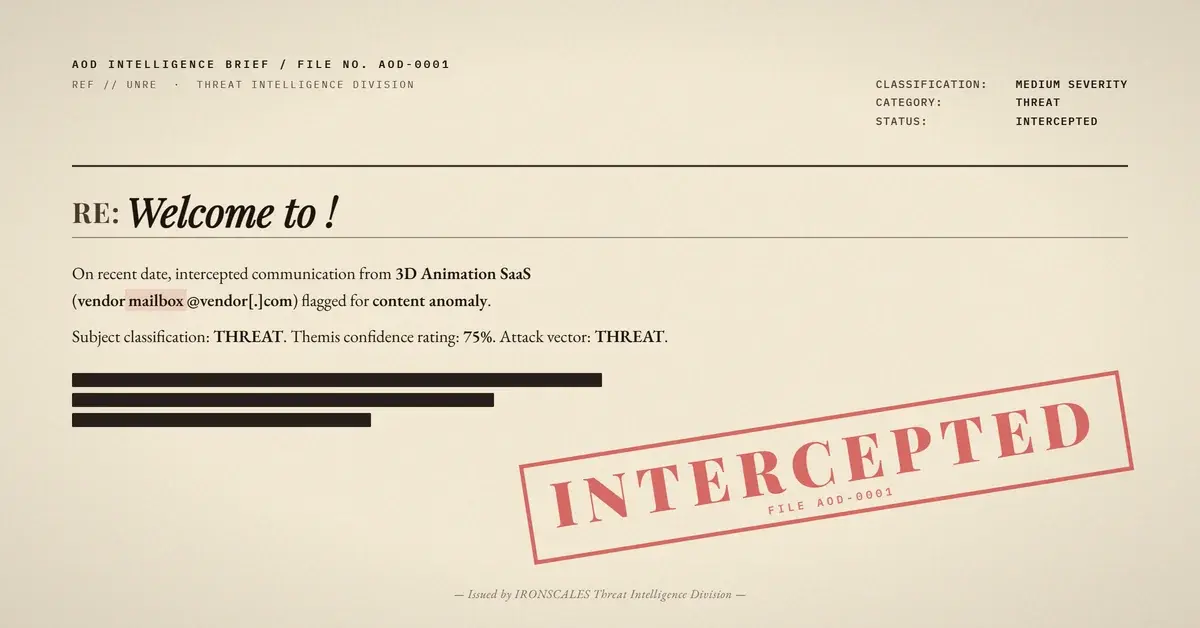
TL;DR A construction lien waiver request reached the CFO-titled mailbox of a digital health company. The email promised a legal document for signature, but its single button led, through a host registered five days earlier, to a card reading Subscription confirmed with a subscriber counter. No document, form or field appeared in either capture. What the page does after load was not observed, and the verdict was automated. The mismatch between pretext and payoff is the signal, and it is one that document-or-login-form detectors are not built to read.
Severity: Medium Malicious Link Brand Impersonation MITRE: T1566.002 MITRE: T1583.001
A lien waiver is a document you sign and then live with. This one never showed up.
The email asked a finance leader at a digital health and wellbeing services company to sign a "Conditional Waiver and Release on Progress Payment." The subject promised a final lien rights release. One button, "Access Waiver Document," was the only way forward. It led to a card that said "Subscription confirmed."
No waiver. No form. No field. Just a green check and a large subscriber counter.
The promise: a legal document with consequences
Pretext selection is half of phishing, and this one was chosen well. Lien releases are real paperwork. They move through finance and accounts payable on a schedule driven by progress payments, and signing one gives up rights. A CFO-titled mailbox is exactly where that request lands, and a second mailbox in the same company received it too.
The 2026 Verizon Data Breach Investigations Report puts pretexting at 6% of initial access vectors and the human element in 62% of breaches. A signature request that sounds routine works on that human element, and no exploit is required.
The delivery: a destination that does not match
The button did not point at a signing service. Per the scan record, it went to a page on an aged third-party domain, which then handed off to a host with a long, random-looking name registered on November 4, five days before delivery. That second host sat behind Cloudflare and scanned as malicious on November 12.
The aged domain is treated here as a possible bystander. Its ownership and any role in the chain were not established.
The destination rendered the same dark card in two captures taken three days apart. The counter read 53,792 in the first and 82,645 in the second. That is all that is known about it. Nothing here says the number is fabricated or random.
| Type | Indicator | Context |
|---|
| Domain | shgnamitonastictr-mendila93047182669[.]org | Final landing host, registered five days before delivery, Cloudflare nameservers |
| URL | hxxps://entry[.]shgnamitonastictr-mendila93047182669[.]org/ | Served the "Subscription confirmed" card, scanned malicious |
| Link text | Access Waiver Document | Single call to action in the body |
The mail itself was sent through a European organisation's own Microsoft 365 tenant and authenticated as that organisation. The record does not show how that came about, and the sender is a possible bystander. It is a first-time sender to the recipient company, and the incident was resolved automatically as phishing. This is mapped to T1566.002 for the link-based delivery, with the young landing host fitting T1583.001, acquiring infrastructure.
See Your Risk: Calculate how many threats your SEG is missing
Why a document-or-login detector has nothing to catch
Many defences hunt for one of two things at the end of a click: a fake document or a credential form. This chain offered neither. A detector keyed to a password field sees no field. A detector keyed to a counterfeit PDF sees no PDF.
What it can see is the gap. A lien-waiver request that ends on a subscription card is a contradiction, and the contradiction is the signal. Pair it with a first-time sender, a one-week-old destination and a finance recipient, and the picture is clear without ever seeing a payload. That is the kind of reasoning Themis, the IRONSCALES agentic AI analyst, applies when it weighs context instead of waiting for a form to appear.
CISA phishing guidance and NIST's definition of phishing both frame the attack as deception that induces an action. The action here is the click, and the click already happened by the time the card rendered.
What was not observed
Be precise about the limits. The captures show a card and nothing else. Nothing in the record shows what the page does after load: whether it requests anything, redirects again, or behaves differently for a real browser session than for a scanner.
The verdict was automated. The incident was resolved automatically as phishing, with a high-confidence Themis assessment. No human analyst verdict is claimed.
Emptiness at capture time is not safety. It is a gap in what is known.
Verify the artifact, not the ask
Finance teams already know the rule for payment changes: call back on a known number. Extend it to releases. If a lien waiver arrives by link, find it in the system of record the project already uses, and confirm with the requester through a channel you started.
If the link opens something other than what the email promised, stop. Report it. That mismatch is the entire finding, and it takes ten seconds to notice.
The same logic belongs in controls. Advanced URL and malware protection should score where a link ends up against what the message claimed, not only whether the endpoint looks like a login page. IRONSCALES platform data shows the scale of the exposure: 36,000+ security professionals across 18,000+ organizations share this kind of signal.
For background on how document-themed lures sit alongside other payment fraud, the FBI IC3 2024 report and IBM's Cost of a Data Breach research track the downstream cost. This case is a reminder that the lure and the landing can be completely different stories.
Email Attack of the Day is a daily series from
IRONSCALES spotlighting real phishing attacks caught by Adaptive AI and our community of 35,000+ security professionals. Each post breaks down a real attack. What it looked like, why it worked, and what to do about it.