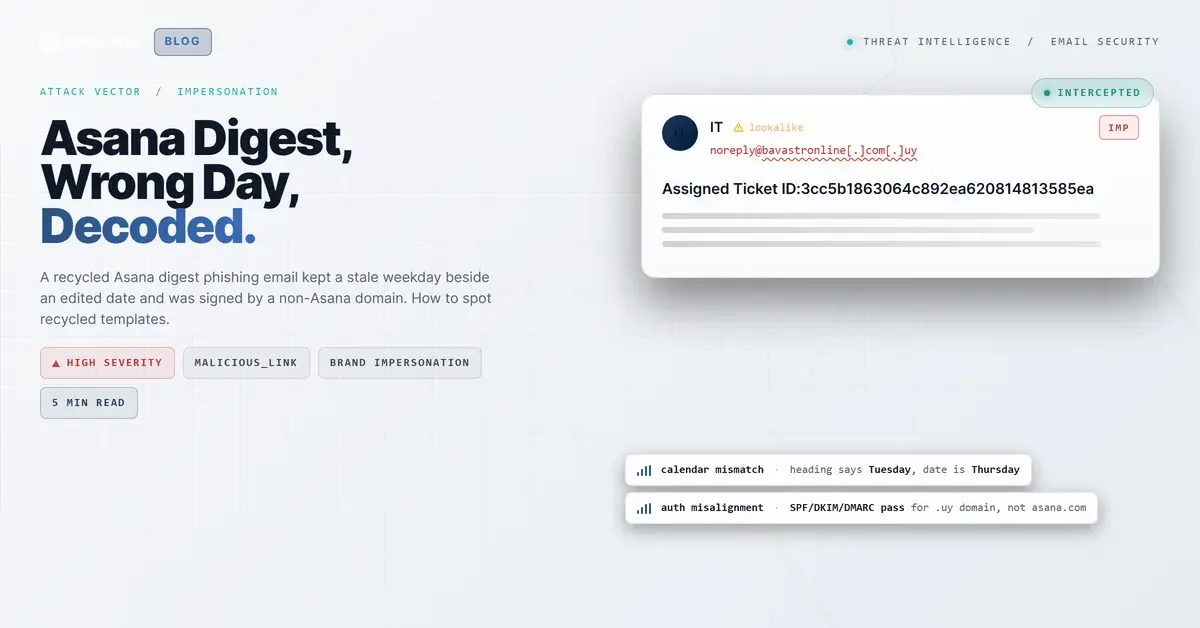
TL;DR A regional airport authority's accounts-receivable mailbox received what looked like an Asana daily task digest. Every Asana link, logo and tracking pixel in it was real. The sender was not Asana: the message came from an unrelated .com.uy domain through Amazon SES, passing SPF, DKIM and DMARC for that domain. The heading read Tuesday beside a date of 10/1/2026, which was a Thursday, and Asana's embedded pixel dated the template to Tuesday, August 18. One button had been swapped to an attacker-built Lovable app. Genuine content proves where a template came from, not who sent the message.
Severity: High Brand Impersonation Malicious Link MITRE: T1566.002 MITRE: T1036 MITRE: T1583.006 MITRE: T1204.001
The heading said "Tuesday: tasks assigned to you today 10/1/2026." October 1, 2026 was a Thursday.
That one stale word is the whole case. Someone took a genuine Asana daily task digest, changed the date, changed the subject line, swapped a single button, and re-sent it to the accounts-receivable shared mailbox at a regional airport authority. They updated the number. They forgot the day.
Everything else in the email was real Asana. The logo loaded from Asana's own CDN. The task links pointed to app.asana.com and scanned clean. Asana's open-tracking pixel was still embedded. None of it meant Asana sent the message.
A real template with a fake envelope
Read the content and you see Asana. Read the headers and you see someone else entirely.
The From line was "IT" on a noreply address at an unrelated Uruguayan domain. The Message-ID and the Received hop both pointed to Amazon SES in the sa-east-1 region. The current-hop authentication results at Microsoft were spotless: SPF pass, DKIM pass for the sending domain, DKIM pass for amazonses.com, DMARC pass, compauth pass. Microsoft scored it SCL 1 and let it through.
Here is the problem. Every one of those passes is aligned to the .com.uy domain. Not one is aligned to asana.com. A real Asana digest is sent and signed by Asana. This one was signed by a domain with no visible relationship to Asana at all, and WHOIS returned nothing on it. Whether that domain belongs to the attacker or to a real business whose SES sending identity was abused is not established, so treat its owner as a possible bystander.
Authentication answered its own question: did this domain send this mail? Yes. It never asked whether that domain had any business sending an Asana digest.
The weekday the attacker left behind
The visible tell is the heading. "Tuesday" beside "10/1/2026" is a contradiction any reader with a calendar can catch. The attacker edited the date to match the send day and left the weekday from the original.
Asana's own pixel corroborates it. The tracking URL carried an email_creation_time field that decodes to Tuesday, August 18, 2026, 12:38 UTC, along with fields identifying the template as a standard summary email with two assigned tasks shown. The original digest was generated on a Tuesday. It arrived on Thursday, October 1, roughly six weeks later.
The body also carried Outlook on the web compose residue, nested reply and forward containers repeated many levels deep. The digest had been forwarded and re-composed in a webmail client before it went out through SES. How the attacker obtained the original digest is not known, and nothing in the record shows any recipient account was involved.
The digest also rendered an Asana workspace name matching the recipient organization's own name. Whether that workspace is the organization's or one built to look like it was not established. Either way, it made the lure feel local.
One button out of many
The attacker changed very little. The subject became "Assigned Ticket ID:3cc5b1863064c892ea620814813585ea." A hidden preheader greeted the recipient mailbox by address and announced "a new security task." And the main call to action became "View in Ticket."
That button was the only non-Asana link in the message. It pointed to an attacker-created subdomain on Lovable, a legitimate AI app-building platform. The platform record rates it malicious, and a scan on the delivery date showed a "Verify you are human" checkbox page. What sat behind that gate was never observed.
This is cheap work. Keep the genuine links, branding and pixel, change one href. A URL scanner sees mostly clean Asana destinations.
See Your Risk: Calculate how many threats your SEG is missing
Mapping the mechanics
- T1566.002, Phishing: Spearphishing Link: a single swapped button inside an otherwise legitimate notification.
- T1036, Masquerading: a genuine Asana template, real CDN assets and an "IT" display name to borrow trust.
- T1583.006, Acquire Infrastructure: Web Services: the landing page hosted as a subdomain on a legitimate app-building platform.
- T1204.001, User Execution: Malicious Link: the attack only proceeds if the recipient clicks "View in Ticket."
Shared finance mailboxes like accounts receivable are read by several people, and nobody owns the question of whether a task assignment makes sense. The 2026 Verizon Data Breach Investigations Report puts the human element in 62% of breaches and phishing as the initial access vector in 16%. Its email gateway data (Figure 54) shows plain phishing at 80% of the attack mix. Lures like this one, built from someone else's real product email, are why that share stays so high.
Indicators
| Type | Indicator | Context |
|---|
| Email | noreply@bavastronline[.]com[.]uy | From address, display name "IT" |
| Domain | bavastronline[.]com[.]uy | Sending domain, SES-authenticated (owner unverified, possibly abused) |
| Domain | info[.]bavastronline[.]com[.]uy | Envelope MAIL FROM and Return-Path domain |
| IP | 23[.]249[.]215[.]12 | Amazon SES sa-east-1 outbound (shared infrastructure, not attacker-owned) |
| URL | hxxps://trust-gate-way[.]lovable[.]app/ | "View in Ticket" button, checkbox gate, verdict malicious |
| Subject | Assigned Ticket ID:3cc5b1863064c892ea620814813585ea | Campaign subject line |
Genuine content is not provenance
The lesson generalizes well beyond Asana. A message can be made entirely of real parts, real links, real logos, real tracking, and still be a forgery. Genuine content tells you where the template came from. Only the envelope tells you who sent the message.
Two checks catch this class. First, compare the brand in the body with the domain that signed the mail. An Asana digest signed by a .com.uy domain through SES is a mismatch no matter how clean the links scan. Second, check whether the email's internal clock agrees with itself and with its arrival. A weekday that contradicts its own date is a sign the content was lifted from somewhere else.
Adaptive AI is built for exactly this kind of signal: a first-time sender, no prior correspondence with the organization, content that claims one brand while the signature belongs to another. Here the Themis recommendation recorded a confidence of 90, flagged the "View in Ticket" link as malicious and matched it against similar phishing reported across the community of 36,000+ security professionals across 18,000+ organizations (IRONSCALES platform data). The incident was automatically resolved as phishing and the message was removed from the mailbox.
Teams that rely on SaaS notifications should treat them as a category worth specific attention. Guidance on collaboration tool protection applies here because attackers are borrowing the look of those tools even when the tools themselves are not involved. CISA phishing guidance stresses verifying unexpected requests through a separate channel, and the Microsoft Digital Defense Report 2024 covers attackers' abuse of legitimate cloud services. The FBI IC3 2024 report and the IBM Cost of a Data Breach 2024 report both keep phishing near the top of entry points.
If a project tool tells you it is Tuesday, check the calendar.
Email Attack of the Day is a daily series from
IRONSCALES spotlighting real phishing attacks caught by Adaptive AI and our community of 35,000+ security professionals. Each post breaks down a real attack. What it looked like, why it worked, and what to do about it.