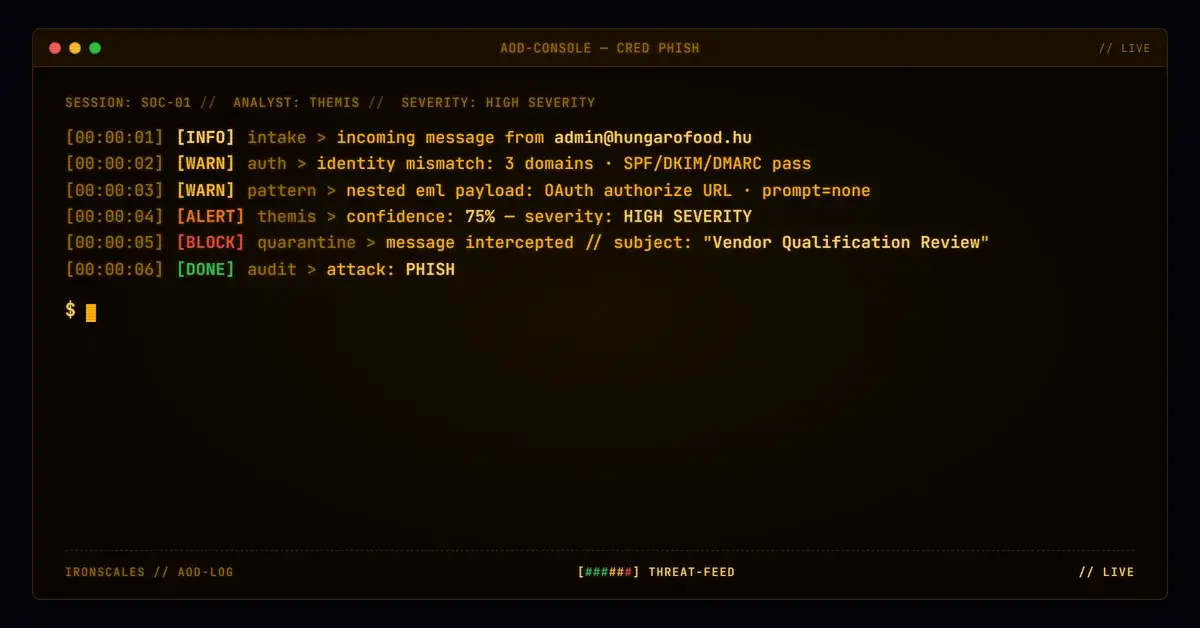
TL;DR A message sent from admin@hungarofood[.]hu via Amazon SES passed SPF, DKIM, and DMARC despite having a Reply-To address on a completely different domain (turchco[.]com). The subject referenced a vendor qualification review, but the body displayed an ACH remittance advice, a mismatch designed to confuse automated classification. The attachment was a nested .eml file from Account@account[.]com containing a Microsoft OAuth authorize URL (login.microsoftonline.com) with prompt=none for silent authentication and a state parameter that base64-decoded to the recipient's email address. The OAuth flow targeted an unregistered third-party application client ID. The attack combined legitimate sending infrastructure, subject-body inconsistency, and a nested file format to deliver a targeted consent phishing payload.
Severity: Critical Credential Harvesting Consent Phishing Oauth Abuse MITRE: {'id': 'T1566.001', 'name': 'Phishing: Spearphishing Attachment'} MITRE: {'id': 'T1550.001', 'name': 'Use Alternate Authentication Material: Application Access Token'} MITRE: {'id': 'T1528', 'name': 'Steal Application Access Token'}
The subject line said vendor qualification review. The body said ACH remittance advice. That mismatch was the first signal something was wrong, but it was not the payload. The payload was inside the attachment: a nested .eml file containing a Microsoft OAuth authorize URL crafted to silently steal an application access token from the specific recipient. This was consent phishing delivered through a multi-layer obfuscation chain.
Authenticated Infrastructure, Mismatched Identity
The outer message was sent from admin@hungarofood[.]hu through Amazon SES infrastructure at IP 54[.]240[.]8[.]42. SPF passed. DKIM passed for both hungarofood[.]hu and amazonses[.]com. DMARC passed. By every authentication measure, the message was legitimate.
But the Reply-To pointed to gary@turchco[.]com, a completely different domain. Responses would never reach the apparent sender. The From, Reply-To, and Return-Path each referenced different domains, a pattern that should trigger identity-mismatch detection but often does not when each individual domain passes its own authentication checks.
The OAuth Authorize URL Inside the Nested .eml
The attachment, named Dart-Remittance-Service-Agreement-nlwz-4891Eml.eml, contained a nested message from Account@account[.]com with a single high-value link:
hxxps://login[.]microsoftonline[.]com/common/oauth2/v2.0/authorize?client_id=e0480c25-5026-4692-bcfe-ca3d98fb25fe&prompt=none&scope=openid&state=Y2hyaX...
Three details made this link dangerous. First, the client_id referenced an unregistered third-party application, not a known Microsoft or enterprise app. Second, prompt=none instructed the identity provider to skip the consent screen and attempt silent token issuance. If the recipient had an active browser session, the attacker could receive an access token without any user interaction. Third, the state parameter base64-decoded to the recipient's exact email address, confirming this was not a mass campaign but a targeted attack personalized to a specific mailbox.
The click chain also included redirect URLs on guzeldagenerji[.]com[.]tr, a Turkish energy company domain that returned Azure AD error strings in its parameters, indicating it served as a waypoint in the OAuth flow.
Why This Bypasses Gateway Scanning
Most email gateways scan URLs in the outer message body but treat .eml attachments as opaque files. The OAuth URL lived inside the nested message, outside the primary scanning scope. Even gateways that recursively inspect .eml content may not flag a login.microsoftonline.com URL because the domain itself is legitimate. The credential harvesting happens through a legitimate Microsoft endpoint, not an attacker-hosted page.
IRONSCALES flagged the message based on behavioral signals: first-time sender, three-domain identity mismatch, nested .eml with an authorize URL, and the subject-body content inconsistency.
See Your Risk: Calculate how many threats your SEG is missing
Indicators of Compromise
| Type | Indicator | Context |
|---|
| Sender Domain | hungarofood[.]hu | Amazon SES-backed Hungarian food distributor domain |
| Reply-To Domain | turchco[.]com | Response diversion domain |
| Nested Sender | Account@account[.]com | Generic identity inside .eml attachment |
| OAuth Client ID | e0480c25-5026-4692-bcfe-ca3d98fb25fe | Unregistered third-party application |
| Redirect Domain | guzeldagenerji[.]com[.]tr | OAuth flow waypoint |
| Sending IP | 54[.]240[.]8[.]42 | Amazon SES origin |
| Attachment Hash (SHA-256) | 54093804eb7204c4c87ebd312f347811110526414571f669578023f630bbe499 | Nested .eml file |
MITRE ATT&CK Mapping
| Technique | ID | Relevance |
|---|
| Phishing: Spearphishing Attachment | T1566.001 | Nested .eml file delivers OAuth authorize URL |
| Steal Application Access Token | T1528 | OAuth flow with prompt=none targets silent token issuance |
| Use Alternate Authentication Material: Application Access Token | T1550.001 | Stolen OAuth token provides persistent access without password |
Email Attack of the Day is a daily series from
IRONSCALES spotlighting real phishing attacks caught by Adaptive AI and our community of 36,000+ security professionals. Each post breaks down a real attack. What it looked like, why it worked, and what to do about it.







/Blue%20Feature%20Flower%20Icons/gear%20head%20icon.svg)
/Misc%20Icons/icon-nav-credential-theft.svg)










/Leadership%20Headshots/Audian%20Paxson%20Headshot%201000x1000%20032026.webp?width=100&height=100&name=Audian%20Paxson%20Headshot%201000x1000%20032026.webp)



.png?width=50&height=50&name=Untitled%20-%20July%2030%2c%202026%20at%2014.53.38%20(3).png)



/Misc%20Icons/icon-red-teaming-agent-gradient-simple.svg)
/Misc%20Icons/icon-phishing-soc-agent-gradient-simple.webp?width=158&height=167&name=icon-phishing-soc-agent-gradient-simple.webp)
/Misc%20Icons/icon-phishing-simulation-agent-gradient-simple.svg)


/Misc%20Icons/icon-nav-encryption.svg)