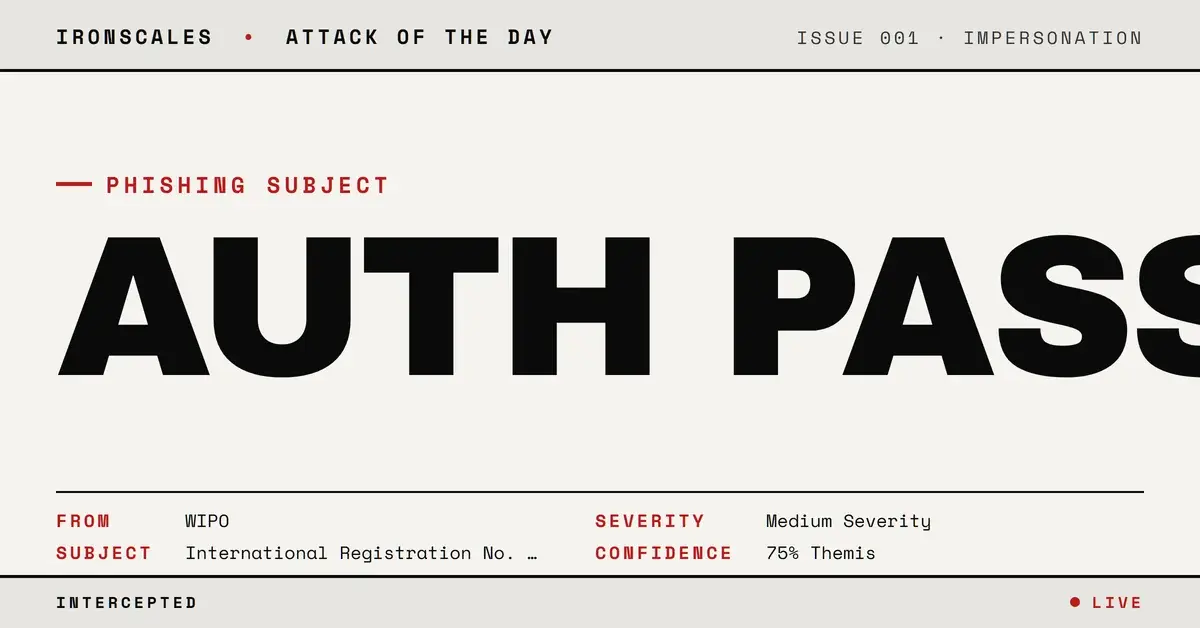
TL;DR A message from noreply@wipo.int passed SPF, DKIM, and DMARC with the sending IP (193.5.93.4 / mx1.wipo.int) matching WIPO's own mail servers. The email referenced International Registration No. 1742546 and directed the recipient to an attached PDF (letter.pdf) containing cancellation and payment language in a WIPO-formatted notice. Static analysis of the PDF found no JavaScript, no interactive forms, no embedded URLs, and no executable content. The attack relied entirely on the institutional authority of the World Intellectual Property Organization to prompt the recipient into taking action on a fabricated trademark cancellation, a social engineering approach that carries zero technical indicators for scanners to detect.
Severity: Medium Social Engineering Brand Impersonation Legitimate Infrastructure Abuse MITRE: {'id': 'T1566.001', 'name': 'Phishing: Spearphishing Attachment'} MITRE: {'id': 'T1036.005', 'name': 'Masquerading: Match Legitimate Name or Location'} MITRE: {'id': 'T1598.003', 'name': 'Phishing for Information: Spearphishing Link'}
The email came from noreply@wipo[.]int. SPF passed. DKIM passed. DMARC passed. The sending IP was 193[.]5[.]93[.]4, which resolves to mx1.wipo.int, a mail server operated by the World Intellectual Property Organization. The message was not spoofed. It was not forged. It passed every authentication check because it was genuinely sent through WIPO infrastructure. The attached PDF was clean. And the entire thing was social engineering.
The Notice That Looked Exactly Right
The email was a short formal notice referencing International Registration No. 1742546. It used a generic salutation ("Dear Sir, Madam,"), included a WIPO-style signature block with the Geneva headquarters address, and directed the recipient to open the attached notification (letter.pdf). Two links in the body pointed to legitimate WIPO documents on wipo.int.
The PDF was one page. Static analysis found no JavaScript, no interactive form fields, no embedded URLs, no executable content. Antivirus returned clean. Sandbox detonation had nothing to detonate. The document contained cancellation and payment language formatted to match WIPO's Madrid System correspondence, referencing the specific registration number and the named holder.
Every technical indicator said this message was safe.
What Made It Dangerous
The danger was not in the code. It was in the content. A trademark cancellation notice from an intergovernmental organization carries institutional authority that most recipients will not question. The instruction to "refer to the attached notification" moves the recipient from reading to acting, and the cancellation framing creates urgency without using the crude "your account will be locked" language that spam filters catch.
If the recipient acted on the notice, whether by calling a number, wiring a payment, or replying with sensitive information, the compromise would happen entirely outside the email channel. No link click. No credential form. No malware execution. The attack surface was the recipient's trust in the institution, not their browser.
Why Gateways Cannot Catch This
Authentication passed because the infrastructure was legitimate. The PDF was clean because it contained no technical payload. The links went to real WIPO pages. There was nothing for a scanner to flag. This attack existed in a blind spot where technical controls have no visibility: the gap between "this message is authenticated" and "this message is legitimate" and "this message is not impersonation."
Multiple recipients and community members flagged this message independently, and IRONSCALES mitigated it through behavioral and community signals rather than technical indicators.
See Your Risk: Calculate how many threats your SEG is missing
Indicators of Compromise
| Type | Indicator | Context |
|---|
| Sender Domain | wipo[.]int | Legitimate WIPO infrastructure |
| Sender Email | noreply@wipo[.]int | Authenticated, SPF/DKIM/DMARC pass |
| Sending IP | 193[.]5[.]93[.]4 | mx1.wipo.int mail server |
| Attachment | letter.pdf (1 page) | No JS, no forms, no embedded URLs |
| PDF Hash (MD5) | f09da7401fbbd43350c5d49ca31e996b | Clean static analysis |
| PDF Hash (SHA-256) | 23a4fb206cd47380a4033cded4adc29ccef7ff9ac276b068b851594d2903001d | Clean static analysis |
| Registration Reference | International Registration No. 1742546 | Cancellation/payment social engineering |
MITRE ATT&CK Mapping
| Technique | ID | Relevance |
|---|
| Phishing: Spearphishing Attachment | T1566.001 | PDF attachment as social engineering delivery |
| Masquerading: Match Legitimate Name or Location | T1036.005 | WIPO institutional formatting and registration reference |
| Phishing for Information: Spearphishing Link | T1598.003 | Prompts action through a separate channel |
Email Attack of the Day is a daily series from
IRONSCALES spotlighting real phishing attacks caught by Adaptive AI and our community of 36,000+ security professionals. Each post breaks down a real attack. What it looked like, why it worked, and what to do about it.







/Blue%20Feature%20Flower%20Icons/gear%20head%20icon.svg)
/Misc%20Icons/icon-nav-credential-theft.svg)










/Leadership%20Headshots/Audian%20Paxson%20Headshot%201000x1000%20032026.webp?width=100&height=100&name=Audian%20Paxson%20Headshot%201000x1000%20032026.webp)



.png?width=50&height=50&name=Untitled%20-%20July%2030%2c%202026%20at%2014.53.38%20(3).png)



/Misc%20Icons/icon-red-teaming-agent-gradient-simple.svg)
/Misc%20Icons/icon-phishing-soc-agent-gradient-simple.webp?width=158&height=167&name=icon-phishing-soc-agent-gradient-simple.webp)
/Misc%20Icons/icon-phishing-simulation-agent-gradient-simple.svg)


/Misc%20Icons/icon-nav-encryption.svg)