TL;DR A card-loyalty phishing email impersonating an Ecuadorian Diners Club miles program reached a distribution manager at a construction chemicals manufacturer. It addressed him by a full four-part legal name in uppercase, a form his employer's directory does not hold, and printed his work address. The card-number field in the same block was empty. That pattern shows the sender held identity data, not account data. Personalisation is not proof of a relationship. The fields a lure fills, and the ones it leaves blank, tell defenders what the attacker actually has.
Severity: High Brand Impersonation Phishing MITRE: T1566.002 MITRE: T1589.002 MITRE: T1583.001 MITRE: T1585.002
The email greeted him by a name his own company does not use for him. Four parts, all uppercase, the full legal form. His employer's directory knows him by two.
Then, a few lines down, under a label reading "Número de Tarjeta", it printed nothing at all.
That pairing is the whole story. A Spanish-language "your miles are expiring" notice, impersonating the Diners Club del Ecuador Club Miles program, landed in the inbox of a distribution manager at the Latin American subsidiary of a global construction chemicals manufacturer. It knew who he was. It had no idea what card he carried, or whether he carried one at all.
A name the directory never held
People read personalisation as proof. "It used my full name, so it must be my bank." This lure was built to trigger that instinct.
Compare the record. The To header and the greeting ("¡Hola, ...!") both used a four-part uppercase legal name. The mailbox profile in the tenant holds a two-part short name: one first name, one surname. The company never supplied the form the attacker used.
So the name came from somewhere else. Where, the record does not establish, and we will not guess. What it does establish is narrower and more useful: the attacker's list pairs legal names with corporate email addresses, and it was not built from the employer's own systems.
The lure also printed the recipient's work email inside a "Detalle" block, as if confirming account details. That is the second piece of identity data. Neither piece is account data.
The empty field is the edge of the list
Here is the block as delivered:
- "Millas por expirar: 9,447"
- "Número de Tarjeta:" followed by no value
- The recipient's work email address
A real card issuer writing to a real cardholder knows the card, or at least its last four digits. That is the one field a legitimate loyalty notice would fill without effort. This sender could fill the name and the address but not the card.
The useful lesson is not that the template was sloppy. It is what the blank tells you about scope. Every field a personalised lure fills is a column the attacker holds. Every field it leaves empty is a column it does not. Here the columns were name and email. The miles figure, 9,447, is a number anyone can type.
We cannot say whether the recipient holds a Diners Club card or a Club Miles account. Neither could the lure.
The 2026 Verizon Data Breach Investigations Report puts the human element in 62% of breaches and credentials in 39% across the full kill chain. Lures like this one are how identity lists get converted into credentials. MITRE tracks the reconnaissance step as T1589.002 (gathering email addresses) and the delivery as T1566.002, spearphishing link.
See Your Risk: Calculate how many threats your SEG is missing
Borrowed credibility, bought infrastructure
The rest of the lure was assembled to support the name.
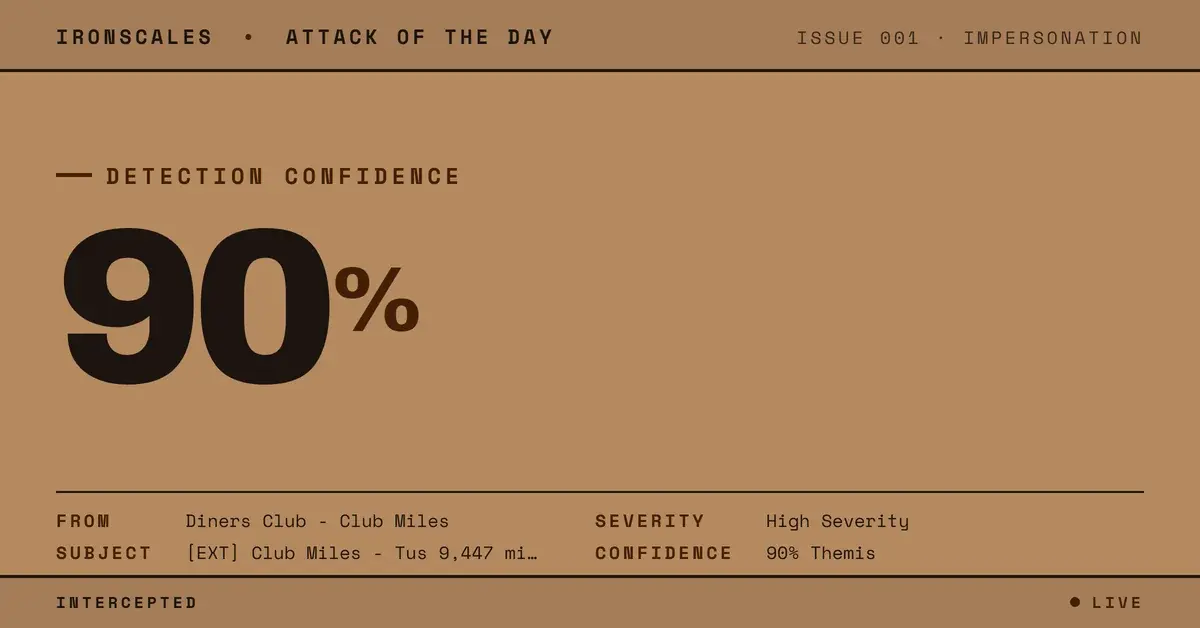
The display name read "Diners Club - Club Miles". The subject, "[EXT] Club Miles - Tus 9,447 millas están por vencer", set a deadline of 30 October 2026, ten days after the message was sent on 20 October. That deadline has already passed. The footer reproduced a brand-style anti-fraud notice saying the program never asks for passwords, codes or card numbers by email or phone.
The callback number printed in the body appears to be the impersonated brand's genuine Quito switchboard. The brand is a bystander here. Its real number was borrowed to make a fake notice feel checkable.
The infrastructure was the attacker's own. The sender domain, clubsmiles.org, was registered on 17 October 2026, roughly two and a half days before delivery, and authenticated on a SendGrid account. Every link was a SendGrid click-tracking wrapper. The resolved destination on clubmiles.lat carried a malicious verdict. With no screenshot in the record, the accurate description is a landing page flagged malicious, not a confirmed credential form.
What the authentication results actually say
At the recipient-side gateway, the message passed SPF, DKIM and DMARC (the sender published p=none). It passed because the attacker owned the domain, not because anyone was fooled.
At Exchange Online, the current-hop results showed SPF softfail, DKIM fail and DMARC fail. Those failures come from the recipient's own gateway re-injecting the message on its way to M365. They are a plumbing artifact, not attacker tampering and not evasion. Reading them as a sign of forgery would send an investigation in the wrong direction.
Microsoft assigned SCL -1 and delivered to the inbox. Authentication confirmed clubsmiles.org sent it. It could not say whether clubsmiles.org had any right to the brand.
How it was caught
The landing URL verdict, a first-time sender with no prior correspondence anywhere in the organization, and a newly registered return-path domain added up. Themis, the IRONSCALES agentic AI analyst, scored the case at 90 confidence and flagged the new return-path domain. The message was quarantined from the one affected mailbox, and the incident closed as malicious content. A later release request citing "Safe website" was handled and the verdict held.
That release request matters. Someone believed this email was legitimate enough to want back. The full legal name is a big part of why.
Indicators
| Type | Indicator | Context |
|---|
| Domain | clubsmiles[.]org | Sender domain, registered 2026-10-17 |
| Email | notificaciones@clubsmiles[.]org | From address, display name "Diners Club - Club Miles" |
| Domain | em629.clubsmiles[.]org | SendGrid return-path subdomain |
| Domain | clubmiles[.]lat | Landing domain, link verdict malicious |
| URL | hxxps://clubmiles[.]lat/?mc_phishing_protection_id=191111-dbbhi9cjqk5r9sgsdob0 | Resolved landing URL, also shown as fallback link text |
| Domain | u116824750.ct.sendgrid[.]net | SendGrid click-tracking host for the sending account (shared platform) |
| IP | 149[.]72[.]154[.]232 | SendGrid outbound IP (shared platform) |
Read the fields, not the greeting
Train people to audit a personalised email the way an analyst would. Ask which facts it states, and which facts a genuine sender would state that this one does not. A bank knows your card. A courier knows your tracking number. A payroll provider knows your employee ID. When the only facts on the page are your name and your email, the sender holds a list, not a relationship.
CISA phishing guidance tells users to verify through a known channel, and that holds even when the lure prints a real number. Look the number up yourself. NIST defines phishing around exactly this kind of impersonation of a trusted entity.
For security teams, personal-finance lures in work inboxes deserve their own lane. A corporate mailbox has no business receiving loyalty statements tied to a personal card. IRONSCALES platform data, drawn from 36,000+ security professionals across 18,000+ organizations, shows 67.5 phishing emails per 100 mailboxes each month. Crowdsourced reporting through the human element turns one suspicious greeting into a tenant-wide block.
The IBM Cost of a Data Breach report and the FBI IC3 2024 report both show how cheaply lures like this become losses. More on the pattern: the phishing glossary entry.
The name was right. The card was missing. Trust the gap.
Email Attack of the Day is a daily series from
IRONSCALES spotlighting real phishing attacks caught by Adaptive AI and our community of 35,000+ security professionals. Each post breaks down a real attack. What it looked like, why it worked, and what to do about it.