TL;DR A fake LinkedIn Billing invoice for USD 3,990 reached the accounting director of a global commercial real estate firm. It printed LinkedIn's real Sunnyvale headquarters address and a tax ID, then told the reader in the payment box and again in the footer not to remit to that address. Payment was to go only to an ACH account at a US bank whose account name read 'LinkedIn Corporation'. On a domestic ACH credit that name is free text, not a verified owner. The accounting director reported it, and a human analyst resolved it as malicious.
Severity: High Invoice Fraud Brand Impersonation Business Email Compromise MITRE: T1566 MITRE: T1684.001 MITRE: T1657
The fake invoice printed LinkedIn's real corporate address in Sunnyvale, California. Then, in two separate places, it told the reader not to use it.
"Please do not remit payment to the LinkedIn Corporation mailing address above," read a note inside the payment box. The footer repeated the warning right beside the address: "(Note: Please do not remit to this address)." Pay only through the bank details provided, it said. Those details were an ACH block whose account name read "LinkedIn Corporation."
That is the whole trick. The one detail a payer could verify on their own was printed, then disowned. What replaced it was a name typed into a field.
A real address, printed so you would route around it
The message reached the US office of a global commercial real estate services firm on November 19, 2026, addressed to the firm's director of property accounting. The subject line was "for {[firm name]}", the firm's actual name wrapped in curly braces like a template field that never finished rendering.
The body opened with one line, "Please pay this today," then an inline HTML invoice styled as LinkedIn Billing: a Talent & Sales Solutions corporate bundle, billed annually, USD 3,990.00, payment method ACH, due on receipt.
Most invoice fraud tries to hide the gap between the fake and the real. This one put the real thing on the page and steered around it.
That inversion matters because of how people are trained. "Check the vendor's address" is standard accounts payable advice. Here the address checks out. The lure has already anticipated the verification and answered it, in the vendor's own voice, by naming the trusted channel as the one not to use.
Real vendors do sometimes remit through a lockbox at a different address. What they do not do is print their headquarters, forbid you from using it, and offer nothing you can confirm in its place.
How the lure is built
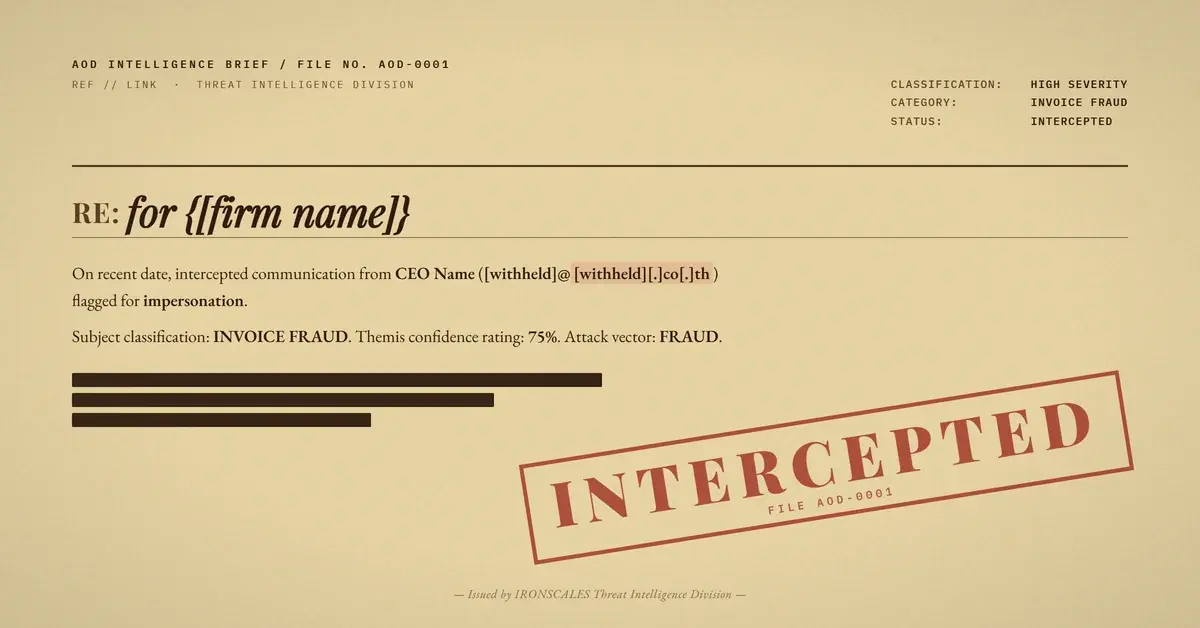
The sender was a mailbox on an unrelated Thai company's domain, with a display name matching the target firm's chief executive. The record does not establish whether that mailbox was compromised or spoofed, so treat the domain owner as another victim, not a suspect.
The invoice carried the trappings of a real billing system: LinkedIn Corporation, a tax ID, invoice number 6110811644, an order number, a customer number, and a PO field left as a single dash.
The dates did not help it. The invoice was dated and due August 4, 2026, so a "due on receipt" bill arrived 107 days past its own due date.
In MITRE ATT&CK terms this is T1566 Phishing delivering an impersonation lure, with T1657 Financial Theft as the objective. There is no link to click and nothing to detonate. The payload is a bank instruction.
The 2026 Verizon Data Breach Investigations Report puts BEC at 3% of the attack mix email gateways block, and pretexting at 6% of initial access vectors. Small shares, but the human element appears in 62% of breaches, and a lure like this one is aimed entirely at a human decision. The FBI IC3 2024 report tracks business email compromise as its own loss category for the same reason.
The account name is a label, not a check
Here is the part most payers get wrong.
On a domestic ACH credit, the receiving bank posts the money by routing number and account number. The account name travels with the payment, but it is generally not matched against whoever actually holds the account. Type "LinkedIn Corporation" into the name field and the transfer goes wherever the digits point.
So the one thing on the invoice that looked like proof of ownership, the account title, proves only that somebody typed it.
The bank named in the block is a real US bank, and a bystander here. Nothing in the record says who controls the account. It is simply not a LinkedIn billing channel the payer could verify.
Put the two halves together and the design is clear. Disown the checkable detail. Substitute an uncheckable one dressed in the vendor's name.
See Your Risk: Calculate how many threats your SEG is missing
Indicators from the invoice
| Type | Indicator | Context |
|---|
| Email | [withheld]@[withheld][.]co[.]th | Sender mailbox on an unrelated Thai company domain; compromise or spoofing not established |
| Display name | Matches the target firm's chief executive | Authority cue on the sender line |
| Subject | for {[firm name]} | Target firm's name inside curly braces |
| Invoice | 6110811644 | Fabricated invoice number |
| Order | HC-06200880 | Fabricated order reference |
| Customer | 809071 | Fabricated customer number |
| Line item | LinkedIn Talent & Sales Solutions Corporate Bundle (Annual), USD 3,990.00 | Billed via ACH, due on receipt |
| Remittance | ACH to a US bank, account name "LinkedIn Corporation" | Account and routing digits withheld |
| Phrase | "Please do not remit payment to the LinkedIn Corporation mailing address above" | Appears in the payment box; repeated in the footer |
Hunt on the phrase. A legitimate remittance notice rarely tells you to distrust the address printed a few lines above it.
Who caught it
The accounting director did. They recognised the invoice for what it was and forwarded it internally as phishing. A global IT operations lead passed it to the helpdesk, a human analyst resolved the incident as malicious in IRONSCALES, and all four copies in the reviewing mailbox were quarantined.
That is the human element doing its job: one trained person, one report, and a verdict that protects everyone else who might see the same lure. IRONSCALES platform data draws on 36,000+ security professionals across 18,000+ organizations, and reports like this one are how a lure with no link and no attachment becomes detectable at all.
The record shows reporting and quarantine. It does not show whether anyone paid, and we will not guess.
What accounts payable should take from it
- An instruction to ignore a vendor's own published details is the warning. Treat "do not remit to this address" with no verifiable alternative as a stop sign, not a convenience.
- An account name proves nothing. Confirm any bank details by calling the vendor on a number from a prior contract or the vendor's own billing portal, never from the invoice. CISA's phishing guidance makes the same point about verifying requests out of band.
- Check the paperwork against the relationship. No PO, a due date months gone, and a subscription nobody remembers ordering are three questions worth asking before any money moves.
- Build vendor payment changes into policy. Impersonated suppliers are a vendor email compromise problem, and the defense is procedural as much as technical. Pair it with business email compromise protection that reads intent, not just links.
NIST defines phishing as a fraudulent solicitation in which the perpetrator masquerades as a legitimate business. This invoice did the masquerade carefully, right down to the real address. It just told you not to trust it.
Email Attack of the Day is a daily series from
IRONSCALES spotlighting real phishing attacks caught by Adaptive AI and our community of 35,000+ security professionals. Each post breaks down a real attack. What it looked like, why it worked, and what to do about it.