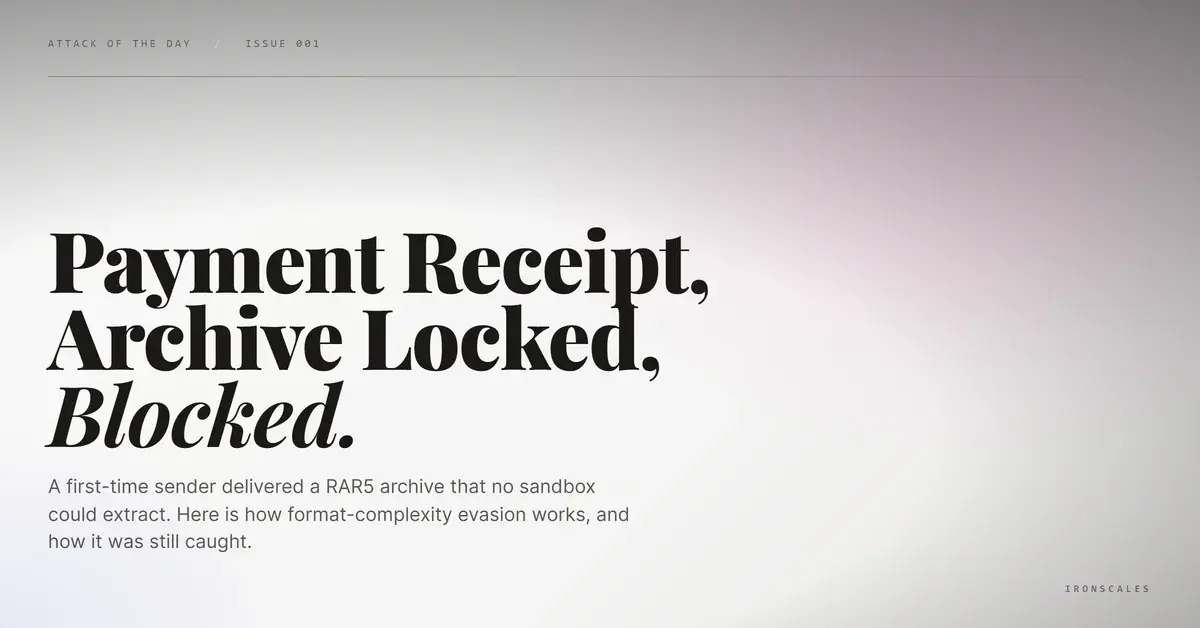
TL;DR A first-time sender delivered a short Italian payment lure to an automotive-parts retailer with one attachment, a real RAR5 archive. The sandbox could not extract it, and upstream scanners could not either, so the file was flagged on format complexity rather than on any visible payload. Byte inspection confirmed a genuine RAR5 magic number, proving deliberate archive-format evasion instead of a mislabeled extension. Weak authentication and a mismatched display name were the corroborating signals that turned an uninspectable file into a confident block.
Severity: High Malware-Delivery Invoice-Fraud Sandbox-Evasion MITRE: T1566.001 MITRE: T1027 MITRE: T1497
Most malicious attachments announce themselves once you open them. A macro fires, a script reaches out, a document renders a fake login page. The security industry has spent years building sandboxes that open files in a safe room and watch what happens next. But that entire model assumes one thing: that the file can be opened at all.
The attack that landed in the inbox of a North American automotive-parts and classic-car restoration retailer did something quieter. It made sure nothing could open it.
A Payment Lure With a Foreign Accent
The email was short and transactional. Written in Italian, the subject and body read like a routine accounting note, a proof-of-payment for a proforma invoice, the kind of message a finance mailbox at a parts supplier sees constantly from overseas vendors. There was no link to click, no urgent threat, no obvious grammar failure. Just a single attachment and an implied instruction to check it.
That restraint is the point. A payment-receipt pretext gives the attacker a reason to attach a file and no reason for the recipient to question it. The Italian language narrows the audience but raises credibility for the specific vendor relationship being impersonated. This is the same social-engineering logic behind business email compromise, where the message succeeds precisely because it looks boring.
The Archive That Would Not Open
The attachment was a RAR5 archive, roughly 2.48 MB, named to look like a bank-transfer receipt. In the analysis pipeline, it never got that far.
The sandbox tried to extract the archive so its contents could be detonated and inspected. Extraction failed. Upstream scanners on the mail path could not open it either. No file inside was ever revealed, no payload was ever executed, and no signature ever matched, because there was nothing for a signature to match against. The container itself was the obstacle.
This is a different failure mode from a corrupt or truncated file. A broken archive throws an error and gets discarded as junk. This archive was not broken. It was constructed so that the tools expected to read it could not, while a determined recipient with the right desktop utility presumably still could. The evasion lives in the gap between what an automated extractor supports and what a modern archive format allows.
Eight Bytes of Proof
It would be easy to dismiss an unreadable attachment as a mislabeled file with the wrong extension. Byte inspection ruled that out. The first eight bytes of the file were 52 61 72 21 1A 07 01 00, the canonical RAR5 signature. This was a genuine RAR5 container, not a renamed executable or a random blob wearing a .rar name.
That single detail changes the interpretation of the whole event. The file was not accidentally difficult. It was legitimately formatted and deliberately packed in a way that defeated inspection. The attacker did not exploit a bug in any one scanner. They exploited format complexity, the fact that fully supporting every feature of a current archive specification is hard, and that "cannot parse" is not the same as "safe." When a sandbox cannot open a file, the file has already won the inspection round.
Authentication Signals That Did Not Add Up
With the payload sealed, the surrounding metadata carried the verdict. The sending domain passed SPF, or Sender Policy Framework, but only because it rode a shared hosting provider that was authorized to send on its behalf. The message carried no DKIM, or DomainKeys Identified Mail, signature at all, so there was no cryptographic proof the content was untouched in transit. DMARC, or Domain-based Message Authentication, Reporting and Conformance, returned a permerror, meaning the domain's policy record could not be evaluated cleanly.
On top of the weak authentication stack sat two behavioral flags. The sender's display name did not match the local-part of the sending address, a classic impersonation tell. And this was a first-time external sender to the organization, with no prior relationship history. Microsoft assigned the message a Spam Confidence Level of 5. Individually, none of these signals is fatal. Together, layered on top of a file that could not be inspected, they form a coherent picture: an unknown sender, weakly authenticated, presenting a payment document nobody can safely read.
Mapping the Tradecraft
The behavior maps cleanly to known adversary techniques. Delivering a weaponized file as an attachment is Spearphishing Attachment (T1566.001), a subtype of Phishing (T1566). Packing the payload inside a container specifically to frustrate parsing aligns with Obfuscated Files or Information (T1027). And building the delivery so it resists automated detonation reflects Virtualization and Sandbox Evasion (T1497). Three techniques, one file, and the common thread is denying the defender a clean look.
The scale of the industry problem is well documented. The 2024 Verizon Data Breach Investigations Report found that phishing appears in 15 percent of breaches and that the human element factors into 68 percent of them. The Microsoft Digital Defense Report 2024 and CISA phishing guidance both stress that email remains the dominant initial-access channel precisely because attackers keep finding ways to slip past content inspection.
Indicators of Compromise
| Indicator | Type | Note |
|---|
fohat[.]cz | Sending domain | SPF pass via shared host, no DKIM |
lubomir.rozmiler@fohat[.]cz | Sender address | Display name mismatched local-part |
hosting90[.]cz | Hosting provider | Shared host authorized in SPF |
3db740c5a3095dc2018d89ccfd13975bf31898ccb806916e62858933b087cbd5 | SHA256 | RAR5 archive, approx 2.48 MB |
| RAR5 archive named like a bank-transfer receipt | Attachment | First 8 bytes 52 61 72 21 1A 07 01 00 |
The Takeaway
The lesson here is uncomfortable but clarifying: a file that cannot be inspected should not be treated as a file that is safe. Legacy filters and standalone sandboxes fail open on formats they cannot parse, and attackers know it. Detection has to move outward, to the signals a message cannot fake, sender history, authentication posture, display-name integrity, and the statistical shape of the relationship.
That is where Adaptive AI and Themis earn their place, correlating the sealed attachment with a first-time, weakly authenticated, mismatched sender and reaching a confident decision without ever needing to open the box. Pairing that behavioral verdict with advanced malware and URL protection closes the gap that format-complexity evasion is built to exploit.
Want to see how many uninspectable payment lures are reaching your finance team right now? See your risk against invoice fraud and business email compromise.
Email Attack of the Day is a daily series from
IRONSCALES spotlighting real phishing attacks caught by Adaptive AI and our community of 36,000+ security professionals. Each post breaks down a real attack. What it looked like, why it worked, and what to do about it.







/Blue%20Feature%20Flower%20Icons/gear%20head%20icon.svg)
/Misc%20Icons/icon-nav-credential-theft.svg)










/Leadership%20Headshots/Audian%20Paxson%20Headshot%201000x1000%20032026.webp?width=100&height=100&name=Audian%20Paxson%20Headshot%201000x1000%20032026.webp)



.png?width=50&height=50&name=Untitled%20-%20July%2030%2c%202026%20at%2014.53.38%20(3).png)



/Misc%20Icons/icon-red-teaming-agent-gradient-simple.svg)
/Misc%20Icons/icon-phishing-soc-agent-gradient-simple.webp?width=158&height=167&name=icon-phishing-soc-agent-gradient-simple.webp)
/Misc%20Icons/icon-phishing-simulation-agent-gradient-simple.svg)


/Misc%20Icons/icon-nav-encryption.svg)