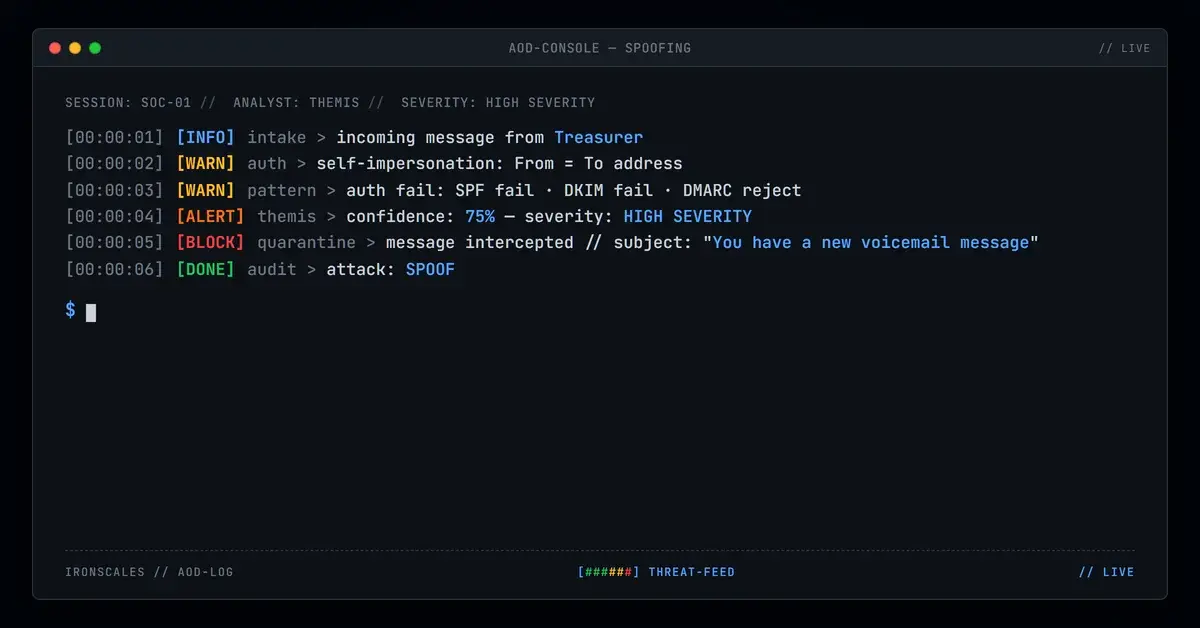
TL;DR A U.S. commercial bank received a fake RingCentral voicemail notification that appeared to come from the recipient's own mailbox, a self-impersonation carrying a malicious SVG attachment disguised as an audio player. The message failed SPF, DKIM, and DMARC, and its footer claimed it had been scanned by Proofpoint Essentials. The bank actually runs Mimecast. That vendor mismatch, a templating leak the kit could not avoid, marked the message as fraudulent. Themis flagged and mitigated it after delivery. The lesson: phishing kits guess at your security stack, and their guesses leave fingerprints.
Severity: High Phishing Impersonation Spoofing MITRE: T1566.001 MITRE: T1684.001
The email landed in the treasurer's inbox on a Friday afternoon. Subject line: a wireless caller had left a 22-second voice message. The layout was clean. A RingCentral logo sat at the top, the current date underneath, and a prompt to click the attached file to hear the recording on a phone or PC.
Everything about it read as routine. Except the message appeared to come from the treasurer's own email address.
That is the detail worth sitting with. The From header and the To header were identical, both the treasurer's mailbox at a U.S. commercial bank. Not a spoofed vendor domain, not a lookalike. The recipient's own name, staring back at them. It is a technique called self-impersonation, and it works because a message that appears to come from yourself rarely triggers the same suspicion as one from a stranger. It can also slip past allow-list rules written to trust internal senders.
A Voicemail That Was Never Recorded
The pretext was a fake voicemail notification dressed as RingCentral, one of the more heavily impersonated telephony brands. The body pushed a single action: open the attachment to listen. There was no in-message transcript, no callback prompt, no legitimate playback. Just a file.
That file was the payload. It arrived as an SVG named to look like an audio player, Play_Audio_vm_[redacted].svg, and the platform verdict came back malicious. SVG files feel harmless because we file them under "images," but they are text-based markup that can carry embedded scripts and active content. Attackers lean on that gap, disguising SVGs as audio buttons or document viewers to smuggle live content past filters that wave images through. Treat an unexpected SVG the way you would treat an unexpected executable, because functionally that is closer to what it is.
The lure carried the usual tells if you knew to look. The caller was named in the subject with a phone number whose area code, 433, is not an assigned North American area code. The copy leaned on awkward phrasing and mixed punctuation that no polished brand template would ship. And a large inline image blob padded the body, a common trick for hiding intent from content scanners.
But none of those was the detail that truly gave it away.
The Footer That Gave It Away
At the bottom of the message sat a reassuring line: This email has been scanned by Proofpoint Essentials.
The bank does not run Proofpoint. Its inbound mail flows through Mimecast.
That is the whole attack unravelling in a single sentence. A phishing kit ships with a boilerplate footer designed to borrow the credibility of a well-known security vendor. It is a trust prop. The problem for the attacker is that the kit has no idea which email security product any given target actually uses. It cannot know. So it prints one name and hopes. When that name does not match the victim's real mail path, the footer stops being reassurance and becomes a fingerprint.
This is a templating leak, and it is one of the most reliable tells in phishing triage precisely because the attacker cannot fix it at scale. A kit blasting thousands of organizations would need per-target reconnaissance of each one's security stack to get the banner right, which defeats the economics of mass phishing. The banner is a guess. Guesses leave marks.
See Your Risk: Calculate how many threats your SEG is missing
The Authentication Story Underneath
The footer is the memorable tell, the one a human notices. Underneath it, the machine-readable signals had already collapsed.
The message failed SPF. It carried no DKIM signature. And it failed DMARC under the bank's enforced p=reject policy, which should have bounced it outright. The sending host was an Israeli broadband IP with no relationship to the bank or to RingCentral. On paper, this message had no business reaching a mailbox at all.
It reached one anyway. Authentication verdicts and reject policies are necessary, but they are not a guarantee of non-delivery, and attackers know the gaps between policy and enforcement well enough to keep firing into them. Which is why detection cannot end at the gateway verdict.
That is where Themis, the IRONSCALES agentic AI analyst, picked it up. The behavioral picture was incoherent in a way a static filter shrugs at but a reasoning system flags: a From address equal to the To address, a third-party brand lure, an authentication triple-failure, an invalid caller number, and a security banner naming the wrong vendor. Themis correlated those signals, classified the message as phishing, and mitigated it across the affected mailbox after delivery. No analyst had to assemble the pieces by hand.
Why Self-Impersonation Keeps Working
Self-impersonation is not exotic, and that is the point. It maps to MITRE ATT&CK T1684.001 (Impersonation) paired with T1566.001 (Spearphishing Attachment), and it keeps working because it exploits trust rather than technology.
The 2024 Verizon Data Breach Investigations Report found that the human element was a component of 68% of breaches and that phishing was present in 15% of breaches. The FBI Internet Crime Complaint Center reported more than 2.9 billion dollars in business email compromise losses in its 2023 report, and self-impersonation is a common on-ramp to exactly that kind of fraud. Microsoft's Digital Defense Report 2024 documents how commodity phishing kits industrialize these lures at scale, which is precisely why their boilerplate footers betray them.
What This Bank's Team Should Take Forward
The guidance that comes out of this case is specific, not generic.
- Read the footer. A security-scan banner naming a vendor your organization does not use is a fingerprint, not a comfort. Teach triage staff and users which email security products you actually run, so a mismatch registers instantly.
- Distrust self-addressed mail. A message from your own address that you did not send is an anomaly by definition. Flag From-equals-To patterns for scrutiny and make sure internal-sender allow-lists cannot be exploited by a forged header. The joint CISA guidance on stopping the phishing attack cycle reinforces enforcing authentication and treating anomalous internal-looking mail as suspect.
- Treat SVGs as active content. An SVG dressed as an audio player is a payload wearing a costume. Filter and inspect them accordingly.
- Do not stop at the authentication verdict. This message failed SPF, DKIM, and DMARC and still landed. Layered behavioral detection that augments the gateway is what closed the gap.
The attacker got almost everything right. Clean layout, believable brand, urgent pretext, a payload built to evade image scanning. Then the kit pasted a Proofpoint banner into a Mimecast shop, and the entire illusion collapsed under one line of boilerplate it could never have gotten right.
Email Attack of the Day is a daily series from
IRONSCALES spotlighting real phishing attacks caught by Adaptive AI and our community of 36,000+ security professionals. Each post breaks down a real attack. What it looked like, why it worked, and what to do about it.







/Blue%20Feature%20Flower%20Icons/gear%20head%20icon.svg)
/Misc%20Icons/icon-nav-credential-theft.svg)










/Leadership%20Headshots/Audian%20Paxson%20Headshot%201000x1000%20032026.webp?width=100&height=100&name=Audian%20Paxson%20Headshot%201000x1000%20032026.webp)



.png?width=50&height=50&name=Untitled%20-%20July%2030%2c%202026%20at%2014.53.38%20(3).png)



/Misc%20Icons/icon-red-teaming-agent-gradient-simple.svg)
/Misc%20Icons/icon-phishing-soc-agent-gradient-simple.webp?width=158&height=167&name=icon-phishing-soc-agent-gradient-simple.webp)
/Misc%20Icons/icon-phishing-simulation-agent-gradient-simple.svg)


/Misc%20Icons/icon-nav-encryption.svg)