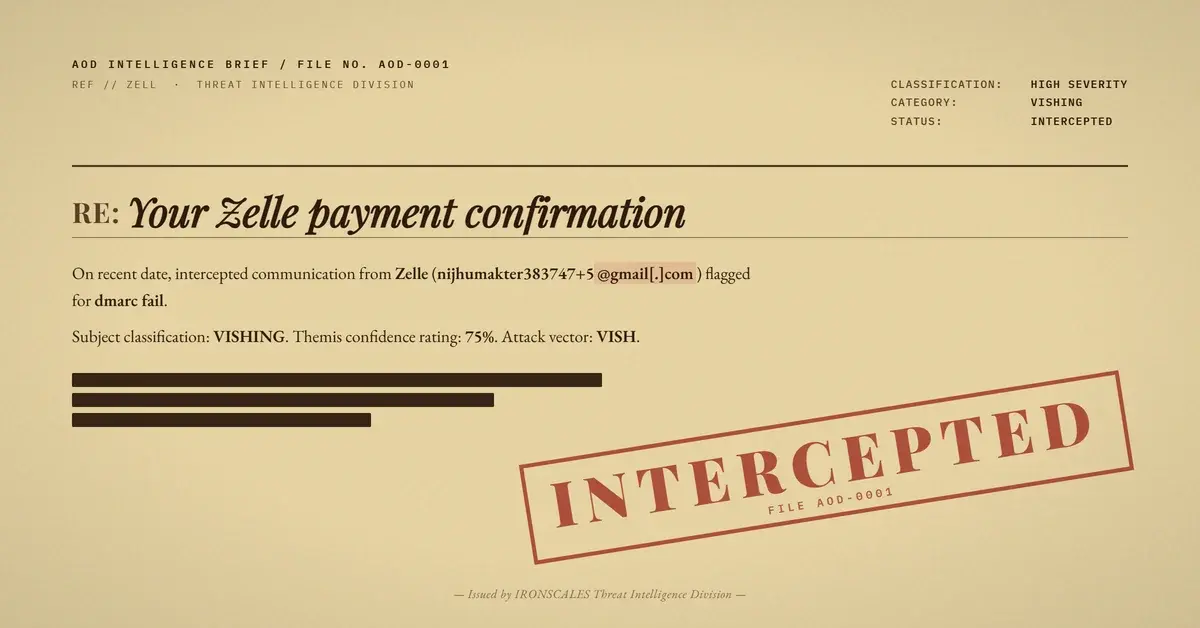
TL;DR A phishing email impersonating Zelle sent from a Gmail address (nijhumakter383747+5@gmail[.]com) through SendGrid infrastructure at IP 134.128.77.216. SPF and DKIM passed for SendGrid, but DMARC failed for gmail.com due to header.from domain mismatch. The email claimed a $450.00 payment had been sent, confirmation ZL20251209P74829. Multiple template artifacts were visible: 'Z elle' with broken brand spacing, a visible placeholder address in the greeting, duplicated Payment Summary blocks, and a date mismatch between the confirmation (December 9) and the sent date (December 15). The entire payload was a TOAD callback number (+1 855-408-4804). No malicious links were present. A SendGrid tracking pixel confirmed open-tracking surveillance.
Severity: High Vishing Impersonation MITRE: {'id': 'T1566.002', 'name': 'Phishing: Spearphishing Link'} MITRE: {'id': 'T1598', 'name': 'Phishing for Information'} MITRE: {'id': 'T1036.005', 'name': 'Masquerading: Match Legitimate Name or Location'}
The email said Zelle had sent a $450.00 payment. The confirmation number was ZL20251209P74829. The brand name in the header was spelled "Z elle" with a space that no legitimate notification would carry. And the greeting addressed the recipient by a placeholder email that belonged to a K-12 school district employee in another state.
There were no links to click. No attachments to open. The entire payload was a phone number.
A Template That Fell Apart Under Inspection
The message arrived from nijhumakter383747+5@gmail[.]com through SendGrid infrastructure at IP 134.128.77[.]216. SPF and DKIM passed for SendGrid because the email was genuinely sent through SendGrid's platform. DMARC failed for gmail[.]com because the header From domain did not match the authenticated sending domain. This is a textbook mismatch: a Gmail address displayed in the From field while a completely different ESP handled delivery.
The template carried multiple visible failures. The brand name "Z elle" had broken spacing, likely from a rendering issue in the attacker's template builder. The greeting included a visible placeholder, an email address belonging to a school district employee, left in brackets where a recipient name should have been. The Payment Summary section was duplicated, appearing twice in the HTML body. And the dates did not agree: the confirmation referenced December 9, but the email's sent date was December 15.
These artifacts are not incidental. They are the fingerprints of a mass-produced callback phishing campaign assembled from a template that was never quality-checked against real Zelle notifications.
The Phone Number Was the Weapon
The email contained no clickable links, no redirects, and no attachments. URL scanners had nothing to evaluate. Sandbox detonation had nothing to detonate. The only actionable element was a phone number: +1 855-408-4804.
This is TOAD (Telephone-Oriented Attack Delivery), a subset of vishing. The attacker's goal was not to steal credentials through a fake login page. It was to get the recipient to call. Once connected, a live operator or automated system would conduct the actual social engineering, extracting payment details, account credentials, or remote access under the pretext of resolving the fraudulent payment.
A SendGrid tracking pixel embedded in the HTML confirmed that the attacker was monitoring which recipients opened the email, providing intelligence on which targets were most likely to engage.
Why There Was Nothing for a Scanner to Catch
Themis evaluated the convergence of signals: DMARC failure on a From/ESP domain mismatch, a Gmail address routed through SendGrid, broken brand rendering, a visible placeholder email in the greeting, duplicated content blocks, and a phone number as the sole CTA with no supporting links or attachments.
No single artifact was the detection trigger. The DMARC failure alone might occur in legitimate transactional email. Template artifacts alone might be dismissed as a formatting issue. But the combination of authentication mismatch, brand rendering failures, template leaks, and a TOAD callback pattern created a behavioral fingerprint that content scanning could not replicate.
See Your Risk: Calculate how many threats your SEG is missing
Indicators of Compromise
| Type | Indicator | Context |
|---|
| Sender Email | nijhumakter383747+5@gmail[.]com | Gmail address, display name "Zelle" |
| Sending IP | 134.128.77[.]216 | SendGrid infrastructure |
| DMARC | Fail for gmail.com | Header From/ESP domain mismatch |
| Brand Artifact | "Z elle" (broken spacing) | Template rendering failure |
| Placeholder Leak | Visible email address in greeting | Template variable not substituted |
| Duplicated HTML | Payment Summary block appears twice | Template assembly error |
| Date Mismatch | Confirmation: Dec 9, Sent: Dec 15 | Inconsistent template data |
| TOAD Number | +1 855-408-4804 | Callback phishing, sole CTA |
| Payment Claim | $450.00, confirmation ZL20251209P74829 | Fabricated transaction details |
| Tracking | SendGrid open-tracking pixel | Recipient surveillance |
MITRE ATT&CK Mapping
| Technique | ID | Relevance |
|---|
| Phishing: Spearphishing Link | T1566.002 | Email delivery of social engineering payload via ESP |
| Phishing for Information | T1598 | TOAD callback designed to extract payment or credential data |
| Masquerading: Match Legitimate Name or Location | T1036.005 | Zelle brand impersonation with fabricated payment confirmation |
Email Attack of the Day is a daily series from
IRONSCALES spotlighting real phishing attacks caught by Adaptive AI and our community of 36,000+ security professionals. Each post breaks down a real attack. What it looked like, why it worked, and what to do about it.







/Blue%20Feature%20Flower%20Icons/gear%20head%20icon.svg)
/Misc%20Icons/icon-nav-credential-theft.svg)










/Leadership%20Headshots/Audian%20Paxson%20Headshot%201000x1000%20032026.webp?width=100&height=100&name=Audian%20Paxson%20Headshot%201000x1000%20032026.webp)



.png?width=50&height=50&name=Untitled%20-%20July%2030%2c%202026%20at%2014.53.38%20(3).png)



/Misc%20Icons/icon-red-teaming-agent-gradient-simple.svg)
/Misc%20Icons/icon-phishing-soc-agent-gradient-simple.webp?width=158&height=167&name=icon-phishing-soc-agent-gradient-simple.webp)
/Misc%20Icons/icon-phishing-simulation-agent-gradient-simple.svg)


/Misc%20Icons/icon-nav-encryption.svg)